
Anyone who has spent hours inside a content optimization editor knows the specific exhaustion of "score chasing." You stare at a dashboard, artificially injecting terms like "semantic web" or "business synergy" into your paragraphs, hoping the gauge turns from yellow to green. For years, tools like Surfer SEO, Clearscope, and MarketMuse defined content strategy by demanding that writers manually construct thousands of words to satisfy correlation algorithms.
But search has fundamentally changed. Google is aggressively expanding AI Overviews, prioritizing video, elevating forum discussions, and fetching direct data points for user queries. Simultaneously, users are shifting their search behaviors toward ChatGPT, Perplexity, and Gemini.
In this environment, optimizing a 3,000-word editorial piece by hand is no longer the only—or even the best—way to capture search visibility. If your goal is to capture market share, the most effective Surfer SEO alternatives aren't just competing text editors; they are entirely different methodologies. You can rank on Google without writing articles manually by shifting your resources toward programmatic architecture, multimedia indexing, automated pipeline generation, and AI visibility management.
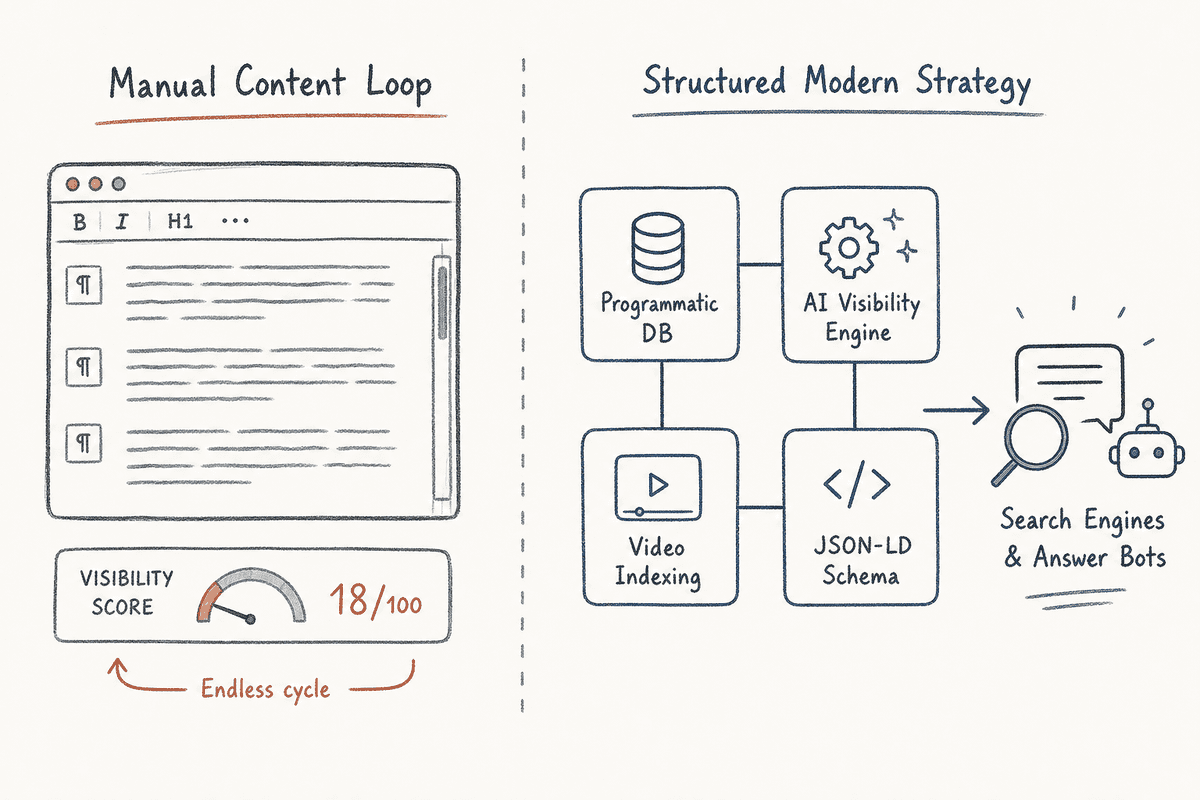
The End of Score-Chasing and Manual Content Labor
Traditional NLP (Natural Language Processing) tools operate on a simple premise: they scrape the current top 10 search results, analyze the term frequency-inverse document frequency (TF-IDF), and give you a checklist of words to include.
The structural flaw in this model is that it assumes the best way to answer a query is with a traditional blog post. It also forces content teams into a reactive loop—parroting what competitors have already published rather than introducing net-new information. When every agency and SaaS company uses the same optimization tool to target the same keywords, the internet fills with homogenous, bloated content.
AI search engines and generative models do not care about your keyword density score. They care about structured evidence, brand mentions across authoritative nodes, and easily parseable data schemas. You do not need to manually type out paragraphs to feed these systems. Instead, you need to provide data in formats that machines can instantly understand, categorize, and serve to users.
The Shift from Text to Entities and Answers
When a user asks Google or an AI assistant about a product category, the engine isn't looking for a narrative essay. It is looking for entities, relationships, and facts.
If you want to rank high on Google without writing content by hand [1], you must transition from being a "content writer" to a "data publisher." This means leveraging databases, video transcripts, AI workflow automation, and structured markup to build pages that answer questions definitively.
Alternative Strategy 1: Programmatic SEO (pSEO) and Data-Driven Pages
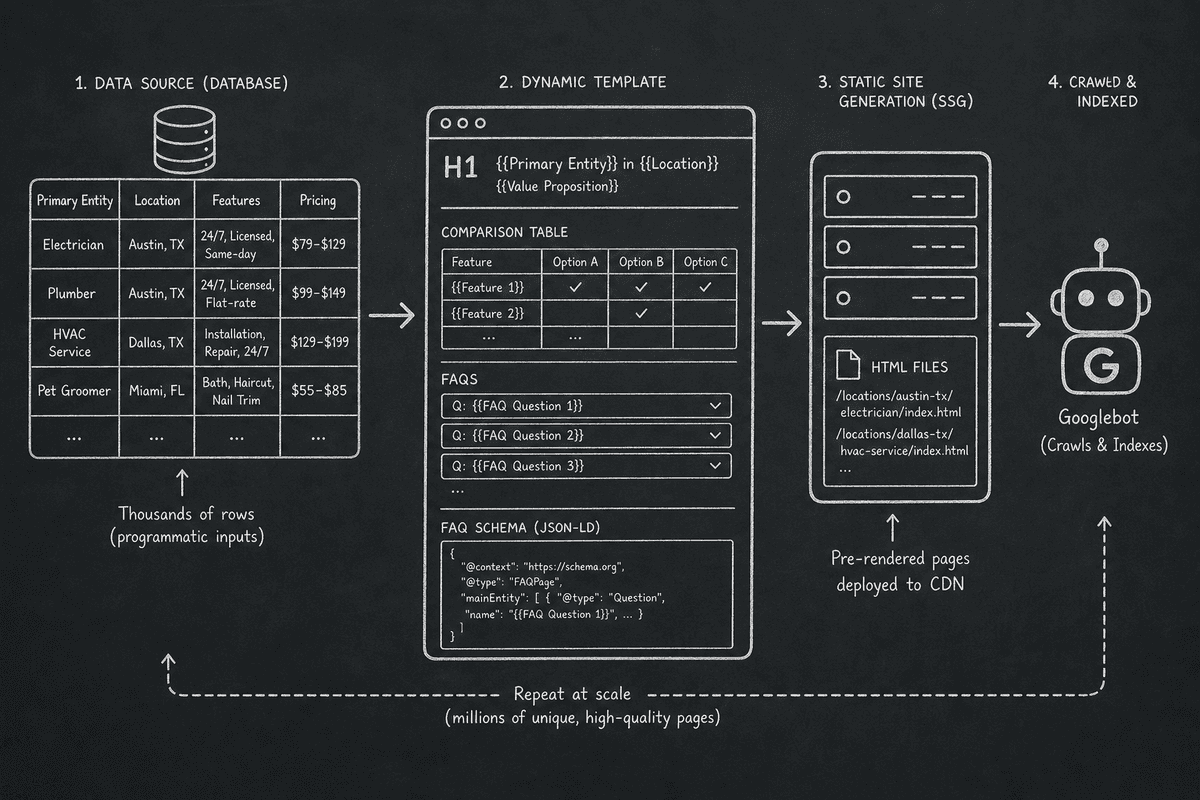
Programmatic SEO is the process of building landing pages at scale using a database rather than a CMS text editor. Instead of writing an article about "Best CRM for Dentists in Chicago," you build a single page template and populate it dynamically with database fields: [Industry], [City], [Feature Set], and [Pricing].
This is how companies like Zapier, G2, and Tripadvisor generate millions of indexed pages without a massive army of manual writers.
Structuring a Programmatic Database
To execute programmatic SEO effectively, you need a robust dataset. This dataset acts as your "content." You assemble it through API connections, public datasets, or proprietary product data.
Your database needs the following components to replace manual writing successfully:
- Primary Keys: The core entity (e.g., a software integration, a local service area, a specific template).
- Modifier Variables: The attributes that change query intent (e.g., location, industry, compatibility).
- Unique Data Points: Numbers, statistics, or binary features that differentiate this page from a generic competitor. (e.g., "Supports HIPAA compliance: Yes").
- Synthesized Descriptions: Short, automated summaries generated via API (using OpenAI or Anthropic) based on the strict data parameters, rather than open-ended writing.
Constructing the Page Template
Once your database is populated, you map it to a frontend framework. If you are learning How to Build an SEO Landing Page (7-Step Guide), the programmatic approach requires designing modular UI components rather than a standard text body.
You map data to:
- Dynamic H1 tags
(e.g., {Tool 1} vs {Tool 2} for {Industry}) - Comparison tables (automatically populated by your database)
- Bullet points of features
- Dynamic FAQ schemas
Handling Technical Rendering for Programmatic Sites
Because programmatic SEO often relies on modern web frameworks (like React, Vue, or Angular) to fetch and display thousands of data rows dynamically, you must ensure Googlebot can actually read the content.
If your data is buried behind client-side rendering, you will not rank, regardless of how good the database is. You must implement server-side rendering (SSR) or static site generation (SSG). For a deeper technical implementation, refer to the requirements for SEO for Single Page Applications: A 5-Step Guide (2026).
Alternative Strategy 2: AI Visibility and Evidence-Backed Automation
The most significant threat to traditional SEO is the rise of AI-driven search engines like ChatGPT, Gemini, and Perplexity. Buyers are no longer typing fragmented keywords into Google; they are asking complex, multi-variable questions to AI assistants.
If an AI assistant doesn't know your brand exists, or worse, recommends your competitor, traditional content optimization will not save you. You must optimize for AI visibility.
Monitoring AI Search Engines
To rank in AI Overviews and assistant responses, you need to understand how these models source their answers. They rely heavily on real-time citations and trusted domain mentions.
This is where specialized platforms replace traditional SEO tools. BeVisible helps teams monitor how AI assistants answer buyer questions, which brands they recommend, and which sources they cite. It tracks ChatGPT, Gemini, Perplexity, AI Mode, and AI Overviews across buyer prompts, then turns visibility gaps into evidence-backed opportunities, articles, review, scheduling, and publishing work.
Instead of writing a 3,000-word article to hit an arbitrary word count, the workflow looks like this:
- Identify the Prompt: BeVisible detects that buyers are asking Perplexity, "What is the best AI visibility tracking software for B2B SaaS?"
- Analyze the Gap: The platform reveals that your brand is entirely missing from the AI's response, while a competitor is cited three times.
- Extract the Missing Evidence: The AI is citing the competitor because they have specific feature documentation and G2 reviews that match the prompt's criteria.
- Automate the Fix: Instead of manually drafting a blog post, you use BeVisible to structure the missing evidence (feature specs, structured data, pricing API) and automate the publishing work to inject those facts into the ecosystem.
By providing clear, structured facts that AI models can ingest, you capture the AI recommendation without ever opening a standard text editor.
Alternative Strategy 3: Dominating Through Multimedia and Video SEO
Google's search results are increasingly visual. For many "how-to" and informational queries, Google prioritizes YouTube carousels above standard blue links. If you want to capture search traffic without writing articles, create videos.
The Video-to-SERP Pipeline
A single, well-structured YouTube video can rank in Google Search for multiple long-tail keywords. To understand how to create SEO content that ranks on Google through video [2], you must treat the video file as an information container optimized for search crawlers.
- Scripting via Automation: You do not need to write a script manually. You can feed technical documentation or existing standard operating procedures (SOPs) into an LLM to format a conversational script.
- Audio and Visual Generation: Modern tools allow you to generate high-quality voiceovers and even AI avatars, or you can record a simple loom video over a slide deck. The production value matters less than the information density.
- Optimizing the YouTube Upload: Google indexes the YouTube transcript, the title, the description, and—most importantly—the timestamps.
- Chapter Markers as SERP Features: By manually structuring your YouTube chapters (e.g.,
01:15 - How to configure the API,02:30 - Testing the webhook), you create direct jump-links that Google displays in the search results. A user searching for "testing the webhook" will see your video chapter above a written article.
Expanding Video into Zero-Click Content Assets
Once the video is live, embed it on a minimalist landing page on your domain. Add a raw text transcript below it. You have now created a multimedia page that satisfies user intent, keeps dwell time incredibly high (as users watch the video), and provides Google with hundreds of indexed words via the transcript—all without you writing a single paragraph.
Alternative Strategy 4: Ranking Without a Website (Parasite SEO & Authority Hijacking)
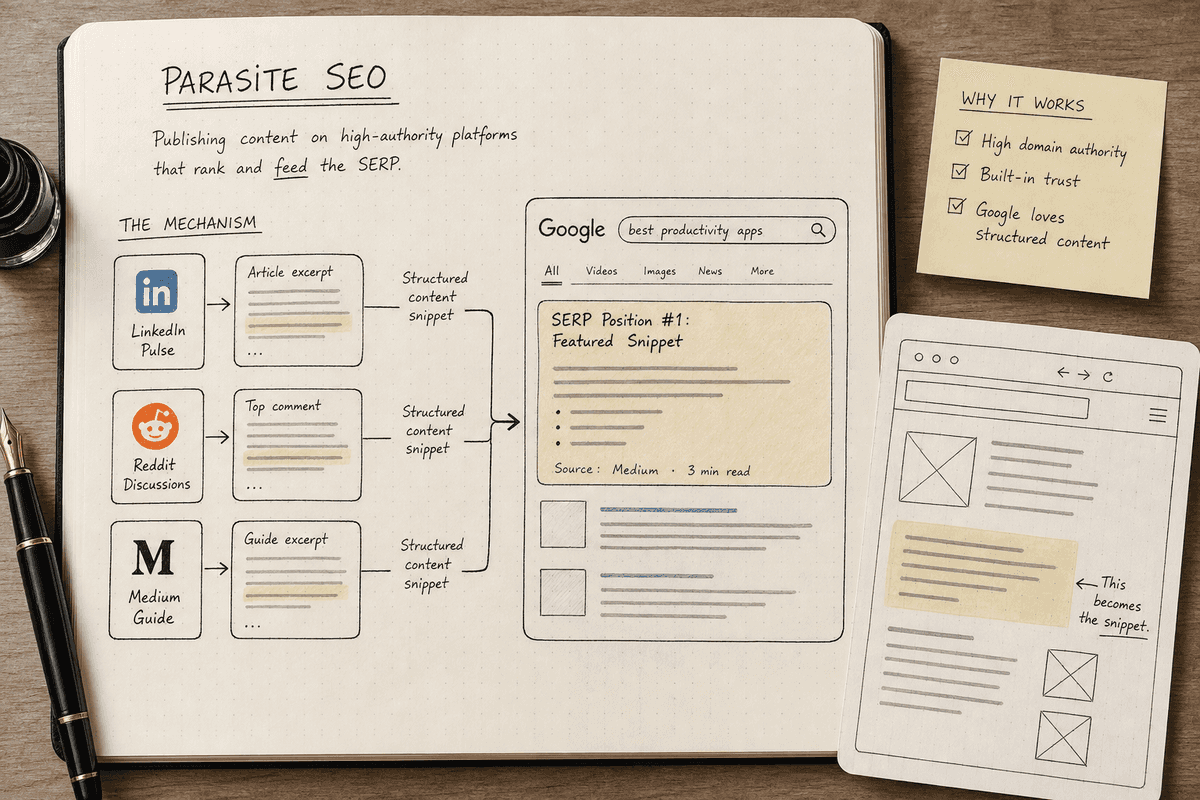
You can rank on the first page of Google within 24 hours without a website by leveraging the domain authority of established platforms [4]. This strategy, often referred to as Parasite SEO or Authority SEO, bypasses the need for your own CMS, content writers, and backlink building campaigns.
Leveraging High-DR Platforms
Google implicitly trusts massive platforms with rigorous user-generated content standards or editorial oversight. By placing your information on these sites, you inherit their ability to rank instantly.
Effective platforms for this strategy include:
- LinkedIn Articles and Pulse: Highly authoritative and frequently indexed within minutes.
- Medium: Excellent for thought leadership and long-form structured guides.
- Reddit & Quora: Google is heavily favoring forum content in its "Discussions and Forums" SERP feature. Answering questions comprehensively on Reddit with structured bullet points can capture first-page rankings for years.
- GitHub Repositories: For technical, developer-focused, or SaaS audiences, a well-documented GitHub README often outranks traditional marketing pages.
The Operational Playbook for Authority SEO
Instead of writing a blog post for your low-authority startup domain, you identify a high-volume keyword and create a comprehensive answer on a platform like Medium or LinkedIn.
You format this content using strict hierarchical headers (H2, H3) and bulleted lists. The goal is to optimize for the Featured Snippet. Because the host domain already has the trust signals, Google only needs to evaluate your on-page structure. If your information is formatted more logically than the current ranking page, you can displace them rapidly.
Alternative Strategy 5: Semantic Schema and Structured Data Publishing
Search engines are fundamentally parsing machines trying to build a Knowledge Graph of the world. Traditional SEO writing attempts to describe relationships through prose. Structured data defines these relationships explicitly using code.
You can often outrank beautifully written articles by providing Google with a perfectly executed JSON-LD schema. When you learn how to write content that ranks #1 on Google using structured formatting [5], you realize that machines prefer reading JSON over English.
High-Impact Schema Types
Stop relying on words to explain what your page is about. Use standard markdown tables or backend data structures to feed Google exactly what it wants.
Implementing Schema Without Coding
You do not need to be a developer to implement robust structured data. If you are using a CMS like WordPress, plugins handle the heavy lifting. If you are running a custom stack, AI tools can generate flawless JSON-LD markup based on a simple bulleted list of facts.
You paste the JSON-LD script into the <head> of your HTML document. When Googlebot crawls the page, it immediately registers the entity relationships, bypassing the need to parse long paragraphs of text.
Alternative Strategy 6: Workflow Automation (The API Pipeline)
The true alternative to Surfer SEO isn't another writing tool; it's a completely automated pipeline. By connecting disparate data sources through an automation platform (like Make or Zapier), you can generate highly specific, technically accurate web pages on demand.
The Architecture of an Automated SEO Pipeline
A zero-manual-writing pipeline requires three components: a trigger, a processor, and a destination.
1. The Trigger (Data Ingestion) The automation begins when a new piece of data becomes available. This could be:
- A new feature added to your product roadmap in Jira or Linear.
- A new customer review posted on G2.
- A competitor changing their pricing (tracked via a web scraper).
- A new visibility gap identified by BeVisible when an AI assistant fails to recommend your brand.
2. The Processor (AI Formatting) Once the trigger fires, the raw data is sent to an LLM via API. You do not use the LLM to "write a blog post." You use it as a formatting engine. You prompt the API with strict instructions:
- "Take this Jira ticket about our new SOC2 compliance feature."
- "Format it into a structured HTML landing page."
- "Include an H1, a bulleted list of security protocols, and an FAQ section."
- "Do not add introductory fluff, marketing jargon, or transitional paragraphs."
3. The Destination (CMS Publishing) The automation platform takes the strictly formatted HTML and pushes it directly to your CMS (Webflow, WordPress, Ghost) via API. It creates the slug, sets the meta description, tags the category, and hits publish.
This pipeline can operate hundreds of times a day, updating your site with real-time, factually accurate pages that satisfy search intent—all without a human ever touching a keyboard.
Overcoming the "AI Penalty" Myth
Many marketers fear that automated content will be penalized by Google. Google's official guidance states that they do not penalize content simply because it is generated by AI; they penalize low-quality, spammy content created solely to manipulate search rankings.
If your automated pipeline is taking proprietary data (like your actual product updates, your real customer reviews, or your specific AI visibility gaps) and formatting it into useful, easily readable web pages, you are providing value. The penalty only comes when you use automation to scrape other people's articles and spin them into derivative garbage.
Alternative Strategy 7: The Local Pack and Operational SEO
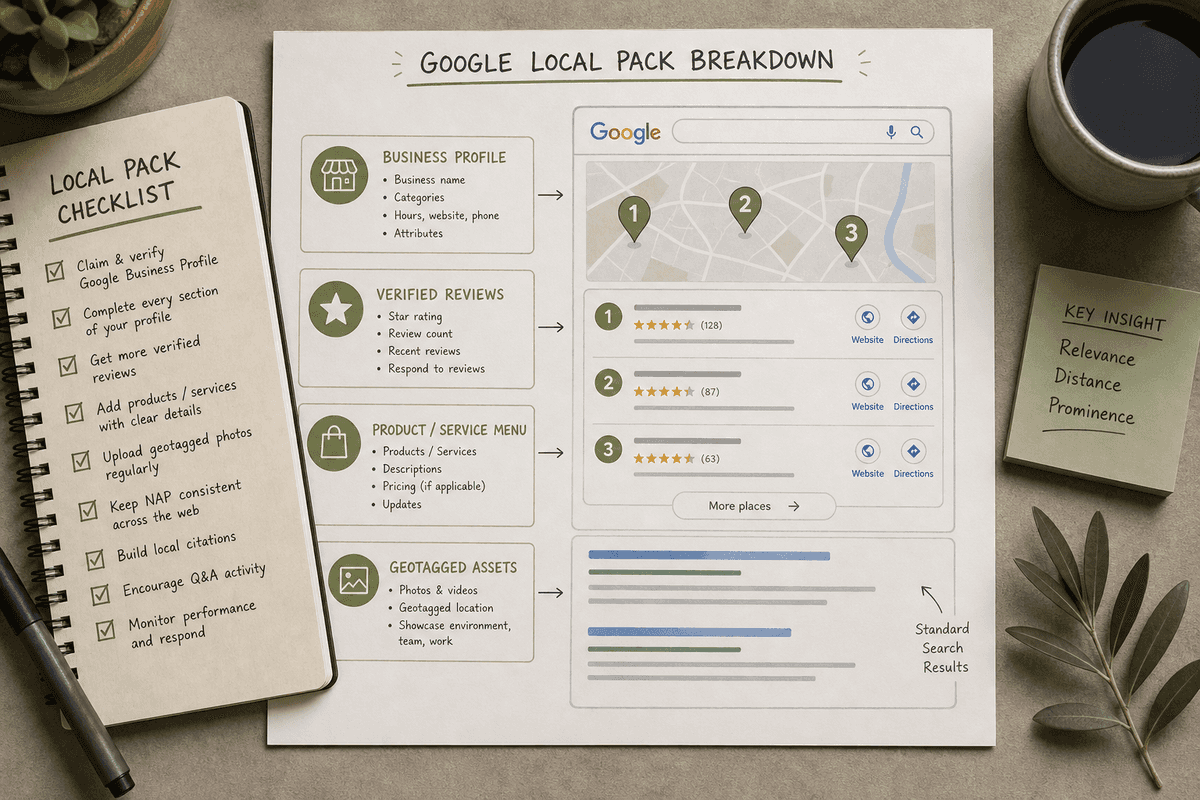
For service-based businesses, agencies, and regional SaaS deployments, the fastest way to the top of Google involves zero article writing. It involves dominating the Google Local Pack (the map section).
Google heavily prioritizes the local map section for queries with local intent. If someone searches for "B2B SaaS deployment consultants in Chicago," Google will show the map before it shows any blog posts.
Optimizing the Google Business Profile
Ranking in the Local Pack is an operational task, not a creative one.
- Claim and Verify: Establish ownership of the profile.
- Data Completeness: Fill out every single field. Add business hours, exact service areas, categories, and attributes (e.g., "women-owned," "online appointments").
- Product and Service Menus: Upload your actual services as products within the profile, complete with pricing and descriptions.
- Review Velocity: Implement automated systems to request reviews from satisfied clients. A steady stream of authentic, keyword-rich reviews is the strongest ranking factor for local search.
- Geotagged Photography: Upload photos of your office, your team, or your software dashboard regularly.
None of these tasks require drafting articles, yet they will drive higher-converting traffic than a purely informational blog post. If you are comparing Hiring SEO Services in Phoenix? 5 Red Flags (2026), one of the biggest red flags is an agency that promises to write 20 blog posts a month for a local business while ignoring their Google Business Profile entirely.
Navigating the Costs: Agency Rates vs Automation
When teams realize they need to scale their search presence, they often face a choice: hire a traditional SEO agency to write articles, or invest in building automated pipelines and programmatic architecture.
Relying on human writers to chase NLP scores is expensive and scales linearly. Every new article requires more human hours. When you review SEO Charges UK: Agency Rates vs Automation (2026), the financial math strongly favors automation for specific types of content.
Building a programmatic SEO database or an AI automation pipeline requires a higher upfront technical investment. You have to pay developers or technical marketers to configure the APIs, set up the webhooks, and design the templates. However, once the system is running, the marginal cost of publishing the next 1,000 pages is practically zero.
Agencies are still valuable, but their role must shift. Instead of paying an agency to write standard blog posts, you should pay them for technical SEO, digital PR (link building), and system architecture.
Implementation Timeline: Moving Away from Manual Content
Transitioning from a manual, Surfer-driven process to an automated, structured data approach requires a phased rollout. You cannot flip a switch overnight.
Month 1: Audit and Architecture
- Audit your existing content to identify pages that are bloated with unnecessary text.
- Define your primary entities. What are the core concepts your brand needs to own?
- Set up AI visibility monitoring (using BeVisible) to establish a baseline of how LLMs and AI Overviews currently perceive your brand.
- Choose your primary non-manual channel: Will you focus on programmatic SEO, YouTube video generation, or automated data pipelines?
Month 2: Prototyping the Pipeline
- If choosing programmatic SEO, build your first database with 50-100 rows of clean data. Design the frontend template and test the dynamic routing.
- If choosing automation, map out your first Make.com or Zapier workflow. Connect your data source to your AI formatting prompt, and test the CMS API connection.
- Implement sitewide JSON-LD schema markup for your organization, products, and key offerings.
Month 3: Scaling and AI Visibility Optimization
- Turn on the automated pipelines or publish the programmatic database.
- Monitor indexation closely via Google Search Console.
- Review the BeVisible dashboard to see if the newly published structured data is successfully altering how AI assistants answer buyer prompts.
- If AI engines are still missing your brand, adjust the API prompts to inject more explicit, evidence-backed claims into your automated publishing workflow.
Frequently Asked Questions
Can you really rank on Google without writing any text?
Yes, but you still need text on the page; you just don't have to write it manually in the traditional sense. A page ranking via programmatic SEO contains text, but that text is pulled dynamically from a database. A page ranking for a video contains text in the form of an automated transcript. The distinction is between manual editorial drafting and automated data structuring.
Will Google penalize programmatic or automated content?
Google penalizes unoriginal, low-value content designed solely to manipulate rankings. If your programmatic database combines multiple data sources to create a unique, highly useful comparison tool or directory, Google will reward it. If you use automation to scrape Wikipedia and spin the text, you will be penalized. The focus must remain on the utility of the data provided.
How does tracking AI visibility replace content writing?
Traditional content writing assumes you need to capture traffic on Google search and funnel it to your site. AI visibility tracking acknowledges that the AI assistant itself is often the final destination for the user.
By tracking how ChatGPT or Perplexity answers questions, you identify exact factual gaps (e.g., the AI doesn't know your software integrates with Salesforce). You then fix that gap by adding a structured data point or a single line of text to your documentation via automation, rather than writing a 2,000-word article about Salesforce integrations.
Do I still need backlinks if I use these alternative strategies?
Yes. Backlinks remain a foundational signal of trust and authority. However, unique data sets, programmatic tools, and comprehensive video assets naturally attract backlinks much faster than generic, score-chased blog posts. When you build a definitive industry database, other sites link to it as a reference, creating a compounding growth loop.
How do Single Page Applications (SPAs) impact this strategy?
SPAs are excellent for building highly interactive, data-driven tools (which rank well), but they pose indexing challenges for Googlebot if not configured properly. If you are building automated tools or programmatic dashboards using an SPA, you must prioritize technical rendering. 11 Best SEO Blogs Every SaaS Founder Needs (2026) frequently cover this, emphasizing that without server-side rendering or pre-rendering, your database will remain invisible to search engines.
The Future is Structured and Automated
The era of writing blog posts to satisfy an NLP checklist is closing. To rank on Google—and to maintain visibility across the rapidly expanding ecosystem of AI assistants—you must transition to a data-first approach.
By leveraging programmatic architecture, automated API pipelines, multimedia assets, and precise schema markup, you can dominate search results and AI recommendations. When you construct pages based on facts, evidence, and structured relationships, you give the machines exactly what they need to recommend your brand, completely eliminating the need to ever write an article manually again.