
The tension at the heart of modern content marketing usually comes down to a single question: Do we optimize for precision, or do we optimize for volume? When scaling organic traffic and building topical authority, growth teams eventually face a fork in the road. On one side, you have meticulous, entity-driven optimization platforms. On the other side, you have hands-off, programmatic generation pipelines.
Understanding how Surfer SEO compares to automated blogging engines requires looking past the basic marketing claims. Surfer SEO and its built-in AI writer are fundamentally optimization-focused tools designed to generate highly structured, entity-rich drafts that compete for difficult search terms [1]. In stark contrast, automated blogging engines are volume-focused platforms built to eliminate the human bottleneck entirely, populating your site with hundreds of articles with minimal oversight [2].
If you are a SaaS founder, agency lead, or B2B marketing director, choosing between these methodologies—or knowing how to blend them—dictates your entire content operation. Furthermore, as search behavior shifts toward generative AI engines like ChatGPT, Gemini, and Perplexity, the way these tools construct content dictates your future brand visibility.
In this comprehensive guide, we will break down the mechanics, workflows, cost structures, and visibility outcomes of Surfer SEO versus automated blogging engines. We will also explore how to audit your content pipeline to ensure your brand doesn't just rank on traditional search engine results pages (SERPs), but actually gets recommended by the AI assistants your buyers are using today.
The Core Difference: Optimization-Focused vs. Volume-Focused Production
To effectively compare these two approaches, we must first define their primary objectives. They are not simply different software interfaces solving the same problem; they represent two completely different philosophies regarding how organic traffic is acquired.
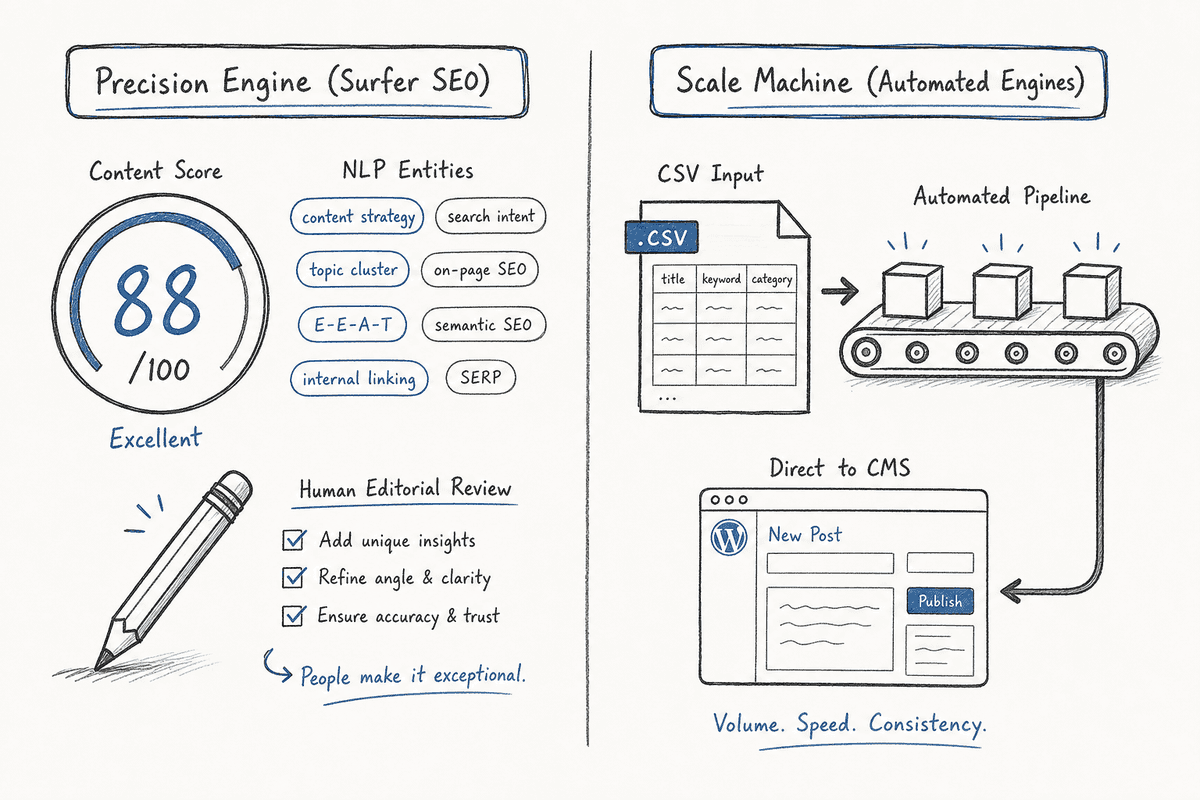
The Precision Engine: Surfer SEO
Surfer SEO operates on the principle that search engines rank pages based on structural and semantic correlations. By analyzing the top-ranking pages for a given keyword, Surfer identifies the exact word counts, heading structures, latent semantic indexing (LSI) keywords, and Natural Language Processing (NLP) entities required to compete.
When you use Surfer’s built-in AI tools, you are paying for an article that has been mathematically engineered to hit a high "Content Score." The goal is to provide a strong SEO foundation that saves hours of manual research [3]. However, it is an assistive technology. It assumes a "human-in-the-loop" workflow. You are expected to review the draft, inject brand voice, add original insights, and polish the final piece before publishing.
The Scale Machine: Automated Blogging Engines
Automated blogging engines (tools like RobotSpeed, Emplibot, or similar bulk-publishers) operate on the principle of topical coverage and long-tail keyword capture. These platforms are designed for operational velocity. You provide a list of keywords, a target audience, and website credentials, and the engine handles the rest.
These tools handle planning, writing, formatting, and publishing directly to your Content Management System (CMS) without human intervention. They are highly effective for capturing top-of-funnel traffic, especially for e-commerce sites or localized directories that require hundreds of supporting pages [4]. The tradeoff, however, is a loss of granular control. Automated engines prioritize speed and consistency over semantic depth and brand nuance.
Deep Dive: The Mechanics of Surfer SEO
If you are building high-stakes, bottom-of-funnel content where a single ranking drop means lost revenue, Surfer SEO provides the necessary guardrails. Let’s look at how the platform actually functions within a marketing stack.
1. Data-Driven Content Scoring
Surfer’s most famous feature is its Content Editor dial, which grades your text from 1 to 100. This score is derived in real-time by comparing your content against the top 10 to 30 ranking pages for your target keyword. The algorithm evaluates:
- Keyword Density and Placement: Ensuring exact match terms appear in the H1, H2s, and first paragraphs without tipping into keyword stuffing.
- NLP Entities: Highlighting the specific nouns, concepts, and semantic relationships that Google expects to see. If you are writing about "CRM software," Surfer will mandate the inclusion of terms like "sales pipeline," "customer retention," and "automation workflows."
- Structural Optimization: Recommending the optimal number of paragraphs, images, and headings.
2. The Hybrid Workflow
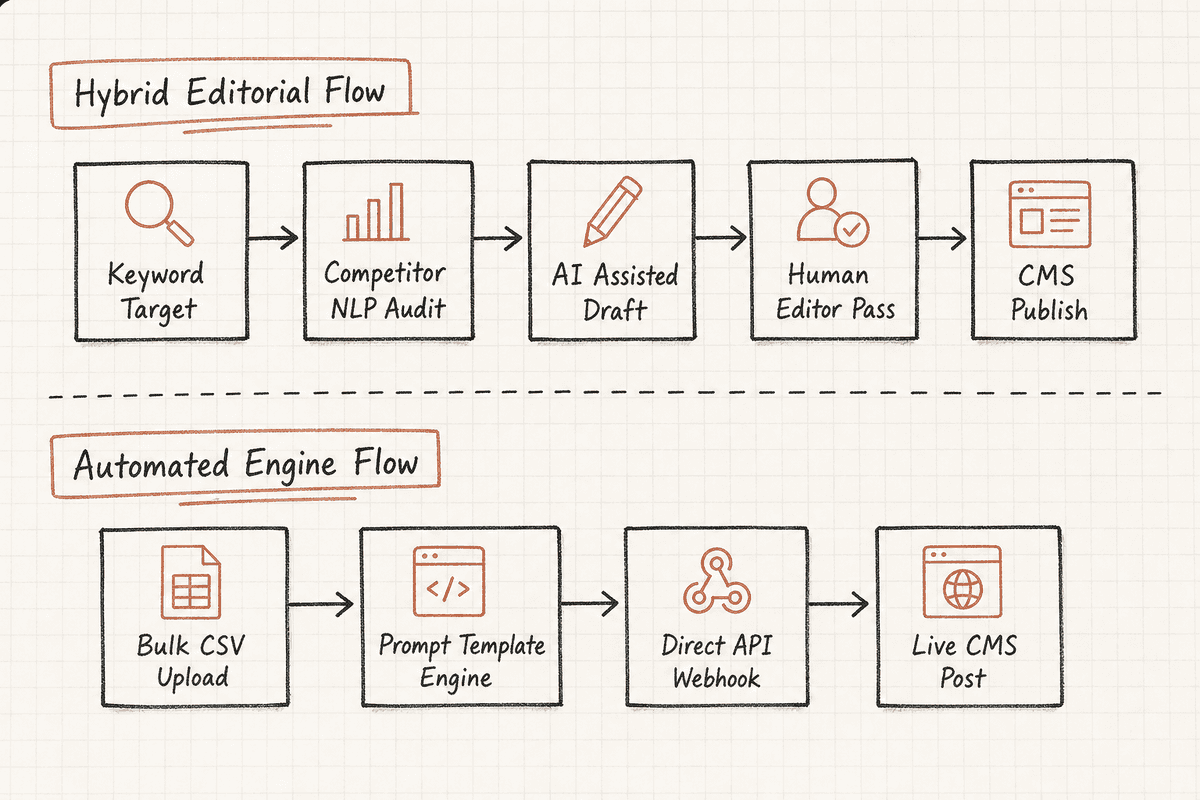
Even when utilizing Surfer AI to generate the initial draft, the workflow remains distinctively hybrid. The process usually looks like this:
- Keyword Selection: The SEO strategist identifies a valuable keyword.
- Brief Configuration: The strategist customizes the Surfer AI outline, selecting which competitor headings to emulate and which tone of voice to apply.
- Generation: The AI produces a draft that mathematically satisfies the required SEO parameters.
- Editorial Review: A human writer reviews the content, adjusting phrasing, adding proprietary data, and ensuring the brand voice is accurate.
- Publishing: The content is manually migrated to the CMS, formatted, and published.
3. Limitations of the Surfer Model
The primary limitation of Surfer SEO is the time and cost associated with this hybrid approach. While it is faster than writing from a blank page, managing a 500-page content rollout via Surfer requires significant editorial bandwidth.
Additionally, some practitioners find the scoring system too prescriptive. Focusing too heavily on hitting an arbitrary green score can result in clunky phrasing, as writers shoehorn obscure keywords into sentences just to satisfy the algorithm [5]. This rigid scoring system can stifle creativity and result in content that reads more like a textbook than an engaging piece of thought leadership.
For teams building complex digital architectures, such as single-page apps, ensuring this meticulously crafted content actually gets rendered and indexed is a separate challenge altogether. If you are deploying high-quality Surfer content on a Javascript-heavy site, you'll need to ensure your technical SEO is flawless. For guidance on this, review our guide on SEO for Single Page Applications: A 5-Step Guide (2026).
Deep Dive: The Mechanics of Automated Blogging Engines
For teams that believe "content is a numbers game," automated blogging engines provide a compelling alternative to manual optimization. These tools are built for content arbitrage, aiming to capture long-tail, low-competition queries through sheer volume.
1. Programmatic Publishing Velocity
The defining characteristic of an automated blogging engine is its ability to bypass the traditional editorial bottleneck. The mechanics are relatively straightforward:
- Bulk Input: Users upload a CSV file containing hundreds or thousands of keyword targets.
- Prompt Engineering Under the Hood: The engine utilizes predefined LLM prompts (often leveraging OpenAI's APIs or proprietary models) to construct articles. These prompts are designed to create standard structures: introductions, H2s, bullet points, and conclusions.
- Direct CMS Integration: Using REST APIs or Webhooks, the engine pushes the completed HTML directly into WordPress, Webflow, Shopify, or custom CMS platforms as published posts or scheduled drafts.
2. The Hands-Off Workflow
The workflow for an automated engine is designed to be asynchronous.
- Campaign Setup: The marketer defines the site, niche, target audience, and posting frequency (e.g., "Publish 3 articles per day").
- Keyword Injection: The engine pulls from an uploaded list or auto-generates semantic clusters based on a seed topic.
- Continuous Deployment: The engine runs in the background, autonomously researching, writing, and publishing content without requiring any human approval.
3. Limitations of the Volume Model
The "set it and forget it" nature of automated blogging is also its greatest vulnerability. Because the process is entirely autonomous, the risk of quality degradation is high.
- Hallucinations and Inaccuracies: LLMs can and will invent facts. If an automated engine is writing technical B2B content, it may confidently publish incorrect software features or misquote industry regulations. Without human review, these errors go live instantly.
- Thin Content Penalties: Search engines have sophisticated "Helpful Content" algorithms designed to demote generic, unoriginal text. Automated engines often produce "flavorless" content that summarizes existing SERP data without adding unique value. Scaling this rapidly can trigger site-wide quality filters.
- Internal Cannibalization: When generating hundreds of posts automatically, the system may write 15 different variations of "Best HR Software," causing keyword cannibalization that dilutes your site's overall ranking power.
When considering the deployment of these tools, it's crucial to weigh software costs against traditional agency services. If you're comparing the cost of high-volume software against outsourcing, you might find our breakdown on SEO Charges UK: Agency Rates vs Automation (2026) particularly insightful.
Feature-by-Feature Comparison
To make an informed decision, marketing teams must evaluate how these methodologies compare across core functional areas.
Content Briefs vs. Programmatic Prompts
Surfer SEO shines in the planning phase. Its ability to generate dynamic content briefs based on real-time competitor analysis is unparalleled. You can see exactly which headings your competitors use and decide whether to adopt or ignore them. It empowers the strategist.
Automated engines obscure this process. You are relying on the platform's internal prompt architecture. You cannot manually tweak the heading structure of article #47 before it gets written; you must trust that the engine's generalized prompt will handle the keyword adequately.
Semantic Depth vs. Surface-Level Coverage
Surfer’s NLP analysis ensures that your content contains the deep, semantic relationships necessary to establish topical authority. It forces the inclusion of secondary and tertiary concepts that signal expertise to search engine crawlers.
Automated engines typically rely on the standard predictive capabilities of the underlying LLM. While modern LLMs are decent at predicting related concepts, they do not inherently cross-reference their output against live SERP data unless explicitly programmed to do so. This often results in surface-level coverage that lacks the nuance required to outrank established competitors on high-difficulty terms.
Indexation Latency and Crawl Budgets
When you use Surfer SEO, you are likely publishing a few highly optimized pages a week. Search engines can easily crawl, process, and index these URLs without exhausting your site's crawl budget.
When using automated engines, you might inject 500 new URLs into your sitemap in a single month. This sudden explosion of content can overwhelm search engine crawlers. If Google's initial crawl determines that a large percentage of these new pages are thin or duplicative, it may throttle your crawl rate, leaving hundreds of pages permanently listed as "Discovered - currently not indexed."
AI Search Visibility: The New Frontier
The most critical factor in comparing these tools in 2026 is not how they perform on traditional Google SERPs, but how they interact with AI-driven search assistants like ChatGPT, Gemini, Perplexity, and Google’s AI Overviews.
This is the exact problem we solve at BeVisible. We help teams monitor how AI assistants answer buyer questions, which brands they recommend, and which sources they cite. When you shift your focus from traditional keyword tracking to AI visibility monitoring, the flaws and strengths of both Surfer SEO and automated engines become sharply apparent.
How LLMs Retrieve and Recommend Content
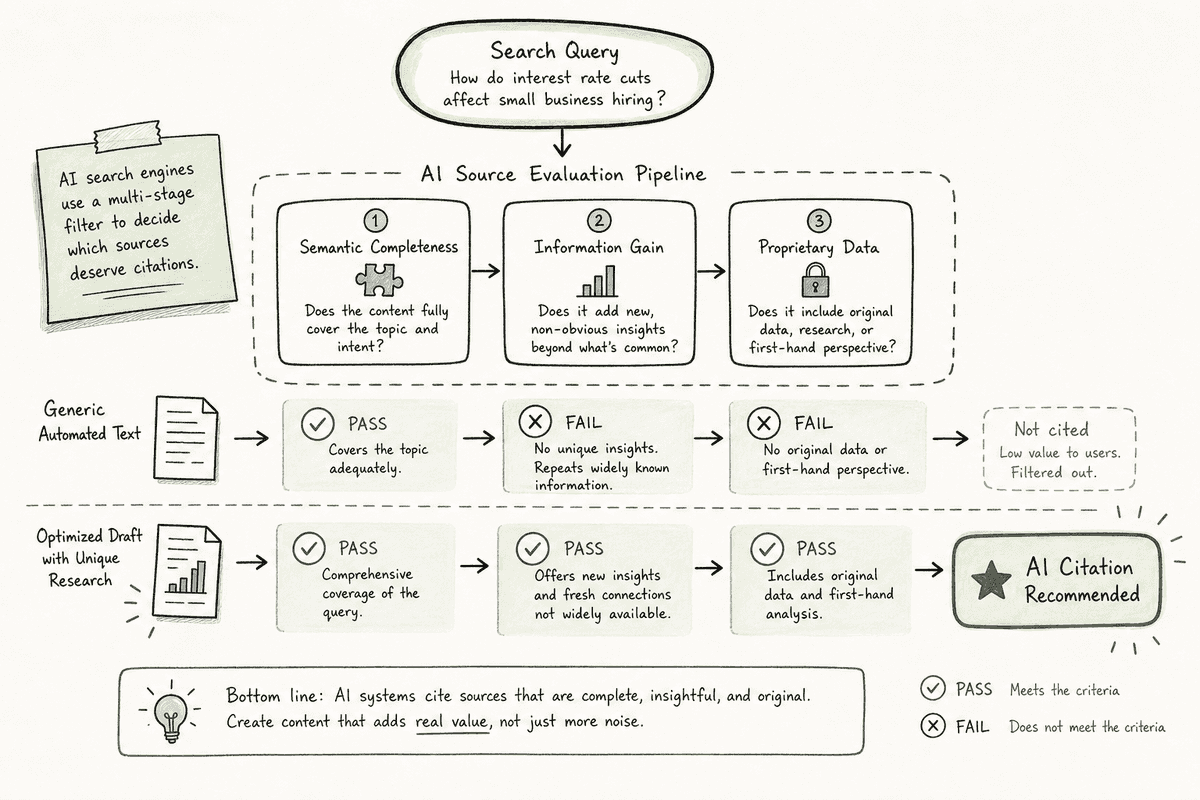
AI search engines use Retrieval-Augmented Generation (RAG) to answer user prompts. When a user asks Perplexity, "What is the best automated blogging engine for a Shopify store?", the AI does not look at a list of blue links. It actively reads the content of top pages, extracts facts, synthesizes an answer, and cites its sources.
To be cited as a source by an AI assistant, your content must possess specific traits:
- Unique Statistics or Proprietary Data: AIs prefer pages that offer hard numbers they can extract.
- Clear Consensus and Entity Density: AIs look for semantic completeness to verify the page is authoritative.
- High Information Gain: AIs prioritize pages that say something different than the rest of the internet. If five pages say the exact same thing, the AI only needs to cite one of them.
Evaluating Surfer SEO for AI Visibility
Surfer SEO is highly effective at achieving semantic completeness (Trait #2). By forcing you to include a wide array of NLP entities, Surfer ensures your page looks highly authoritative to a web crawler.
However, Surfer does not inherently generate high Information Gain (Trait #3). Because its scoring model is based on averaging what currently ranks in the top 10, relying solely on Surfer can lead to homogenization. If you simply copy the structure and entities of your competitors, an AI assistant has no reason to cite you over the incumbent. To win in AI search with Surfer, human editors must inject unique opinions, contrarian viewpoints, and proprietary data into the optimized draft.
Evaluating Automated Engines for AI Visibility
Automated blogging engines fundamentally struggle with AI search visibility. Because they operate autonomously, they cannot conduct original research, interview subject matter experts, or form unique opinions. They are built to regurgitate existing consensus at scale.
When AI assistants evaluate programmatic content, they often recognize it as thin or derivative. If your automated engine publishes 100 glossary terms, ChatGPT might scrape them for basic definitions, but it is highly unlikely to recommend your brand as a leading solution for a complex buyer prompt.
If your marketing strategy relies on influencing buyers through AI assistants, relying entirely on hands-off automation will result in severe visibility gaps. This is why tracking AI citations is paramount; it allows you to identify exactly where your programmatic content is failing to resonate with AI models, allowing you to manually intervene and upgrade those specific pages.
A Practical Scenario: The B2B SaaS Growth Dilemma
To illustrate how these tools compare in practice, let’s look at a realistic scenario.
Imagine you are the Growth Lead at a mid-market HR tech company. Your software helps enterprise HR teams automate onboarding. You have two goals for Q3:
- Rank #1 for the highly competitive, high-intent keyword: "Enterprise onboarding software integration."
- Capture long-tail, top-of-funnel traffic for 150 different HR compliance terms (e.g., "Form I-9 retention rules by state").
Applying the Surfer SEO Approach
For the bottom-of-funnel keyword ("Enterprise onboarding software integration"), you cannot afford to miss. The lifetime value of a customer searching for this is $50,000.
Here, Surfer SEO is mandatory. You generate a Surfer brief, analyze the specific NLP entities (e.g., "Active Directory," "API webhooks," "SOC2 compliance"), and use Surfer AI to build a structurally perfect draft. Then, you hand this draft to your lead engineer and product marketer. They spend four hours adding proprietary integration diagrams, case study data, and brand messaging. The resulting page is a masterpiece. It takes a week to produce, but it ranks well and gets cited by ChatGPT when enterprise buyers ask about HR integrations.
For guidance on structuring this exact type of high-value asset, refer to How to Build an SEO Landing Page (7-Step Guide).
Applying the Automated Engine Approach
Now, consider the 150 HR compliance glossary terms. Writing these manually using Surfer SEO would take hundreds of hours and tens of thousands of dollars in writer fees. The ROI is negative because these are low-intent, informational queries.
Here, an automated blogging engine makes sense. You upload the 150 terms, configure a prompt to write factual, concise definitions with standard HR disclaimers, and set the engine to publish five posts a day to your site's "HR Glossary" subfolder. The content isn't inspiring, but it's factually accurate enough to capture long-tail clicks. It acts as a wide net, capturing top-of-funnel traffic that you can later retarget with paid ads.
Cost Efficiency and Unit Economics
The financial models behind these tools dictate how they scale.
Surfer SEO Pricing Economics
Surfer SEO typically operates on a subscription model combined with a credit system for AI generation. You pay a baseline monthly fee for the auditing and NLP tools, plus an additional cost (often $15 to $30 per article) to use Surfer AI.
Because of the per-article cost and the required human editorial time, the unit economics of a Surfer-optimized article are relatively high. If an article costs $20 in software credits and $150 in editorial time, your total cost per post is $170. This requires you to be highly strategic about keyword selection; you only target keywords with a clear path to revenue.
Automated Blogging Pricing Economics
Automated engines operate on a vastly different financial model. Some charge a flat monthly fee for unlimited generation, while others charge based on API token usage (which is exceptionally cheap).
The unit cost of an automated article can drop to mere pennies. If you spend $100 a month on an automated engine to produce 500 articles, your cost per post is $0.20. The human labor cost is negligible after the initial setup. This makes it financially viable to target zero-volume keywords or hyper-niche, localized queries that would never justify a $170 manual investment.
Implementation Edge Cases and Failure Modes
Before overhauling your content operation, you must understand the edge cases where these tools break down.
Surfer SEO Failure Modes
- The Over-Optimization Trap: When writers become obsessed with achieving a 100/100 Surfer score, they often write unnatural, disjointed sentences. Google’s helpful content systems are increasingly adept at detecting text that reads like an SEO checklist rather than organic communication.
- Irrelevant Competitor Averages: If the current top 10 SERP results are low-quality forum posts or outdated PDFs, Surfer’s algorithm will recommend you build a page that mimics that low-quality structure. You must manually curate which competitors Surfer includes in its baseline analysis.
Automated Engine Failure Modes
- The "Orphaned Content" Crisis: Automated engines publish at scale, but they rarely handle internal linking intelligently. If you auto-publish 300 articles without integrating them into your site's existing architecture, you create "orphaned pages" that crawlers struggle to find and users never see.
- Brand Voice Dilution: B2B brands spend years cultivating a specific tone—authoritative, empathetic, or analytical. Automated engines default to a generic, enthusiastic "AI voice" (often overusing words like "delve," "crucial," and "landscape"). If your entire blog suddenly shifts to this generic tone, buyer trust evaporates. Keeping up with industry standards for brand messaging is critical; you can explore expert perspectives on this via our list of the 11 Best SEO Blogs Every SaaS Founder Needs (2026).
- Indexation Penalties on JS Frameworks: If your site is built on React, Angular, or another single-page application framework, rapidly pushing thousands of programmatic pages via API can cause severe rendering bottlenecks. Search engines may simply abandon crawling your site if the server response times degrade under the weight of the automated publishing load.
Finding the Middle Ground: The Strategic Synthesis
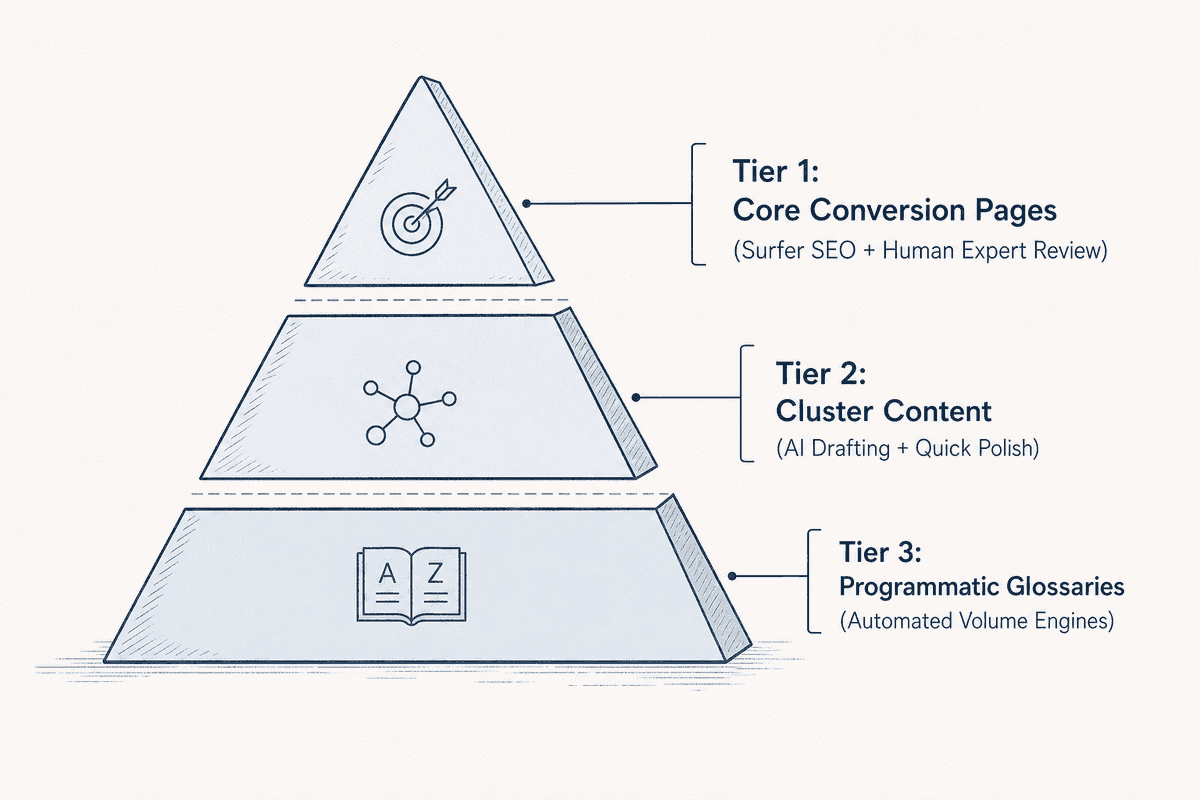
The most sophisticated growth teams in 2026 do not view this as an either/or decision. They synthesize both approaches into a tiered content architecture.
Tier 1: Core Product Pages and High-Intent Conversions These are your money pages. They require human oversight, original research, proprietary data, and rigorous Surfer SEO optimization to ensure structural dominance. They are the pages you actively monitor via BeVisible to ensure AI assistants are recommending them when buyers ask direct comparison questions.
Tier 2: Supporting Cluster Content and Informational Guides These pages support the Tier 1 assets. You might use Surfer AI to generate the drafts rapidly, but you still apply a human editorial pass to ensure internal linking is tight and the brand voice is maintained.
Tier 3: Programmatic Glossaries, Localized Pages, and Long-Tail Capture This is where automated engines excel. You deploy programmatic automation to build out vast libraries of standardized information (e.g., "SEO agencies in [City]" or "How to calculate [Financial Metric]"). This builds massive topical relevance for the domain without exhausting your editorial budget.
By stratifying your content operation, you leverage the precision of Surfer SEO where it matters most, while utilizing the velocity of automated engines to build a wide traffic net.
Frequently Asked Questions (FAQ)
Can I use automated blogging engines and Surfer SEO together?
Yes. Many advanced teams use automated engines to mass-produce top-of-funnel content (like glossary terms or local landing pages) while reserving Surfer SEO for high-converting, bottom-of-funnel pillar pages. Attempting to run automated output through Surfer manually defeats the purpose of automation, but running a tiered strategy using both tools independently on the same domain is a common and effective practice.
Do search engines penalize automated blogging tools in 2026?
Search engines do not penalize the use of automation or AI generation; they penalize the quality of the output. If an automated engine produces thin, repetitive, or inaccurate content that provides a poor user experience, algorithms will demote the entire site. If the automated content is highly structured, factual, and useful (e.g., a programmatic database of technical specifications), it can rank exceptionally well without manual intervention.
How do I know if my content is visible to AI tools like Perplexity or ChatGPT?
Traditional SEO tools like Surfer track standard Google rankings, but they do not measure LLM visibility. To track if your content is being cited by AI assistants, you need an AI visibility monitoring platform like BeVisible. We track the specific buyer prompts across ChatGPT, Gemini, and Perplexity, allowing you to see exactly which brands are recommended and where your content is failing to secure citations, turning those visibility gaps into actionable editorial updates.