
If you are evaluating the "best how does surferseo compare to automated blogging engines tools beyond Surfer SEO" search results, you are likely hitting a wall with your current content production strategy. Your marketing team needs to secure visibility not just in traditional search engines, but within the rapidly shifting interfaces of AI assistants like ChatGPT, Gemini, and Perplexity.
The dilemma is usually a choice of resource allocation: Do you meticulously craft and optimize a handful of authoritative pillar pages, or do you deploy software to flood your domain with hundreds of semantically relevant articles to build a topical map overnight?
This debate pits two fundamentally different methodologies against each other. On one side, you have optimization-focused platforms like Surfer SEO, which are built to guide human writers (and hybrid AI systems) toward deep, highly structured content. On the other side, you have automated blogging engines designed for hands-off, high-volume production.
Understanding how these distinct toolsets operate, where they fail, and how they impact your brand’s likelihood of being cited by AI engines is critical. Pumping out content without measuring its actual impact on AI search visibility is a guaranteed way to waste budget.
Let's break down the technical realities, the workflow trade-offs, and how to track the actual return on investment when using these distinct approaches.
The Core Difference: Optimization-Focused vs. Volume-Focused Content
To effectively compare these ecosystems, we must first strip away the marketing language and look at the underlying mechanics of how they handle the content lifecycle.
Surfer SEO: The Craftsman’s Approach to Search Authority
Surfer SEO operates primarily as an optimization and structural guide. While the platform has evolved significantly—notably with the introduction of Surfer AI—its core DNA remains rooted in analyzing top-ranking pages to establish statistical benchmarks for success.
As noted by EdgeOnline, Surfer is an SEO tool that focuses heavily on content optimization by providing data-driven recommendations. It analyzes the SERP (Search Engine Results Page) for your target keyword and extracts hundreds of data points, including word count, heading structure, image density, and crucial Natural Language Processing (NLP) terms.
Even when using its automated writing feature, Surfer requires a driver. As SurferSEO states regarding their early launch of Surfer AI, the goal was to provide "SEO-proof AI generation." However, reviews from practitioners highlight the platform's focus on structured groundwork. A review by Firebear Studio notes that while Surfer AI provides a strong SEO foundation and saves hours of manual research, the generated content still heavily benefits from—and often requires—human editing.
Surfer is designed for the "money pages." If you are learning how to build an SEO landing page, Surfer provides the guardrails to ensure that page has the semantic depth required to compete in competitive niches.
Automated Blogging Engines: The Factory Model
Automated blogging engines (sometimes referred to as programmatic SEO tools or auto-bloggers) operate on a fundamentally different premise. These tools—ranging from basic WordPress plugins hooked up to the OpenAI API, to standalone SaaS platforms—prioritize scale and autonomy over granular optimization.
A platform like RobotSpeed exemplifies this approach. In their comparison, RobotSpeed highlights that while product pages are the lifeblood of an online store, a blog is necessary to capture "top-of-funnel traffic." Automated engines are built to capture that traffic at scale.
The typical workflow for an automated engine involves inputting a massive list of keywords or a core topic. The engine then takes over, autonomously researching subtopics, drafting articles, generating featured images, and publishing directly to your Content Management System (CMS) on a scheduled drip. There is little to no human intervention required per article.
The goal here is entity coverage. By publishing 500 articles across a specific niche, the theory is that your domain becomes a recognized topical authority, catching thousands of long-tail search queries that might not warrant the hours of manual labor required by a tool like Surfer.
Architectural Deep Dive: How Both Systems Generate Text
When we evaluate the raw output, it is easy to assume that "AI is just AI," since both Surfer and most automated blogging engines rely on Large Language Models (LLMs) like GPT-4 or Claude under the hood. However, the prompting architecture and the data pipeline fed into those models dictate the final quality.
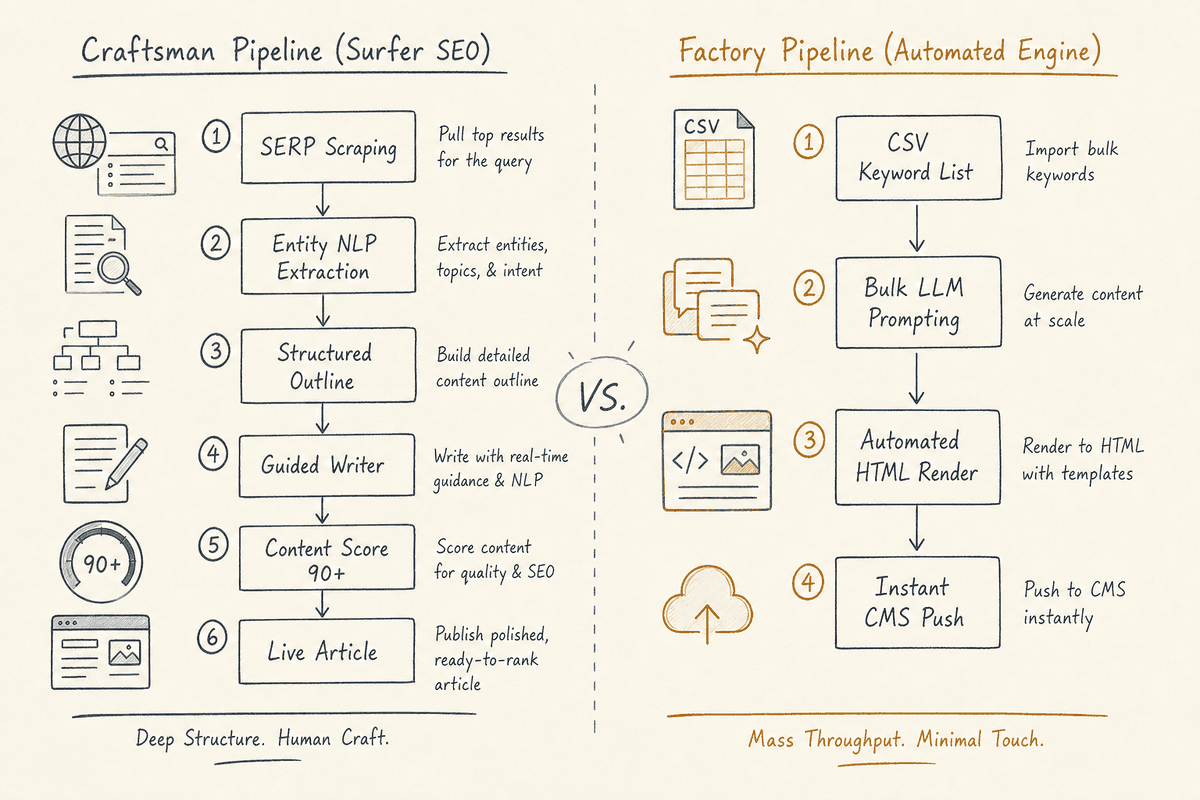
The Surfer AI Pipeline
When you generate an article with Surfer AI, you are not simply passing a prompt to an LLM. Surfer employs a multi-step retrieval and processing pipeline:
- SERP Analysis: The system scrapes the current top 10 ranking pages for your keyword.
- Entity Extraction: It identifies the semantic entities, NLP terms, and structural patterns (H2s, H3s) that those top pages share.
- Outline Generation: It builds a comprehensive outline, forcing the LLM to adhere to the structural norms of the winning pages.
- Drafting: The LLM generates the text section by section, heavily constrained by instructions to include specific NLP phrases at specific frequencies.
- Scoring: The final output is immediately measured against Surfer’s proprietary Content Score, ensuring it mathematically resembles a top-ranking result.
This structured pipeline creates highly relevant, tightly focused text. However, some users find this methodology restrictive. Feedback from practitioners on platforms like Reddit's /r/Blogging indicates that while the content audit features are decent, the rigid scoring system—which hyper-focuses on keyword density and specific term inclusion—can sometimes stifle natural readability.
The Automated Engine Pipeline
Automated blogging engines generally use a looser, faster pipeline designed for bulk execution:
- Keyword Seeding: The user uploads a CSV of 100+ keywords.
- Bulk Prompting: The engine applies a standardized system prompt (e.g., "Write a comprehensive 1500-word article about [Keyword] with an introduction, three main sections, and a conclusion") across the entire list.
- Sequential Generation: The engine processes the articles sequentially, often running multiple API calls to string together longer pieces.
- Auto-Publishing: The text is formatted into HTML and pushed via API to the site's database.
Because these engines prioritize speed and lack the deep SERP-scraping phase per keyword, the resulting content often suffers from "LLM homogenization." The articles are grammatically flawless but structurally generic. They lack the specific data points, competitor insights, and semantic richness that a tool like Surfer enforces.
AI Visibility: Earning Citations in ChatGPT, Gemini, and Perplexity
The transition from traditional Google search to AI-driven answers is the most significant shift in digital marketing today. Marketing teams are no longer just trying to secure a top-ten blue link; they are fighting to be the cited source when a B2B buyer asks Perplexity, "What is the best CRM for a 50-person sales team?" or when a consumer asks Gemini, "How do I fix a leaking P-trap?"
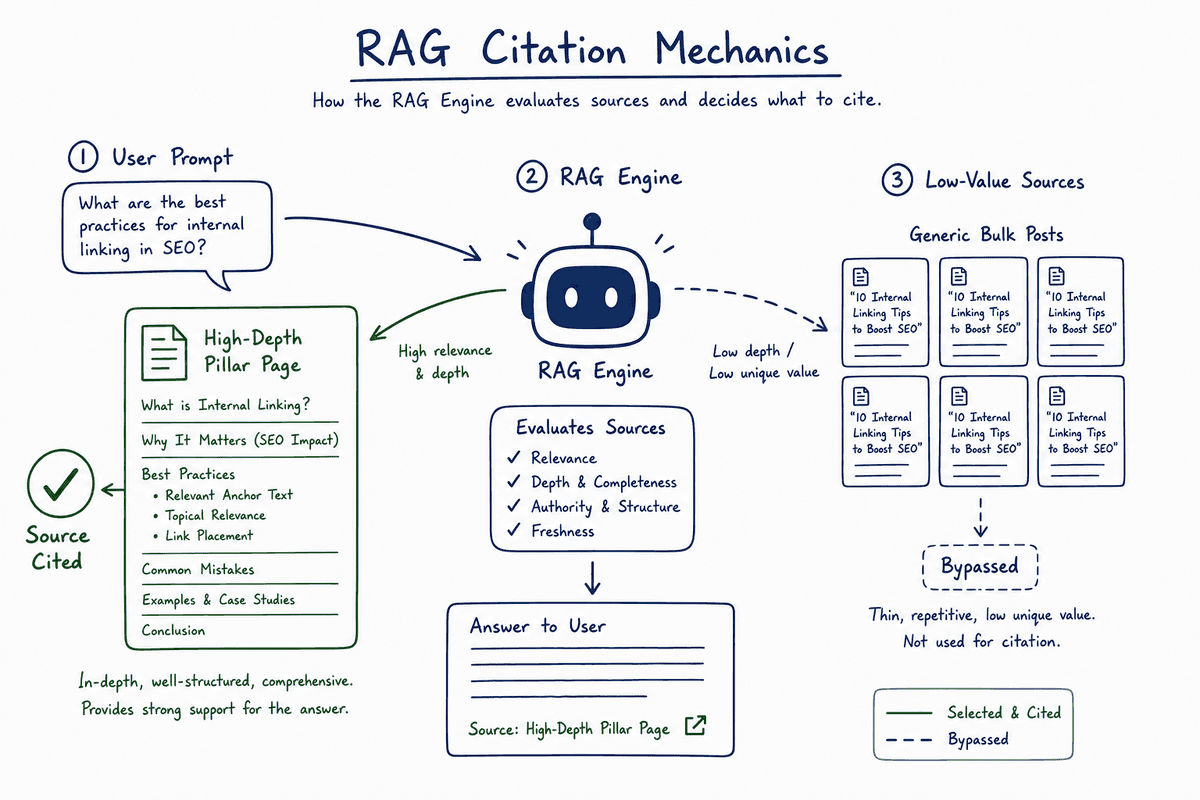
This requires understanding how Retrieval-Augmented Generation (RAG) works. When a user asks an AI assistant a question, the assistant does not simply rely on its training data. It performs a rapid background search, retrieves a handful of relevant live web pages, and synthesizes an answer, citing those retrieved pages as sources.
How do you get your pages retrieved by these systems?
The Case for Deep Optimization (Surfer's Strength)
AI assistants prioritize comprehensive, highly structured, and semantically dense information. When a RAG pipeline scrapes a page, it looks for clear hierarchy (well-defined H2s and H3s) and deep entity relationships.
Surfer SEO excels at this. By forcing you (or its AI writer) to include highly specific secondary keywords and structural elements, the resulting page becomes a dense cluster of information. When an AI assistant needs to synthesize a complex answer, a 3,500-word, highly optimized pillar page is an incredibly attractive source to pull from.
If you are a SaaS founder monitoring the best SEO blogs to refine your strategy, you will notice a consistent theme: AI engines reward depth. Surfer forces depth.
The Case for High Volume (The Automated Engine's Strength)
Conversely, RAG systems also look at domain authority and topical relevance. If Perplexity is evaluating two domains to answer a question about specialized manufacturing software, it will favor the domain that appears to be a dedicated hub of information on that topic.
This is where automated engines hold a theoretical advantage. By rapidly deploying hundreds of articles around a tight cluster of long-tail keywords, you can signal to search engines (and the search engines powering AI RAG pipelines) that your site is a comprehensive topical authority.
However, the risk is severe. AI assistants are increasingly adept at identifying and ignoring shallow, generic AI-generated content. If you use an automated engine to publish 500 low-effort buying guides, those pages may index, but they are highly unlikely to be cited as authoritative sources by ChatGPT. They lack unique insights, original data, and the nuanced semantic relationships that high-quality synthesis requires.
Monitoring the Reality of Your Output
This is the exact problem BeVisible solves. You can spend thousands of dollars on Surfer AI credits to build perfect pages, or you can spend thousands on automated engines to build topical maps. But if you aren't tracking how AI assistants actually use your content, you are operating on guesswork.
BeVisible helps teams monitor exactly how AI assistants answer buyer questions. It tracks ChatGPT, Gemini, Perplexity, AI Mode, and AI Overviews across your target prompts.
If you deploy a mass of automated content, BeVisible will show you if those pages are actually earning citations. If they aren't, you have a visibility gap. You can then take that data and decide to upgrade those specific pages using an optimization tool like Surfer, turning weak, ignored content into heavily cited, evidence-backed assets. By tracking these platforms, teams turn missing mentions and competitor wins into actionable scheduling and publishing work.
Key Comparison Criteria: Evaluating Workflow, Quality, and Scale
When choosing your toolset, you must evaluate how these platforms impact your daily operations, your budget, and your ultimate conversion rates. Let's break down the primary comparison factors.
1. Content Quality and Brand Protection
Quality is subjective, but in the context of B2B marketing, it translates to trust.
When you use Surfer SEO (manually or via Surfer AI), you are building content designed to rank, but you are also forced to review and refine. The platform’s interface is built around an editor. It encourages you to stay engaged with the text. This friction is actually a feature when it comes to brand protection. It prevents egregious hallucinations or embarrassing formatting errors from hitting your live site.
Automated engines remove this friction. While this allows for massive scale, it introduces significant brand risk. An automated engine pulling from a poorly structured API request might confidently state incorrect pricing, recommend a competitor, or generate entirely fabricated statistics. If you rely on automation to handle the publishing step without human review, you will eventually publish something that harms your brand's credibility.
2. Workflow Integration and Human Capital
How does your team actually work?
If you are a solo founder or running a small agency, managing human writers is difficult. Analyzing the SEO charges UK agencies bill out, you quickly see that human-driven content creation is the largest bottleneck in search marketing.
Automated engines solve this bottleneck entirely. You can configure an engine on a Friday, and by Monday, you have 50 new localized landing pages. The workflow is inherently asynchronous.
Surfer SEO, conversely, is a synchronous tool. It requires a project manager to generate the brief, a writer (or AI operator) to draft the text inside the editor, an editor to review the score, and a CMS manager to format and publish the final piece. It is a heavier lift. The trade-off, again, is the final quality and the likelihood of earning high-value AI citations.
If you are evaluating hiring SEO services in Phoenix or anywhere else, understanding which workflow the agency uses is critical. Agencies charging premium rates should be providing the craftsmanship of the Surfer methodology, not simply passing on the API costs of an automated engine.
3. Unit Economics and Cost Scaling
The financial models of these platforms dictate how you use them.
Surfer SEO operates on a relatively high cost-per-article model. Surfer AI credits are expensive, often costing tens of dollars per generation. This forces you to be strategic. You only use Surfer for keywords that have direct commercial intent or significant search volume.
Automated blogging engines usually operate on a flat subscription plus raw API usage costs (which are incredibly cheap). You might be able to generate 1,000 articles for the cost of 5 Surfer AI articles.
This drastic difference in unit economics defines the strategy. Automated engines allow you to target ultra-long-tail keywords with zero search volume (often called "zero-volume keywords") on the assumption that even if only one person searches for it a year, the content was essentially free to produce.
The Hybrid Strategy: Bridging Quality and Volume
The most sophisticated marketing teams in 2026 do not view this as a binary choice. The "best" tool is often a combination of both methodologies, applied to different areas of the website architecture.
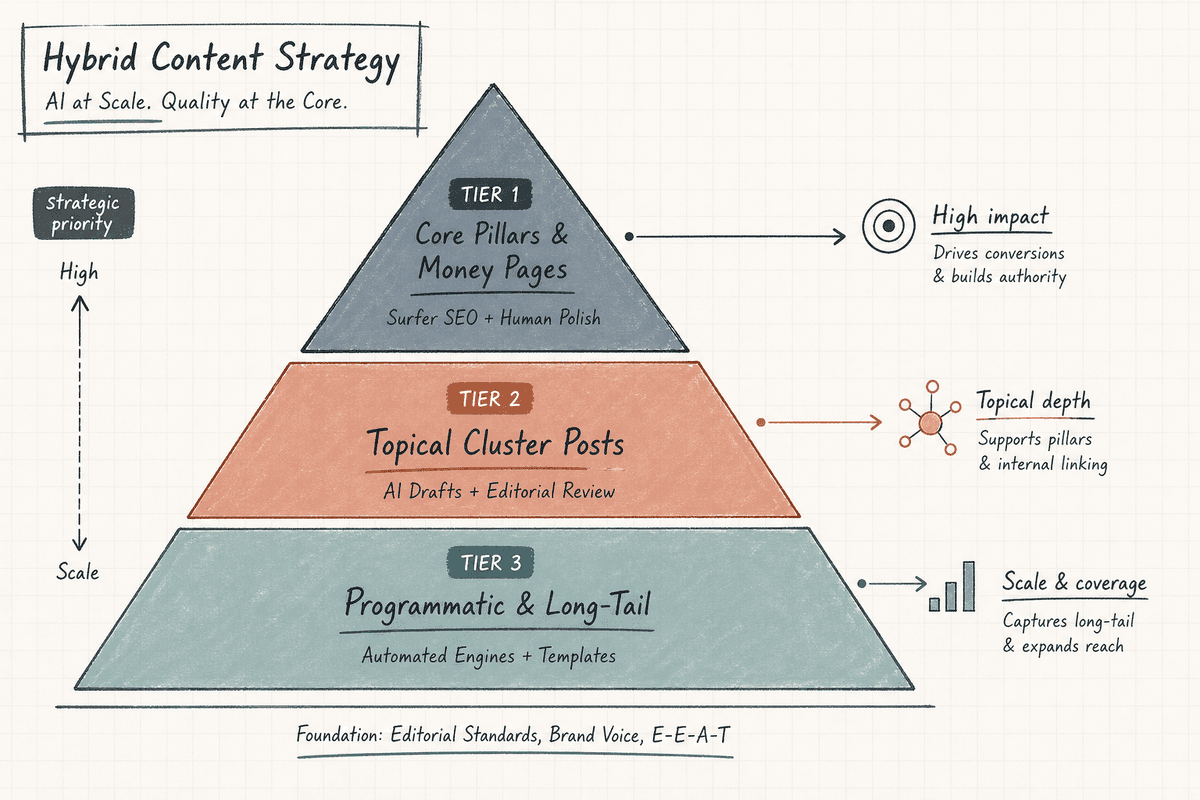
A hybrid content strategy categorizes website pages into distinct tiers of importance, applying the appropriate tool to each tier.
Tier 1: Core Commercial Pages and Pillar Posts
These are your money pages. They include product landing pages, comprehensive definitive guides, and high-competition comparison posts (e.g., "Best CRM Software 2026").
- The Toolset: Surfer SEO, heavy human editing, original data inclusion.
- The Goal: Rank top 3 in Google Search, earn deep citations in Perplexity and ChatGPT, drive direct conversions.
- The Workflow: Manual keyword research, Surfer Content Editor, expert review, custom graphics.
Tier 2: Supporting Content and Topical Clusters
These are the articles that support your pillar pages. They answer specific "how-to" questions, provide industry news, or explore secondary topics.
- The Toolset: Surfer AI or higher-end AI writers, moderate human editing.
- The Goal: Build topical authority, capture mid-funnel traffic, support Tier 1 pages via internal linking.
- The Workflow: Bulk generation via AI, followed by a human editor checking facts, adding internal links, and ensuring the tone matches the brand.
Tier 3: Broad Coverage and Programmatic Expansion
These are highly specific, repetitive topics where the structure remains identical across hundreds of variations. Examples include local service pages ("SEO Services in Austin", "SEO Services in Dallas"), glossary terms, or basic data lookup pages.
- The Toolset: Automated blogging engines, programmatic SEO frameworks, headless CMS integrations.
- The Goal: Capture hyper-specific, long-tail top-of-funnel traffic. Establish a massive footprint for entity extraction.
- The Workflow: Database structuring, automated prompt engineering, hands-off publishing.
This tiered approach requires careful technical implementation. If you are applying an automated engine to a dynamic frontend, you must ensure search engines can actually crawl the content. Reviewing guides on SEO for single page applications is vital here; deploying 1,000 automated articles onto an SPA that Googlebot cannot render defeats the entire purpose of the volume strategy.
3 Major Pitfalls When Scaling AI Content in 2026
Regardless of whether you lean toward Surfer's optimization or the bulk generation of automated engines, scaling AI content introduces distinct risks that can severely impact your domain authority and brand reputation.
1. Ignoring AI Search Visibility Metrics
The biggest failure mode in modern content marketing is continuing to track success solely through legacy ranking trackers. Traditional search consoles will show you impressions and clicks from standard Google queries, but they are entirely blind to the RAG pipelines used by AI assistants.
If you deploy a mass of automated content and see your traffic slowly decline, you might assume the content is poor. But without tracking AI visibility, you miss the nuance. Perhaps ChatGPT is answering the user's question directly, using your content as a citation. The user gets their answer and never clicks through to your site.
This is a visibility win, but a traffic loss. If you don't use platforms like BeVisible to monitor these specific AI assistant citations, you will make the wrong strategic decisions, potentially deleting content that is actively feeding brand awareness within LLMs.
2. The "Set and Forget" Disaster
Automated blogging engines are marketed heavily on the dream of passive growth. The reality is that search engine algorithms (and the quality filters on AI platforms) are continuously updated to detect and demote low-effort, programmatic spam.
If you set an automated engine to publish 10 articles a day and check back three months later, you risk discovering that your entire domain has been algorithmically suppressed.
Even with automation, human oversight is non-negotiable. You must routinely audit the output for structural integrity, accuracy, and formatting. You must also ensure that the internal linking structure generated by these tools actually makes logical sense and isn't just creating confusing, cyclical loops that frustrate both users and crawlers.
3. Over-Optimizing at the Expense of Readability
While automated engines suffer from being too generic, optimization platforms like Surfer carry the opposite risk: creating content that reads like a textbook written by a robot trying to impress a search engine.
When users fixate obsessively on achieving a Surfer score of 95+, they often force awkward, exact-match phrases into sentences where they do not belong. They dilute their strong, original arguments by stuffing in loosely related NLP terms just to turn a red metric green.
AI assistants, particularly advanced models like Claude 3.5 Sonnet and GPT-4o, are increasingly capable of recognizing semantic stuffing. If your content is difficult for a human to read because it is choked with awkwardly placed keywords, it is also likely to be bypassed by a high-end RAG system looking for clear, authoritative answers. Optimization should guide the structure, not strangle the prose.
Frequently Asked Questions
Is Surfer SEO considered an automated blogging engine?
No. While Surfer SEO offers an AI writing feature (Surfer AI) capable of generating full articles, the platform is fundamentally an optimization tool. It is designed to analyze competitor data, provide semantic recommendations, and guide the creation of highly structured content. Automated blogging engines prioritize hands-off, bulk content generation and direct publishing, often sacrificing deep, page-level optimization for speed and scale.
Can automated content rank in Google AI Overviews and ChatGPT?
Yes, but the likelihood is significantly lower for complex, high-value queries. AI assistants prefer to cite comprehensive, highly structured, and semantically rich pages. Automated content, which is often generated rapidly and superficially, tends to lack the depth and unique insights required to be selected as a primary source. Automated content is more effective for capturing hyper-specific, low-competition, top-of-funnel search queries.
Do I still need human editors if I use highly optimized AI tools like Surfer AI?
Absolutely. Reviews from industry professionals consistently highlight that while AI tools provide an excellent foundational draft and save hours of research, human editing is essential. Human editors ensure the brand voice is consistent, verify the accuracy of claims, inject original insights or company-specific data, and smooth out any awkward phrasing caused by rigid keyword inclusion requirements.
Final Thoughts on Building a Future-Proof Tech Stack
Choosing between the optimization power of Surfer SEO and the rapid deployment of automated blogging engines is not about finding one perfect tool; it is about building a tech stack that matches your business objectives.
If your goal is to dominate high-value, commercial intent queries and secure citations as the definitive authority within AI assistants, you need the structural guidance and semantic depth that optimization platforms provide. If your goal is to rapidly build a massive entity footprint to capture long-tail, top-of-funnel awareness, automated engines offer unmatched leverage.
However, neither approach is complete without execution tracking. The era of blindly publishing content and waiting for traffic is over. Modern marketing teams must deploy their content strategically and then rigorously monitor how that content performs across ChatGPT, Gemini, Perplexity, and AI Overviews. By tracking these platforms, identifying where competitors are winning citations, and turning those visibility gaps into targeted editorial work, you ensure that every piece of content—whether painstakingly optimized by hand or generated at scale—actually drives measurable business value.