
When a prospective buyer asks ChatGPT, Perplexity, or Google AI Overviews for product recommendations, the traditional SEO playbook offers zero visibility. You can hold position one on Google organic search for a primary keyword and still be completely invisible inside the generative answer that prospective customers read.
Generative engines do not rank websites by traditional backlinks alone. Instead, they use Retrieval-Augmented Generation (RAG) to pull real-time references from a distinct subset of sources: authoritative industry roundups, niche review sites, community discussions, and high-trust editorial publications. If your brand is not mentioned across those specific sources, AI assistants will gladly recommend your competitors instead.
To win market share in AI search, marketing teams need tools that show exactly which sources AI engines cite for their core buyer prompts. In this guide, we break down how AI citation retrieval works, evaluate the top citation tracking platforms available, and outline an actionable strategy to turn citation gaps into published pipeline.
How AI Search Engines Pick Their Sources: RAG and Citation Mechanics
To understand why traditional rank trackers fail in AI search, you have to look at how large language models construct responses. When a user enters a query like "best workflow automation software for mid-market SaaS," models like ChatGPT Search, Perplexity, Gemini, and Google AI Overviews execute a multi-step retrieval process.
First, the system reformulates the prompt into underlying search queries. Second, it fetches raw web pages from live search indexes or internal web caches. Third, a re-ranking algorithm evaluates these sources for factual density, authority, and topic relevance. Finally, the language model synthesizes an answer while attaching inline citations or footnote links to the sources that directly backed its claims.
 This architecture introduces three critical dynamics that every marketing team must navigate:
1. Domain Authority vs. Citation Trust
An enterprise site with high domain authority might fail to earn a citation if its content lacks dense, structured factual statements. Conversely, a modest blog or community thread on Reddit that directly answers a technical question with clear data will frequently get cited as a primary source.
2. The Citation Gap
A citation gap occurs when an AI engine answers a buyer prompt by citing third-party websites, media publications, or competitor domains while omitting your brand entirely. Identifying these exact source URLs gives content and PR teams a precise target list for outreach and content creation.
3. Share of Model vs. Traditional Ranking
Traditional rank tracking measures where your URL appears on a static page. AI visibility tracking measures two distinct metrics:
- Brand Share of Model: How often your brand or product name appears in the generated response text.
- Citation Share: Which exact web URLs the AI engine cites to validate its response.
If an AI assistant mentions your brand name but links exclusively to a third-party review site or a competitor's comparison post, you lack citation ownership. If those third-party pages change or update their recommendations, your brand visibility can vanish overnight.
5 Key Criteria for Choosing an AI Citation Tracker
Not all AI monitoring platforms serve the same purpose. Academic reference checkers verify whether an AI tool hallucinates quotes in research papers. Enterprise marketing teams, however, need commercial visibility tools that track buyer prompts and cite source URLs across major search platforms.
When evaluating tools that show which sources AI cites, prioritize these five criteria:
- Multi-Engine Coverage: The platform must monitor ChatGPT Search, Gemini, Perplexity, Google AI Overviews, and Google AI Mode simultaneously. Tracking a single LLM provides an incomplete picture of buyer search behavior.
- URL-Level Citation Granularity: Broad domain reporting (e.g., "cited by reddit.com") is insufficient for marketing execution. You need exact page URLs (e.g.,
reddit.com/r/SaaS/comments/...) to analyze the precise context behind the recommendation. - Buyer Prompt Customization: The ability to run custom, multi-turn buyer prompts, localized persona queries, and long-tail decision queries rather than fixed, static keyword lists.
- Actionable Remediation Workflows: A great platform does not merely report missing citations. It highlights specific visibility gaps and helps you convert those insights into published articles, content updates, and digital PR campaigns.
- Crawler Analytics & AI Bot Tracking: Understanding how often OpenAI, Perplexity, and Google crawlers visit your site helps verify whether indexing issues are blocking your content from AI retrieval pipelines.
6 Best Tools That Show Which Sources AI Cites
Here is a detailed breakdown of the leading software platforms designed to monitor AI citations, track search visibility, and help marketing teams capture AI market share.
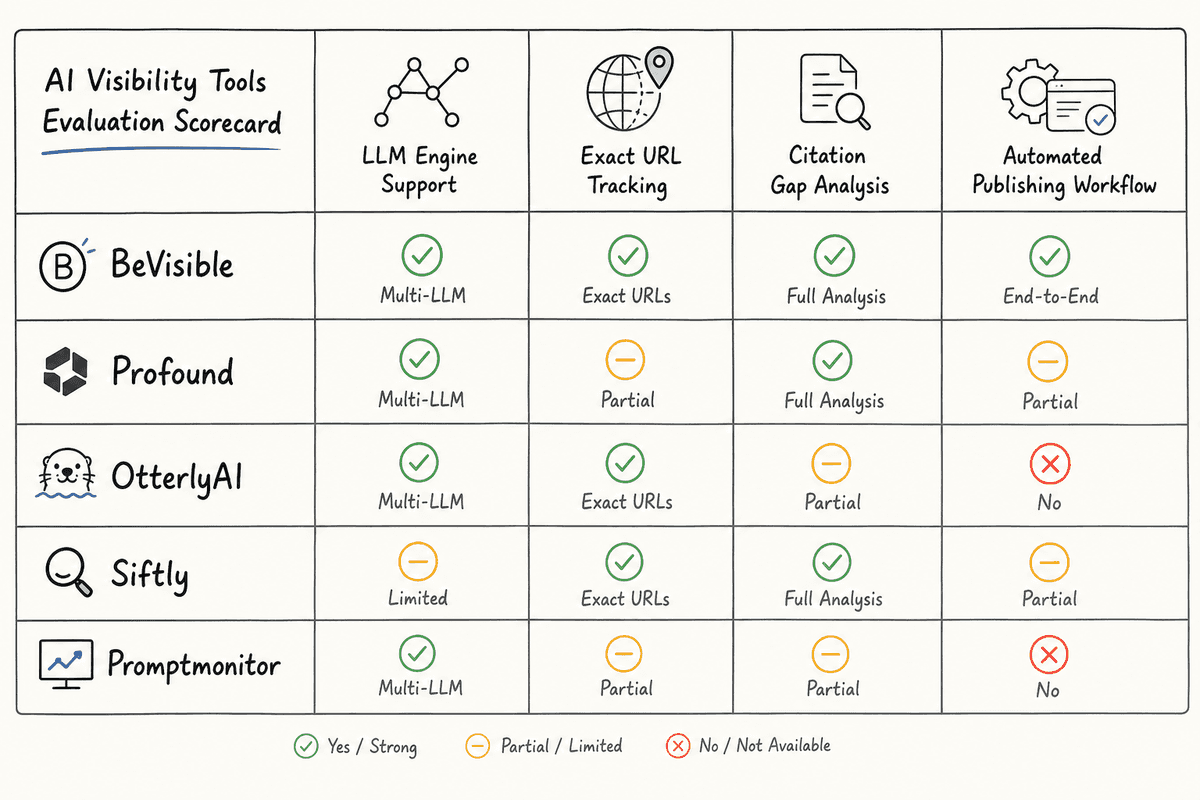
1. BeVisible
Best overall for end-to-end AI visibility monitoring and execution
BeVisible is built specifically for SaaS founders, B2B marketing teams, growth leads, and agencies that need to monitor how AI assistants answer buyer questions and turn citation gaps into published work.
Rather than leaving teams with static dashboards and manual outreach spreadsheets, BeVisible tracks ChatGPT, Gemini, Perplexity, AI Mode, and Google AI Overviews across custom buyer prompts. It reveals which brands get recommended, which specific URLs AI engines cite as evidence, and where your brand suffers from visibility gaps.
Key Features & Strengths
- Complete Multi-Engine Tracking: Monitors brand recommendations, citation URLs, and visibility scores across ChatGPT, Gemini, Perplexity, AI Mode, and AI Overviews.
- Citation Source Breakdown: Pinpoints the exact external URLs, media outlets, and community hubs AI engines trust when evaluating your product category.
- Evidence-Backed Execution Engine: Converts missing mentions, weak citations, and competitor wins into structured opportunities, research notes, and ready-to-publish content.
- Integrated Publishing Workflow: Streamlines article drafting, review, scheduling, and multi-channel publishing so marketing teams can claim unranked citations instantly.
Best For
Growth teams and marketing leaders who want a unified platform to track AI source citations and immediately execute the content needed to capture missing AI share of voice.
2. Profound
Best for enterprise prompt scale and crawler log tracking
Profound is designed for enterprise organizations requiring high-volume prompt monitoring across global markets and complex product categories.
Key Features & Strengths
- High-Volume Prompt Simulation: Runs millions of daily synthetic prompts to track citation shifts across regional buyer segments.
- AI Crawler Log Analysis: Tracks when proprietary AI web crawlers (such as GPTBot, PerplexityBot, and Google-Extended) crawl your site pages.
- Enterprise Security & Compliance: Offers advanced user permissioning and custom API access for enterprise data warehouses.
Tradeoffs
The platform's high price point and complex reporting structures make it less accessible for mid-market SaaS companies or smaller content teams looking for fast, tactical execution.
3. OtterlyAI
Best entry-level citation tracker for small marketing teams
OtterlyAI provides a straightforward entry point for teams that want basic monitoring across major AI platforms without complex enterprise setup.
Key Features & Strengths
- Broad LLM Monitoring: Covers ChatGPT, Perplexity, Gemini, Claude, and Google AI Overviews.
- Simple Dashboarding: Tracks whether your brand URL appears in response citations for core queries.
- Affordable Entry Pricing: Entry plans make it accessible for bootstrapped startups and solo marketers.
Tradeoffs
Lacks deep workflow tools to remediate citation gaps once discovered. Teams must manually orchestrate content creation and outreach elsewhere.
4. Siftly
Best for automated citation gap analysis
Siftly focuses on identifying specific queries where competitors earn citations while your brand is left out.
Key Features & Strengths
- Citation Gap Detection: Highlights exact prompts where competitor URLs are cited as primary references.
- Content Recommendation Engine: Suggests structural edits for existing content to improve likelihood of AI indexing.
Tradeoffs
While strong at gap detection, Siftly offers limited integration with publishing tools, requiring manual handoffs to editorial teams.
5. Promptmonitor
Best for digital PR and outreach list creation
Promptmonitor analyzes AI search responses to uncover which third-party publications and domain authorities dominate citations across specific niches.
Key Features & Strengths
- Third-Party Citation Aggregation: Groups cited sources by domain type (e.g., media, review portals, tech blogs).
- Outreach Target Identification: Helps digital PR teams build target lists of high-impact websites that AI engines frequently reference.
Tradeoffs
Focuses primarily on external domain discovery rather than monitoring direct brand sentiment or providing an end-to-end content production pipeline.
6. Wrodium
Best for tracking brand fact accuracy in AI citations
Wrodium specializes in content freshness and factual accuracy verification across generative engine outputs.
Key Features & Strengths
- Fact Consistency Alerts: Detects when AI engines cite outdated pricing tables, retired features, or inaccurate product specs.
- Source Attribution Tracing: Traces factual hallucinations back to the specific legacy web page or scraper source responsible.
Tradeoffs
Niche focus on fact verification means it lacks broader prompt tracking and automated visibility workflows.
Step-by-Step: Turning AI Citation Gaps into Published Content
Monitoring which sources AI cites is only half the battle. To win generative market share, marketing teams must systematically capture those citations. Here is a five-step framework for closing AI visibility gaps.
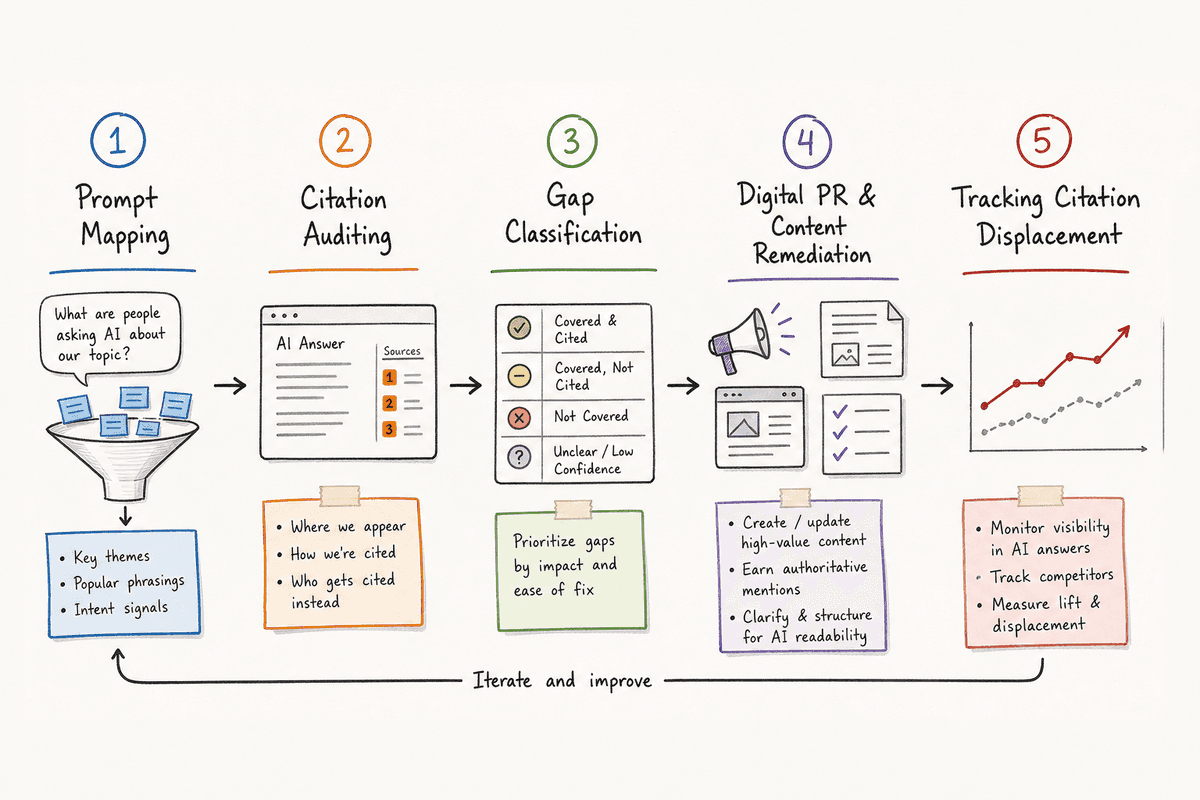
Step 1: Map Buyer Intent Prompts
Traditional keyword research focuses on high-volume short-tail search queries. AI prompt mapping requires defining conversational buyer scenarios. Group your prompts into three distinct operational buckets:
- Category Discovery Prompts: "What are the best tools for automated invoice processing?"
- Comparison & Alternative Prompts: "Tool A vs Tool B for enterprise security compliance."
- Technical Feasibility Prompts: "How to integrate single-page applications with real-time analytics."
Step 2: Audit Cited Sources Across Engines
Run your target prompts through an AI visibility monitoring platform to extract every cited URL. Categorize the retrieved sources into three buckets:
- Owned Assets: Your website, official documentation, or corporate blog posts.
- Earned External Hubs: G2, Capterra, Reddit, industry news sites, or independent comparison blogs.
- Competitor Owned Assets: Competitor landing pages, customer case studies, or blog posts.
Step 3: Identify the Citation Strategy Gap
Analyze why the AI engine selected those specific sources:
- Format Match: Did the AI cite a structured comparison table or bulleted list?
- Data Density: Did the source contain specific numerical benchmarks or original research?
- Third-Party Consensus: Is the AI relying on consensus across multiple forum threads or review platforms?
Step 4: Execute Targeted Content Remediation
Once you know why a source was selected, execute a dual-pronged remediation plan:
- Owned Content Updates: Build dedicated, highly-structured assets tailored to clear buyer questions. If you need to build dedicated search landing pages, follow a proven framework like our guide on How to Build an SEO Landing Page (7-Step Guide).
- Digital PR & Community Engagement: If AI engines rely heavily on community discussions or third-party review hubs, update your brand presence on those platforms or pitch guest coverage to top-cited industry blogs.
Step 5: Measure Citation Displacement
Monitor your prompt set over 30 to 60 days. Large language models update their search caches periodically. Track whether your newly published assets or updated PR listings begin displacing competitor citations in generated answers.
How to Track AI Citation Traffic for Free Using Google Analytics 4
While dedicated AI visibility platforms provide deep prompt analysis and competitor tracking, you can also track real user traffic arriving from AI citations using Google Analytics 4 (GA4).
When a user clicks a citation link inside ChatGPT, Perplexity, or Claude, the browser sends referral data to your analytics engine. By creating a Custom Channel Group in GA4, you can isolate AI referral traffic from standard organic search.
GA4 Setup Instructions
- Open Google Analytics 4 and navigate to Admin > Data Settings > Custom Channel Groups.
- Click Create New Channel Group and name it
AI Search Referrals. - Add a new channel rule with the following logic:
- Source: Matches Regex
.*(chatgpt|perplexity|claude|gemini\.google).*
- Source: Matches Regex
- Save the channel group and apply it to your Acquisition reports.
Regex Pattern for Major AI Referral Engines:
.*(chatgpt\.com|perplexity\.ai|claude\.ai|gemini\.google\.com|copilot\.microsoft\.com).*
Limitations of GA4 Citation Tracking
GA4 only records instances where a user reads an AI response and actively clicks the citation link to visit your website. It cannot track:
- Zero-Click AI Answers: Scenarios where a buyer reads your brand name in an AI answer and makes a buying decision without clicking through.
- Competitor Citations: Which sources AI engines cite when your brand is completely omitted from the answer.
- Uncited Model Mentions: Instances where ChatGPT mentions your brand without attaching an inline hyperlinked source.
To measure true market share in AI search, GA4 referral tracking must be paired with an active AI citation monitoring tool.
Common Myths About AI Source Citations
As marketing teams rush to adapt to Generative Engine Optimization (GEO), several dangerous misconceptions have taken root.
Myth 1: "High Domain Authority Guarantees AI Citations"
In traditional SEO, a high Domain Rating (DR) combined with thousands of backlinks could brute-force a page to position one. In AI search, RAG models prioritize semantic precision, factual density, and clear formatting over sheer backlink volume. A clear, well-structured post from an authoritative niche site will routinely out-cite an enterprise blog post that is filled with generic corporate fluff.
Myth 2: "AI Engines Index New Content Instantly"
While real-time search engines like Perplexity and Google AI Overviews fetch live web pages quickly, foundational model updates and long-term memory retrieval systems lag behind. It can take weeks or months for an updated third-party review or new blog post to become a consistent citation source across all major LLMs.
Myth 3: "Google AI Overviews Use the Exact Same Ranking Signals as Organic Search"
Google AI Overviews pull from Google's broader web index, but the selection algorithm for generative answers differs significantly from traditional organic ranking algorithms. An organic result at position six that contains a clear, concise comparison table is often preferred by AI Overviews over position one's long-form, dense text.
Frequently Asked Questions
What is the difference between AI share of voice and AI citation tracking?
AI share of voice measures how frequently your brand or product name appears in generated answers across a set of target prompts. AI citation tracking focuses specifically on the external source URLs that the AI assistant links to or references to validate those answers.
How often do AI assistants update their cited sources?
Real-time search tools like Perplexity and Google AI Overviews refresh citations continuously based on live web retrieval. Chatbots like ChatGPT and Claude update citations when executing live web queries, but relies on training updates and periodic web re-indexing for cached knowledge retrieval.
Can you prevent AI crawlers from scraping your site without losing citation visibility?
If you block AI crawlers (like GPTBot or PerplexityBot) via your robots.txt file, those AI engines cannot read your owned content in real time. While third-party sites mentioning your brand may still be cited, blocking AI crawlers severely reduces the likelihood of your owned domain being directly linked in AI answers.
Which AI engine provides the most transparent citation links?
Perplexity currently offers the most transparent citation interface, placing clear, direct source cards at the top of every response. Google AI Overviews and ChatGPT Search also provide inline links, but their selection criteria lean more heavily on multi-source consensus.
Claim Your Brand's Share of AI Citations
The shift from keyword SERPs to generative AI answers requires a fundamental change in how marketing teams measure visibility. Winning in 2026 means knowing exactly which sources ChatGPT, Gemini, and Perplexity trust—and systematically building the content required to become their primary reference.
By monitoring buyer prompts, auditing citation sources, and acting quickly to close visibility gaps, you can ensure your brand stays front and center whenever prospective customers ask AI for recommendations.