
If you ask a large language model a complex question, you’ll get a confident answer. But confidence is not accuracy, and a generated response without a verifiable source is often useless. For academic researchers, an unverified AI claim is a professional liability. For B2B marketing and growth teams, an unverified AI claim—or worse, an AI answer that cites a competitor instead of your brand—represents lost revenue.
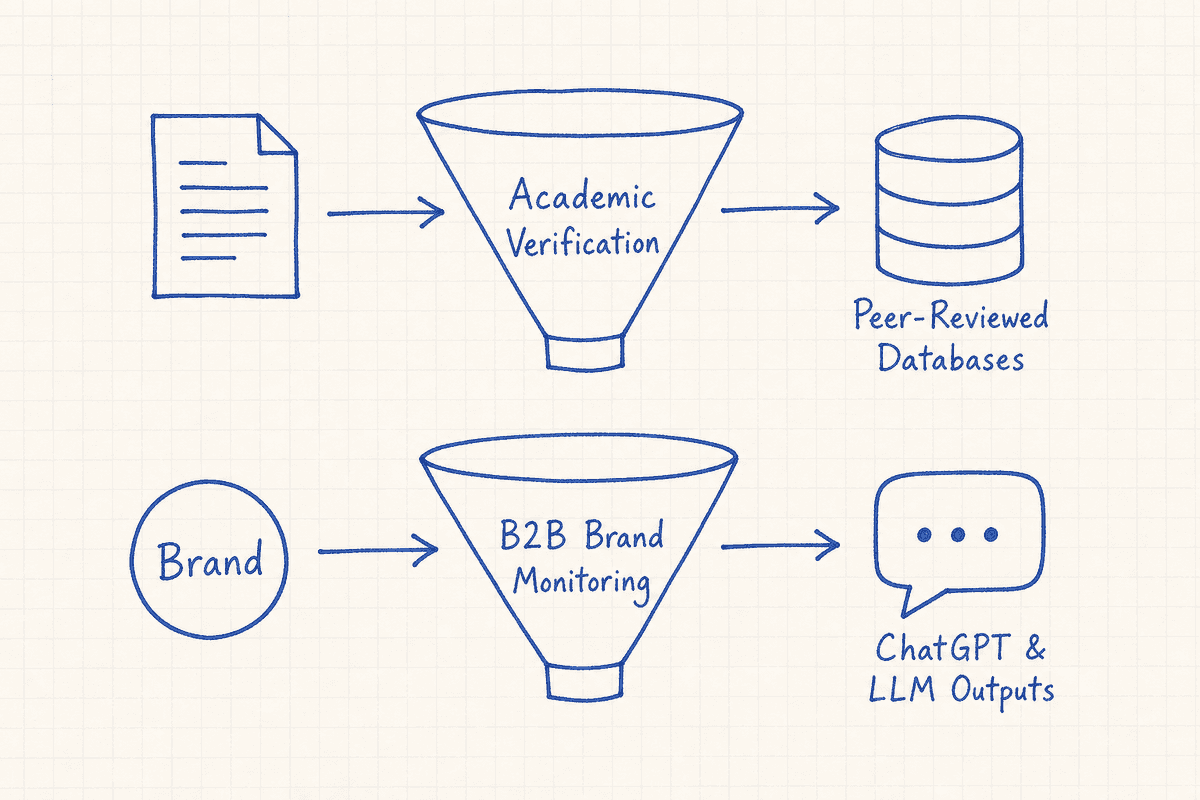
Citation tracking in artificial intelligence has fractured into two distinct disciplines. The first is verification: tools built to cross-reference AI-generated text against peer-reviewed academic databases to prevent hallucination. The second is visibility: tools designed to monitor generative engines (like ChatGPT, Gemini, and Perplexity) to see which brands and sources they cite when answering buyer prompts.
Whether you are verifying scientific literature or auditing your brand’s presence in AI Overviews, you need dedicated software. Standard search engine optimization tools rely on traditional crawling metrics, which fail to capture how AI agents synthesize and retrieve data using Retrieval-Augmented Generation (RAG).
This guide breaks down the top AI citation tracking tools across academic, consumer, and B2B visibility use cases, detailing how they work, where they fail, and how to use them to verify claims or capture market share.
The three tiers of AI citation tracking
Not all citation trackers are built for the same data. According to extensive software testing on verifiable citations, the tooling market generally splits into three distinct categories based on the underlying source database.
- Academic & Research (Tier 1): Tools that restrict their retrieval to peer-reviewed journals, published papers, and verified scientific databases. These are used primarily for literature reviews and fact-checking scientific claims.
- Generative Web Search (Tier 2): Conversational search engines that scrape the live web and news sources to append inline citations to their generated answers.
- B2B Visibility & AI SEO (Tier 3): Enterprise monitoring platforms that track how foundational models (ChatGPT, Claude, Gemini) answer specific buyer questions, measuring which corporate domains are cited most frequently.
 Understanding which tier you need dictates the software you should adopt. Let's examine the leading tools in each category.
B2B brand visibility & AI search monitoring
For SaaS founders, growth teams, and marketing agencies, traditional search volume is dropping as users bypass Google for ChatGPT, Perplexity, and AI Overviews. If a potential customer asks ChatGPT, “What is the best CRM for a healthcare startup?”, you need to know which tools the AI recommends and which websites it cites as evidence.
These platforms do not verify academic claims; they monitor market presence.
1. BeVisible
BeVisible is an AI visibility monitoring and execution platform built specifically for B2B teams who need to track and influence their presence in AI models. While traditional rank trackers monitor Google's blue links, BeVisible monitors the actual conversational outputs of ChatGPT, Gemini, Perplexity, and Google AI Overviews.
Instead of just reporting a raw citation metric, BeVisible focuses on the execution gap. The platform tracks your target buyer prompts, analyzes how AI assistants answer those questions, identifies which brands they recommend, and highlights the exact sources they cite.
When BeVisible detects a visibility gap—for instance, if ChatGPT recommends a competitor because it relies on a specific Reddit thread or a third-party review site you aren't active on—it turns that missing mention into evidence-backed opportunities. Teams use this data to schedule targeted content updates, prioritize review campaigns, and publish work that forces the AI models to re-evaluate their recommendations.
2. Profound & OtterlyAI
If you want to track aggregate citation rates for your brand across multiple AI platforms, Profound and OtterlyAI serve as solid monitoring dashboards. They function similarly to traditional brand listening tools, but pointed at LLMs.
They excel at providing high-level dashboards showing where AI traffic is originating and how often your brand name appears in generated text. However, they are primarily observation tools. The jump from "we are not cited in Gemini" to "here is the exact content we need to publish to fix it" often requires manual data extraction and analysis by an SEO or content team.
Academic & peer-reviewed research tools
Academics face a different problem: LLMs invent sources. Ask a generic model for a paper on a niche topic, and it may generate a highly plausible title, attribute it to real authors in the field, and even invent a DOI.
As noted in academic circles, including discussions on finding genuine citations, relying on standard conversational AI for a PhD or rigorous research is dangerous without specialized verification tools.
3. Scite.ai
Scite.ai is widely considered the gold standard for academic citation tracking. Instead of merely counting how many times a paper has been cited, Scite uses natural language processing to generate "Smart Citations."
When Scite analyzes a paper, it extracts the exact sentence where a citation occurs and classifies the context. It tells you whether the citing paper supports the original claim, contrasts with it, or merely mentions it in passing. This allows researchers to immediately see the consensus around a specific methodology or finding without having to read dozens of subsequent papers manually.
4. Sourcely
Sourcely takes a different approach, functioning as a reverse-citation engine. If you have written a paragraph of academic or technical text and need to back it up with credible, peer-reviewed sources, Sourcely scans your text and cross-references it against academic databases to suggest verifiable literature.
This is particularly useful for researchers trying to bridge the gap between their synthesized thoughts and the existing body of literature. It eliminates the tedious process of hunting for a specific paper that proves a well-known technical concept you’ve already summarized.
5. Elicit & Consensus
Both Elicit and Consensus act as AI-powered research assistants. When you ask a question like “Does creatine improve cognitive function?”, they do not generate a black-box answer. Instead, they query databases like Semantic Scholar, retrieve the top 10-20 relevant papers, and synthesize an answer based only on those papers. They provide a matrix showing the sample size, methodology, and conclusion of each cited paper directly alongside the AI summary.
Web-browsing AI models with native citations
For general research, news gathering, and everyday inquiries, users rely on consumer AI models that have integrated live web browsing. These tools are the reason B2B brands need visibility monitors in the first place.
6. Perplexity AI
Perplexity AI is a conversational search engine designed fundamentally around source tracing. Unlike earlier versions of ChatGPT that relied entirely on static training data, Perplexity operates as an advanced RAG (Retrieval-Augmented Generation) system.
When a user enters a prompt, Perplexity queries a live search index, retrieves relevant web pages, reads them, and synthesizes an answer, placing inline citation numbers (e.g., [1], [2]) next to every single claim. Clicking these numbers takes the user directly to the source domain.
7. ChatGPT Search & Gemini
Both OpenAI and Google have integrated real-time search and citation features into their flagship models. Google’s AI Overviews function similarly, pulling data from the standard Google index and displaying citation cards above the fold.
For businesses, the critical realization is that these models do not cite sources equally. They heavily favor high-authority domains, specific data formatting (like tables and lists), and pages with rapid load times and clean technical architecture.
Decision matrix: Comparing citation tools
Choosing the right tool depends entirely on your objective. Using an academic tool for B2B SEO will yield no useful data, and using a visibility tool for a literature review will lead to unverified, non-peer-reviewed sources.
Below is a comparison based on criteria for testing reference platforms:
The technical mechanics of AI citations (Why models cite what they cite)
To effectively track and influence AI citations, you have to understand how models retrieve data. Modern AI search relies on Retrieval-Augmented Generation (RAG).
When a user prompts an AI, the system converts that text into a vector (a mathematical representation of the query's meaning). It then searches its database for content vectors that closely match. The closest matches are pulled into the AI's context window, and the model writes an answer based on those specific chunks of text.
This architecture creates specific failure modes and opportunities for citation tracking.
Citation hallucination
If the AI's retrieval step fails to find highly relevant data, but the model is prompted to be helpful, it may attempt to bridge the gap using its foundational training data. This is where citation hallucinations occur. The model knows that a specific concept is usually discussed by a specific author or brand, so it generates a realistic-looking but entirely fake URL or paper title.
Tracking tools like Scite and Sourcely exist specifically to catch this failure mode in academia. In B2B marketing, this manifests as AI confidently stating that a software has a feature it actually lacks, or linking to a nonexistent /features/enterprise page on your website.
The indexing bottleneck
For an AI model to cite your brand, your content must be easily parsed by its retrieval bots (like OAI-SearchBot or Googlebot). Many SaaS companies struggle with AI visibility simply because their websites are built on modern JavaScript frameworks that are difficult for bots to render quickly.
If your site relies heavily on client-side rendering, AI bots may crawl an empty page, meaning your data never enters the vector database, and you never get cited.
Fixing this requires strict adherence to technical best practices, such as those outlined in Single-Page Application SEO: What Works in 2026?. Ensuring proper server-side rendering or dynamic rendering is a prerequisite to appearing in AI citations. For a deeper technical checklist, review SEO for Single Page Applications: The Technical Checklist.

Framework: How to audit your brand's AI citations
If you are using a tool like BeVisible to monitor your B2B citations, you cannot simply plug in your brand name and wait. You need a structured auditing framework based on buyer intent.
Here is a step-by-step process for mapping and capturing AI citations.
Step 1: Map your high-intent buyer prompts
AI queries are typically longer and more conversational than traditional Google searches. Instead of targeting "best CRM," target the prompts your actual buyers use during evaluation.
- Comparison prompts: "Compare Salesforce vs HubSpot for a 50-person B2B sales team."
- Problem-solution prompts: "What is the best way to automate invoice reconciliation in Xero?"
- Category prompts: "List the top AI citation tracking tools for enterprise marketing teams."
Step 2: Establish your baseline visibility
Input these prompts into your monitoring platform to track how ChatGPT, Gemini, and Perplexity respond.
Document the following for each prompt:
- Brand presence: Is your brand mentioned as a solution?
- Sentiment: Is the recommendation positive, neutral, or negative?
- Citations: What specific URLs is the AI linking to in order to justify its answer?
Step 3: Analyze the cited sources (The "Why")
When the AI cites a source, it does so because that source contained highly relevant, densely structured information that matched the query vector.
If the AI cited a competitor’s blog post instead of yours, look at their page architecture. Often, the cited page features clear markdown formatting, comparison tables, and direct answers. To beat them, you need to structure your content specifically for AI retrieval. (If you are building these assets from scratch, the How to Build an SEO Landing Page (7-Step Guide) provides the necessary structural foundation).
Step 4: Execute the visibility gap
This is where observation turns into execution. If you find that Perplexity relies heavily on Reddit threads for its comparisons, and your brand isn't mentioned in those threads, your execution step involves community engagement.
If Gemini cites software review directories (like G2 or Capterra) to answer a prompt, you need to spin up a review-generation campaign.
If ChatGPT cites an outdated article from a third-party publication claiming your software lacks a critical feature, your execution step involves targeted digital PR to get that third-party article updated.
Why AI visibility monitoring is replacing traditional SEO reporting
Traditional SEO rank tracking assumes that if you rank #1 on Google, you get the traffic. Generative AI breaks this assumption.
A user might search Google, trigger an AI Overview, get their answer, and leave—a zero-click search. Or they might bypass Google entirely and ask ChatGPT. In both scenarios, traditional rank tracking shows no drop in position, but your traffic and pipeline dry up.
Agencies and in-house teams must pivot their reporting to focus on Share of Model (SoM) and citation frequency. This shift is already impacting how agencies price and package their services, a dynamic explored in SEO Charges UK: Agency Rates vs Automation (2026).
To stay ahead, marketing teams need to immerse themselves in how these models operate. Staying updated through the 11 Best SEO Blogs Every SaaS Founder Needs (2026) is a good start, but actual tooling is mandatory.
Edge cases and common pitfalls in citation tracking
Even with the best tools, measuring AI citations is fraught with nuance. Practitioners need to be aware of several critical edge cases.
Temporal decay in LLMs
Conversational models like ChatGPT cache context dynamically. If you test a prompt on Tuesday, the AI might cite your brand. If you test the exact same prompt on Thursday, it might cite a competitor.
This happens due to temperature settings (the model's randomness) and updates to the retrieval index. Because of this, citation tracking cannot be a one-off manual test. It requires automated, recurring monitoring to establish a statistical baseline. If BeVisible shows you are cited in 80% of test runs over a 30-day period, that is a reliable metric. A single manual test is anecdotal.
The "unlinked" mention
Frequently, an AI model will recommend your brand but fail to provide a clickable citation. It will simply list your software in a bulleted list.
While this still builds brand awareness, it fails to capture direct referral traffic. Converting unlinked mentions into cited links requires feeding the model highly structured data. Creating dedicated "vs" pages, detailed capability matrices, and comprehensive pricing tables gives the model the hard data points it needs to justify linking directly to your domain.
Frequently asked questions about AI citation tools
How do you check if an AI actually used a specific source? In academic contexts, tools like Scite.ai and Elicit restrict the AI to specific databases, guaranteeing the source was used. In general web search, if Perplexity or ChatGPT includes a bracketed citation number (e.g., [1]), it means the text generation for that specific sentence was augmented by the vector data retrieved from that URL.
Are AI citations always accurate? No. Foundational models are prone to hallucination, where they invent URLs, author names, or academic paper titles that sound highly plausible but do not exist. Always verify critical claims using Tier 1 academic tools if publishing technical or scientific research.
Can you force an AI to cite your brand? You cannot force a model, but you can heavily influence it through AI Search Optimization (AIO). This involves creating dense, highly structured content (tables, lists, specific entity relationships) that matches the exact vectors of high-intent buyer prompts. The easier your content is for a bot to parse, the more likely it is to be cited.
Which AI model is currently the best at citing sources? For consumer and general research, Perplexity AI was built from the ground up for source citation and currently offers the most transparent citation linking. For academic research, specialized models like Consensus or platforms like Scite remain far superior to general-purpose LLMs.
Tracking tools that show which sources AI cites is no longer an academic novelty. It is a fundamental requirement for anyone publishing information or selling software on the internet. By understanding the technology behind retrieval-augmented generation and deploying the right visibility tools, teams can stop guessing what the models know and start actively shaping the narrative around their brands.