
Tracking rankings used to mean counting down from ten. If your URL sat in the top three blue links, you captured the traffic. But the rollout of Google’s AI Overviews (AIO), alongside the rapid adoption of Perplexity, Gemini, and ChatGPT, fractured that predictable reality. Today, a user asks a complex B2B question, an AI model synthesizes an answer at the top of the page, and it cites a handful of sources. If your brand is in that citation carousel, you gain high-intent visibility. If you aren't, you effectively do not exist for that query, regardless of your traditional organic ranking.
Early on, marketers scrambled for any tool that could scrape these dynamic, personalized AI summaries. Otterly.ai quickly became a recognizable name for basic monitoring. But as AI search matures in 2026, mere monitoring is no longer a competitive strategy. Staring at a dashboard that tells you your citation dropped from three queries to one doesn't move the needle unless you have a workflow to win it back.
Growth teams need tools that go beyond basic scraping. They need platforms that track across multiple AI engines, integrate historical data, allow custom API extraction, and most importantly, turn missing mentions into executable content briefs.
Here is a comprehensive breakdown of the best ways to track AI Overview citations, moving past baseline tools to platforms and methods that drive actual content execution.
Why Traditional Rank Tracking Fails for AI Citations
Before diving into the tools, it helps to understand why your legacy SEO software might be lying to you.
Most traditional rank trackers send a localized ping to a search engine, scrape the HTML, look for your domain in the standard href attributes of the main organic results, and report a number back.
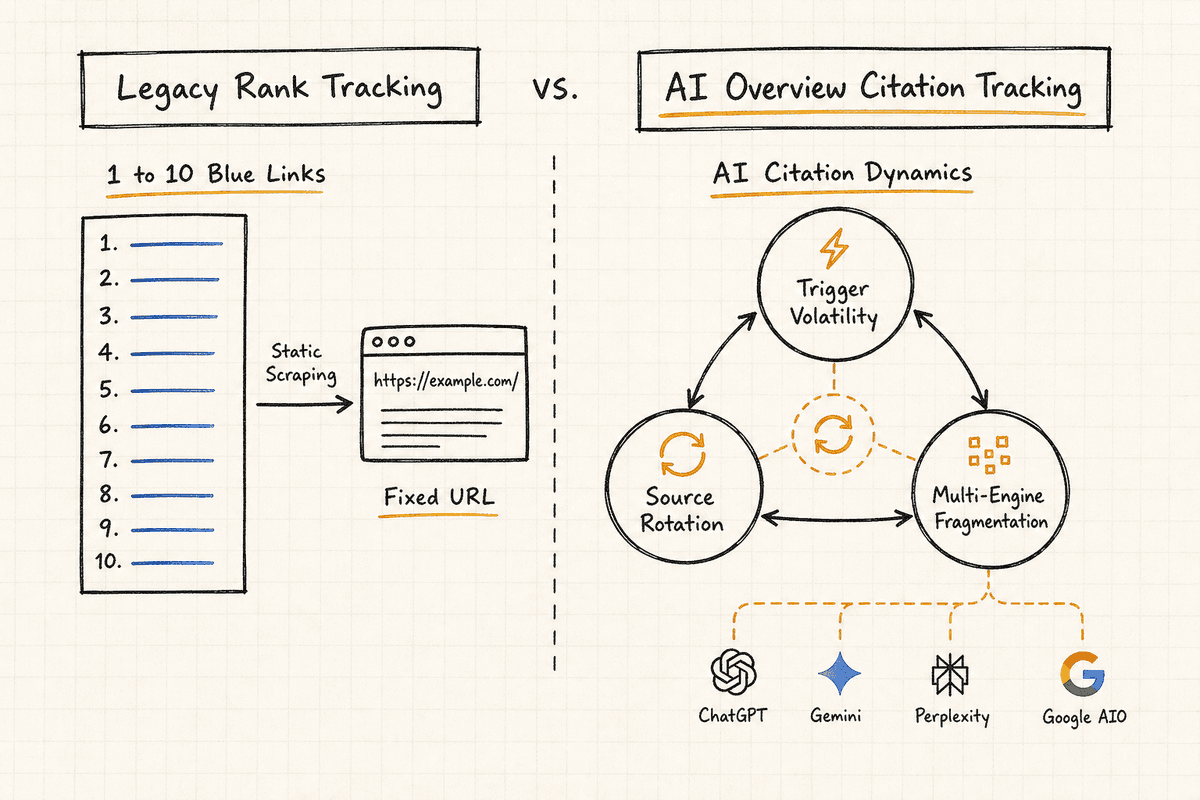
AI Overviews and generative engines break this model in three fundamental ways:
- Trigger Volatility: AI Overviews do not trigger 100% of the time for a given keyword. A query might trigger an AIO on desktop but not mobile, or it might trigger on Tuesday but disappear on Thursday following an algorithmic tweak to reduce server load.
- Citation Rotation: The AI models actively rotate their sources. While the top three traditional organic links might remain static for months, the four links cited inside an AIO carousel can rotate based on real-time relevance, sentiment, and entity relationships.
- Multi-Engine Fragmentation: Google AIO is just one surface. Your buyers are asking the exact same questions in Perplexity, ChatGPT, and Gemini. A tool that only tracks Google misses a massive segment of the buyer journey.
Because of this volatility, you need tools specifically designed to trigger AI features, parse generative text, and map citations back to your domain.
The Otterly.ai Baseline: What It Does and Where It Stops
Otterly.ai gained early traction because it solved the immediate panic of the AI Overview rollout. It allowed users to plug in a list of keywords and see if their brand appeared in the AI-generated responses. It provides a clean interface for checking share of voice within AI summaries.
However, many B2B marketing teams outgrow it quickly. The limitation of baseline tracking tools is that they treat AI visibility purely as an analytics function. They tell you what happened: "Your competitor was cited for 'best CRM for manufacturing' instead of you."
They rarely tell you why it happened, and they do not provide the infrastructure to fix it. If you discover a weak citation, someone on your team still has to manually analyze the competitor's page, figure out what entities they included that you missed, write a brief, assign it to a writer, and publish the update.
To bridge this gap, growth teams are moving toward a mix of execution platforms, enterprise SEO suites, custom APIs, and native webmaster tools.
1. BeVisible: The Execution-Driven AI Visibility Platform
If your goal is not just to stare at citation metrics but to actively capture more AI real estate, BeVisible is designed specifically for this workflow.
BeVisible helps teams monitor how AI assistants answer buyer questions, which brands they recommend, and which sources they cite. Instead of siloing Google AIO, it tracks visibility across ChatGPT, Gemini, Perplexity, AI Mode, and AI Overviews simultaneously across your buyer prompts.
Tracking Across the Entire AI Ecosystem
Your buyers don't just use Google anymore. A developer might ask Perplexity for technical documentation comparisons, while a marketing director asks ChatGPT to summarize software vendors. BeVisible tracks your brand mentions and citations across all these surfaces, giving you a unified "Share of AI Voice" metric.
Turning Gaps into Published Work
The true differentiator is what happens after the tracking phase. When BeVisible detects that a competitor is winning a citation for a high-value buyer prompt, it doesn't just send you an alert. It turns those visibility gaps into evidence-backed opportunities.
The platform facilitates:
- Article Creation: Automatically generating briefs based on the semantic gaps between your un-cited page and the competitor's cited page.
- Review and Scheduling: Moving those updates through an editorial pipeline.
- Publishing Work: Ensuring that the newly optimized content goes live to recapture the AI citation.
For SaaS founders and content teams who need to close the loop between data and revenue, BeVisible acts as both the monitor and the execution engine.
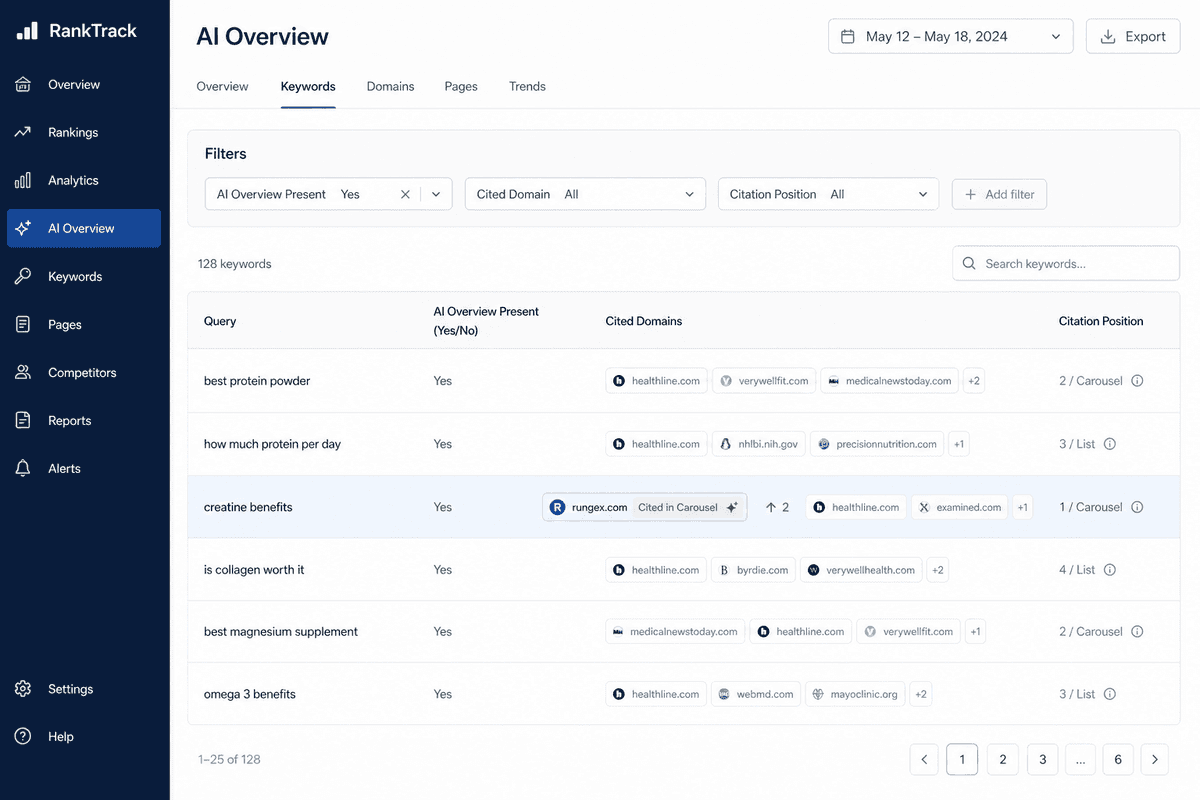
2. Ahrefs: Enterprise-Grade AI Overview Tracking
If you are already heavily invested in traditional SEO infrastructure, Ahrefs has integrated AI citation tracking directly into its core suite. As they detailed in their guide on how to track AI Overviews, they have adapted their crawling infrastructure to detect AI features.
Using Site Explorer for AIO Performance
In Ahrefs Site Explorer, you can now filter your organic keywords report to show only queries where an AI Overview is present. More importantly, you can check the "AI Overview" box to see exactly which of your pages are appearing inside those generative summaries.
This allows you to track performance trends over time using historical data. If a page suddenly loses 20% of its organic traffic, you can check the Ahrefs historical graph to see if that drop correlates with losing a citation in the AI Overview.
Brand Radar for Market Share
For larger teams, the Ahrefs Brand Radar tool provides detailed reporting on citations at a broader level. It tracks:
- Global ownership of specific prompts.
- Competitor citation velocity (who is gaining ground).
- Search volumes attached to the AI-triggered queries.
While Ahrefs is incredibly powerful for macro-level SEO reporting, it is still primarily an analytics tool. You will need to pair it with an execution workflow to act on the data it uncovers.
3. Custom Tracking via SE Ranking API and Python
For technical SEOs and data science teams who want absolute control over their tracking architecture, bypassing out-of-the-box SaaS tools entirely is a viable option.
As demonstrated in industry tutorials on analyzing how to track AI search citations, you can use the SE Ranking API paired with a custom Python script to build a highly bespoke tracking environment.
How the API Workflow Operates
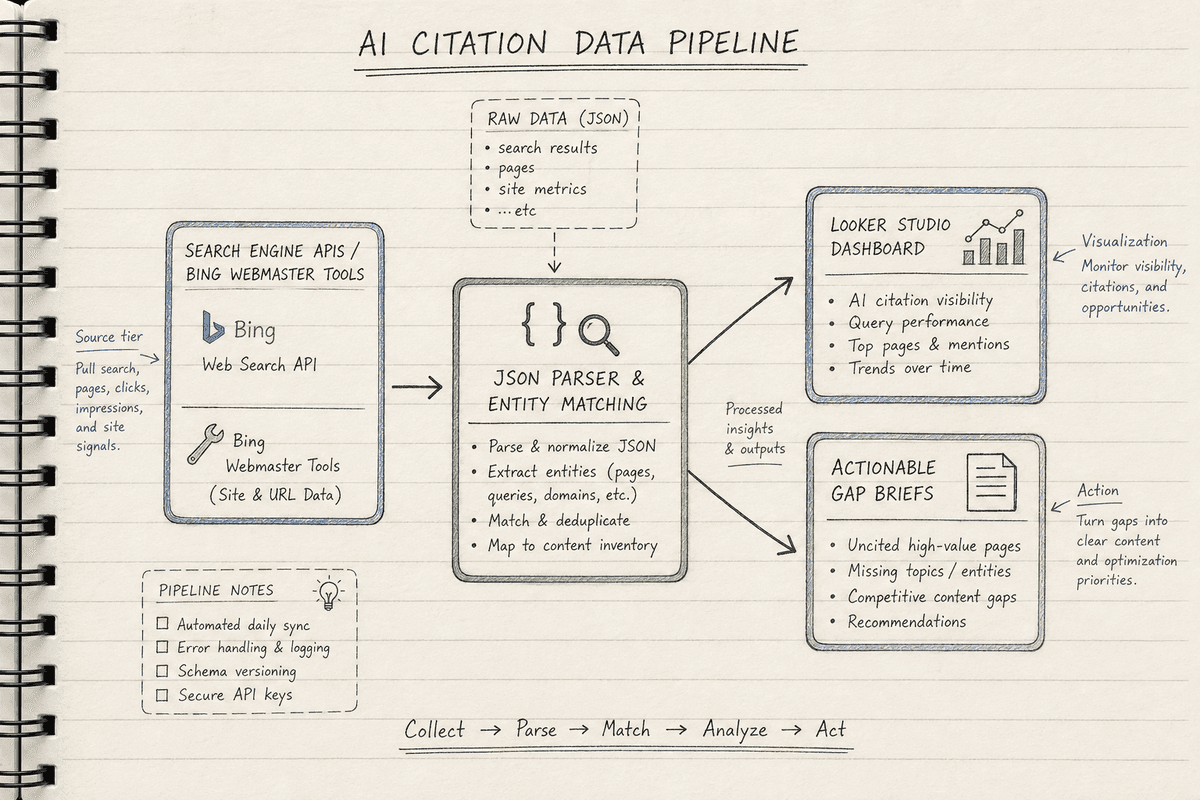
SE Ranking provides an API endpoint that returns raw SERP data, including the presence of AI features. By setting up a script in Google Colab or a local Python environment, you can:
- Pass a list of thousands of keywords via the API on a daily or weekly schedule.
- Parse the JSON response to detect if
ai_overviewor similar generative features are present. - Extract the specific URLs cited within that generative block.
- Match those URLs against your own domain and a list of known competitors.
- Export the structured data into BigQuery or a Google Sheet for data visualization in Looker Studio.
Pros and Cons of the API Approach
The primary advantage here is flexibility. You own the data, you define the tracking frequency, and you can blend this API data with your own CRM metrics to see if AI citations correlate with pipeline generation.
The downside is maintenance. Search engines frequently change the DOM structure and the API payloads related to AI features. If SE Ranking updates their schema, or if Google alters how AIO is flagged, your Python scripts will break and require developer hours to fix.
Side note on technical rendering: If you are using custom scripts to audit why your own pages aren't being cited, ensure you aren't fighting a rendering issue. AI bots need to parse your content easily. If you run a JavaScript-heavy site, brush up on Single-Page Application SEO: What Works in 2026? to ensure your content is actually accessible to the models.
4. Bing Webmaster Tools: The Hidden Free Tracker
Everyone obsesses over Google, but Microsoft Bing has quietly offered one of the most robust, free tools for tracking AI citations natively. Bing integrated generative AI directly into its core search experience early on, and they updated their webmaster tools to reflect this.
There is a free report buried inside Bing Webmaster Tools that shows you exactly which of your pages AI is citing, as noted by researchers tracking how to track AI citations for free.
Accessing the Copilot/AI Report
Within the Bing Webmaster Tools dashboard, navigate to the Performance tab. Bing breaks out standard web search traffic from chat/generative traffic. You can filter the report to show:
- Queries where your domain was cited by Bing's AI.
- Click-through rates (CTR) specifically from AI citations versus traditional organic links.
- Impressions generated solely from the AI chat interface.
While this data only reflects Bing's ecosystem, it serves as an excellent proxy. The fundamental principles of Retrieval-Augmented Generation (RAG) are similar across Google and Bing. If Bing's AI considers your page authoritative enough to cite for a specific topic, it is highly likely you have the right semantic structure to compete for Google's AIO as well.
5. Chrome Extensions for Real-Time AI SERP Scraping
Sometimes you don't need a massive enterprise dashboard; you just need to reverse-engineer a specific SERP right now. Specialized browser extensions have emerged to analyze AI Overview citations in real-time right from your browser.
Tools designed to analyze Google AI overview & AI Mode citations allow you to run a query, wait for the AI to generate its response, and then click a button to scrape the underlying data.
Features of AI Scraping Extensions
- Search Engine Results (SER) Summary Extraction: The extension grabs the exact text generated by the AI, which is useful for analyzing the NLP sentiment of the answer.
- Citation Table Generation: It immediately builds a table of all outbound links cited in the AIO, exposing domains that might be hidden behind a "show more" carousel.
- Domain Presence Reports: It calculates which domains are cited most frequently across the visible generative text.
- Quick Exports: The data can be dumped instantly into Excel or Google Sheets for a quick content gap analysis.
Extensions are phenomenal for content writers actively working on a brief. If a writer is tasked with updating an article, they can use the extension to see exactly which sources the AI prefers today, analyze what those sources have in common, and incorporate those entities into their draft.
Community Frameworks: The Manual Approach
Even with sophisticated tools, many growth marketers are building manual frameworks to deeply understand the quality of their citations. Tracking tools will tell you if you are linked, but they struggle to tell you the context of that link.
As discussed in popular SEO communities regarding frameworks for tracking AI Overview citations, some practitioners prefer a manual spreadsheet approach for their highest-value keywords.
Building a Citation Tracking Matrix
For your top 20 "money" keywords—the queries that drive actual revenue—a manual framework might look like this:
This framework forces you to look at the content formats the AI prefers. Are they citing deep technical documentation, high-level listicles, or user forums? If the AI consistently cites forums for a specific query, no amount of traditional SEO blogging will win that citation.
If you are a local business or an agency, manual tracking is especially important because AI Overviews can be highly localized. For example, if you are looking at Top 7 Agencies for SEO in Durham (Ranked 2026), an AI Overview might pull heavily from local directory reviews rather than standard web content.
How to Build Your AI Overview Visibility Strategy
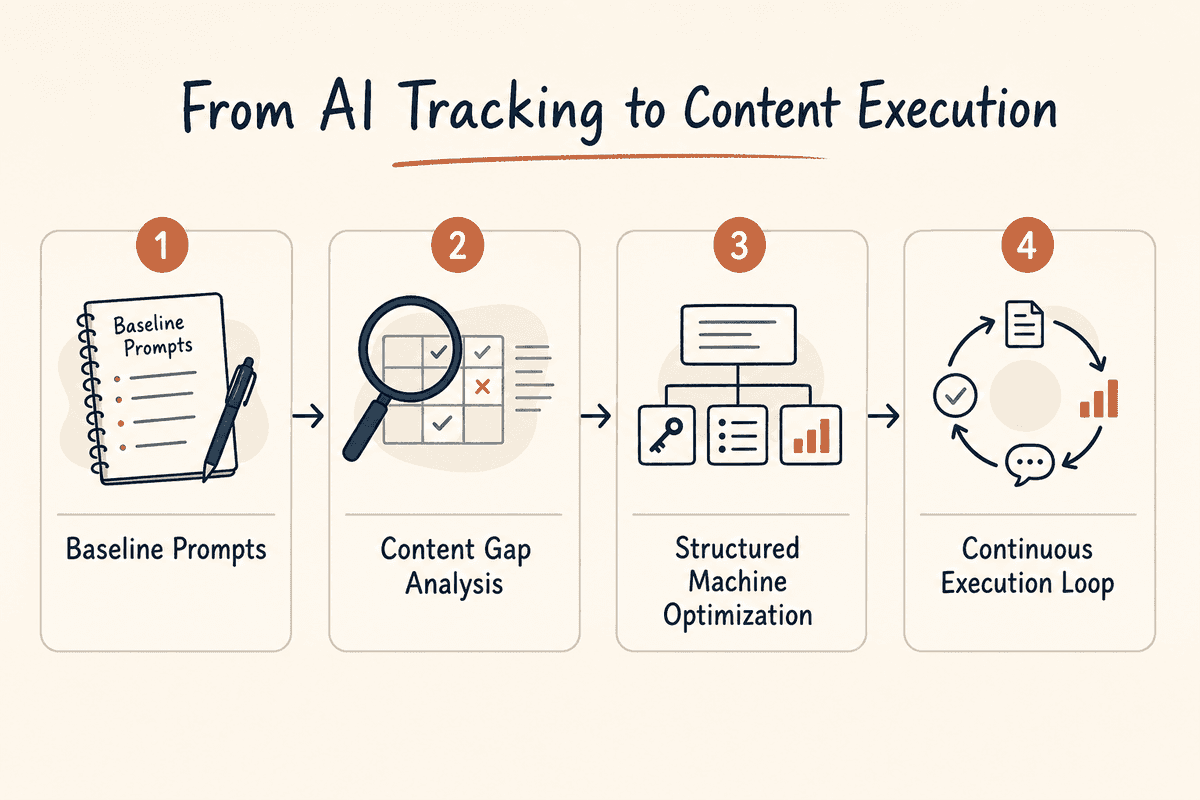
Having the right tools is only 10% of the battle. The other 90% is the operational workflow you build around them. Here is a step-by-step strategy for moving from basic tracking to active execution.
Step 1: Establish Your Baseline Prompts
Do not try to track every keyword your domain ranks for. AI models handle head terms and long-tail conversational prompts very differently.
Focus on:
- Brand Queries: "Is [Your Brand] safe to use?" or "Alternatives to [Your Brand]." You must dominate the citations for your own brand.
- Commercial Intent Questions: "What is the best tool for [specific pain point]?"
- Comparison Prompts: "[Your Brand] vs [Competitor Brand]."
Step 2: Analyze the Content Gaps
When you use a tool like BeVisible or Ahrefs and find that a competitor is cited instead of you, analyze the AI's response carefully.
- Did the AI quote a specific statistic that only the competitor provided?
- Did the competitor use a specific content structure (like a standard markdown table or bulleted list) that made their data easier to parse?
- Are there entities (related concepts) present in the competitor's page that your page ignored?
Step 3: Optimize for the Machine
To win back a citation, you often need to restructure your page. If you are updating a landing page to capture AI visibility, the architecture matters. Reviewing resources like How to Build an SEO Landing Page (7-Step Guide) can help you structure headers and data points in a way that Retrieval-Augmented Generation (RAG) models prefer.
AI models love direct, unambiguous answers. If a prompt asks "What is the price of X?", do not bury the price beneath 500 words of introductory fluff. Provide a clear, structured pricing table immediately, followed by the context.
Step 4: Continuous Execution
AI Overviews are not "set and forget." Because the models update dynamically, a citation you win in March might be lost in April. This is why platforms that integrate the execution workflow are vital. When a citation drops, your system should automatically flag the page for review, generate a brief of what changed in the SERP, and assign it to your content team.
If you rely on external help for this ongoing maintenance, ensure you vet them carefully. The skills required for AI optimization differ from legacy link-building. If you are exploring external help, knowing what to avoid is crucial—resources like Hiring SEO Services in Phoenix? 5 Red Flags (2026) highlight why outdated SEO tactics will actively harm your AI visibility.
Frequently Asked Questions About Tracking AI Citations
How accurate are AI Overview tracking tools?
Accuracy depends on the methodology. Tools using direct APIs or advanced headless browser networks (like BeVisible and Ahrefs) are highly accurate for the exact moment the scrape occurred. However, because AI Overviews are highly personalized and location-dependent, the citation your tool sees in a server farm might differ slightly from what a user sees on their phone in another city. Treat the data as directional share of voice rather than absolute gospel.
Do AI citations impact traditional click-through rates?
Yes, dramatically. When an AI Overview triggers and answers the user's question satisfactorily, the click-through rate for the traditional blue links below it plummets. However, the links inside the AI citation carousel often see highly qualified, high-intent traffic.
Does standard SEO still matter for AI Overviews?
Absolutely. AI models generally pull their sources from the top-ranking traditional results. You cannot rank on page 5 of Google and expect to be cited in the AI Overview at the top of page 1. Foundational SEO—site speed, technical rendering, and backlink authority—serves as the prerequisite for being considered by the AI model.
If you are running complex architectures, brushing up on the SEO for Single Page Applications: The Technical Checklist is a good idea to ensure technical blockers aren't keeping you out of AI answers. If you're comparing costs on whether to handle this in-house or externally, looking at SEO Charges UK: Agency Rates vs Automation (2026) provides context on how automation tools compare to agency retainers for this technical maintenance.
How often should I monitor AI citations?
For high-revenue commercial terms, weekly monitoring is standard. For informational blog posts, monthly checks are usually sufficient. The key is tying the monitoring frequency to your team's capacity to actually execute updates.
Moving From Observation to Execution
Tracking AI Overview citations is no longer a novelty; it is a fundamental requirement for modern digital marketing. While baseline tools like Otterly.ai introduced the industry to the concept of AI visibility, staying competitive requires a more robust approach.
Whether you rely on the enterprise data of Ahrefs, the custom flexibility of the SE Ranking API, the free native data from Bing, or specialized browser extensions, the goal remains the same. You must uncover where the AI is leaving you out.
But data without action is just overhead. The teams that will dominate search in 2026 and beyond are those using platforms like BeVisible—not just to monitor ChatGPT, Gemini, and AI Overviews, but to instantly turn visibility gaps into published, revenue-generating content. Stop merely watching the AI landscape change, and start building the workflows required to command it.