
Ranking on page one of Google classic search no longer guarantees that prospective buyers see your company when they search. When Google introduced AI Mode alongside standard organic results and AI Overviews, the mechanics of search visibility underwent a structural split.
A 40,000-keyword study highlighted in discussions on modern search retrieval revealed that organic position number one URLs share as little as a 12% overlap with the URLs cited inside Google AI Mode answers. A page can hold the top traditional organic ranking for a high-value commercial query while being entirely absent from the synthesized answer, product comparison cards, and citation pills that Google generates for that exact same query.
+-----------------------------------------------------------------------------+
|                                                                             |
|   Legacy SEO Assumption:                                                    |
|   [ Rank #1 on Organic SERP ] ======> [ Guaranteed Maximum Traffic ]        |
|                                                                             |
|   Actual 2026 AI Search Reality:                                            |
|   [ Rank #1 on Organic SERP ]                                               |
|               |                                                             |
|               +-- Only 12% URL Overlap --+                                  |
|                                          v                                  |
|   [ Google AI Mode Synthesis ] =====> [ 88% Sourced from Alternative Pages] |
|                                                                             |

+-----------------------------------------------------------------------------+
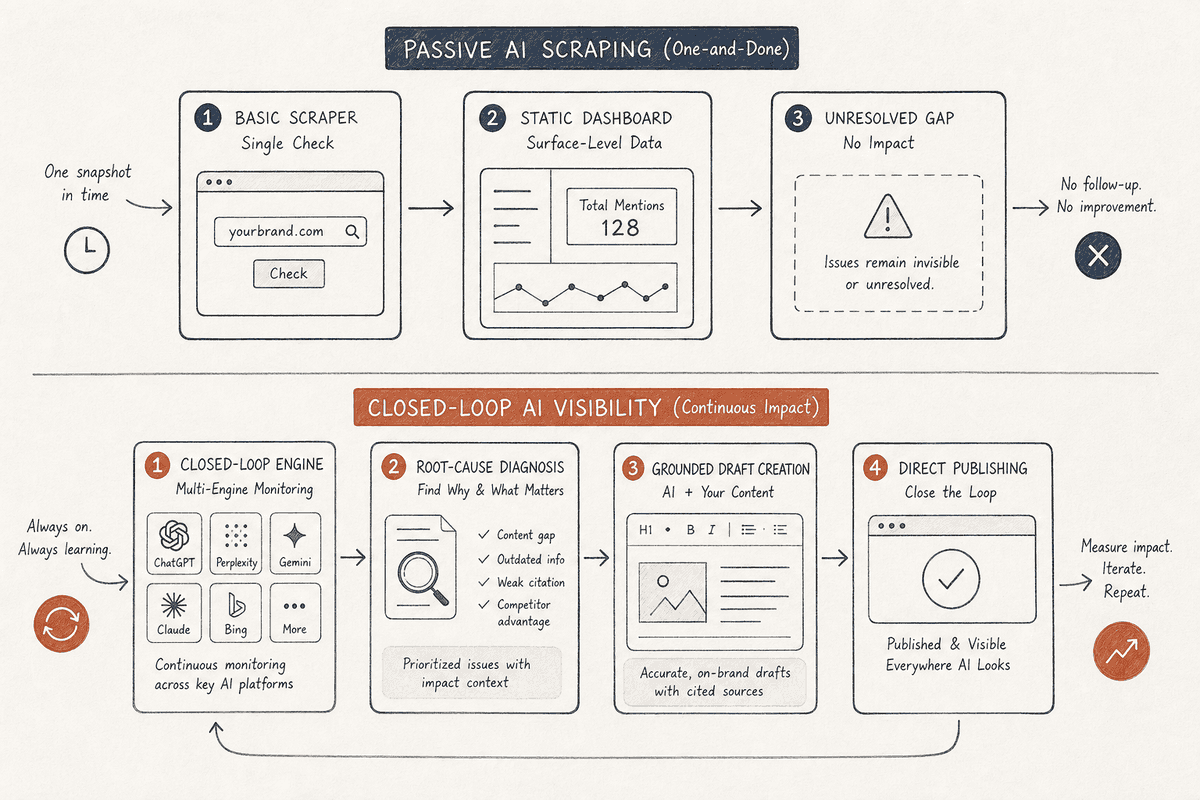
Many marketing teams initially turned to first-generation AI monitoring tools like Otterly.ai to check whether their domain was appearing in generative responses. While basic scrapers provide a simple snapshot of whether your URL was captured during a single scrape, they suffer from two fundamental problems. First, they treat generative engines as deterministic rank trackers, ignoring the high statistical variance inherent to large language models. Second, they stop at reporting bad news. Pointing out that your brand is missing from forty key buyer prompts does not solve the revenue loss unless you can immediately convert those missing citations into authoritative, publish-ready assets that AI retrieval systems favor.
Understanding how to track Google AI Mode visibility requires looking past legacy rank checkers and passive dashboards. You need an operational methodology built around probabilistic retrieval, multi-engine tracking, and an execution loop that systematically bridges citation gaps.
Why Google AI Mode Breaks Traditional Rank Tracking
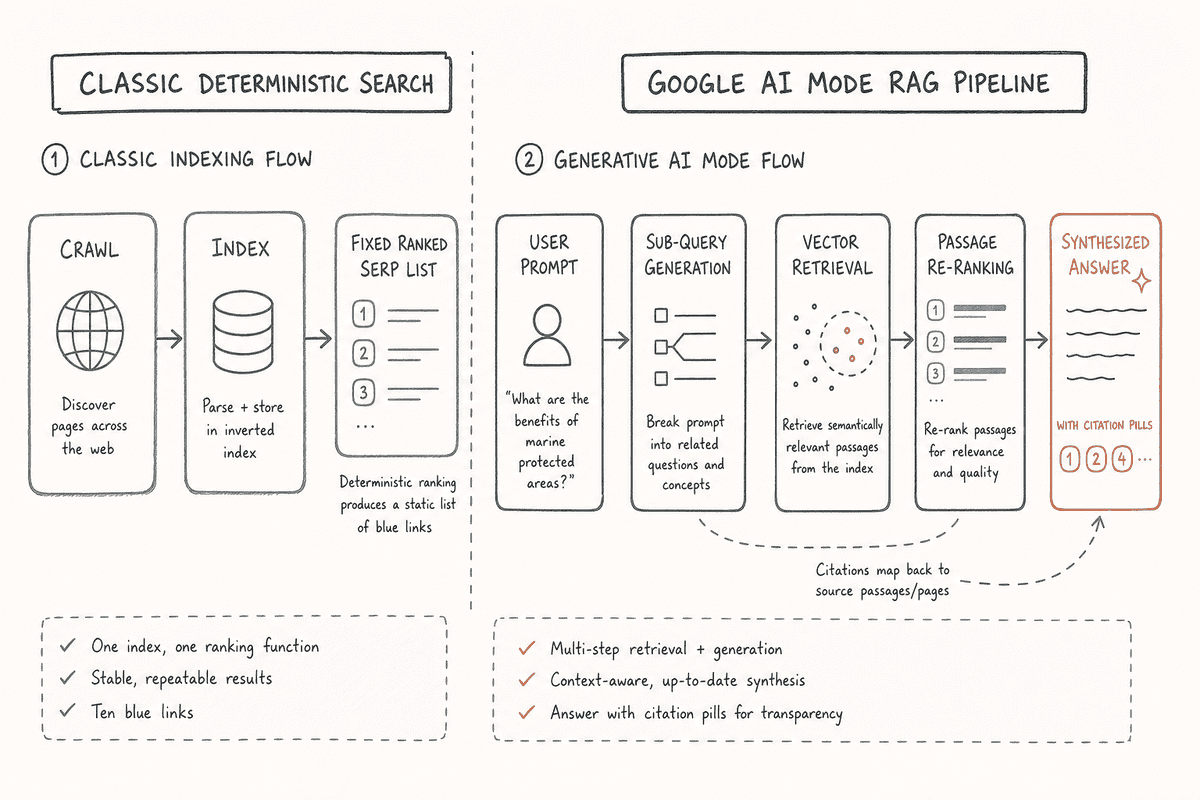
Classic rank tracking operates on a deterministic index. Google crawls a page, parses its content, evaluates backlinks and relevance signals, and places it into an ordered list. Position 3 on Monday is almost certainly Position 3 on Tuesday, barring an algorithm update or competitor overhaul.
Google AI Mode operates on a completely different pipeline. It combines real-time semantic retrieval with Retrieval-Augmented Generation (RAG) and multi-step model synthesis. When a user submits a conversational prompt, Google AI Mode performs several sub-queries across multiple retrieval vectors, selects reference documents based on factual density and semantic alignment, passes those passages into a generative model, and synthesizes a direct answer with citations.
This architectural shift introduces three tracking challenges that traditional SEO tools were never built to handle:
1. Probabilistic Response Volatility
Large language models are non-deterministic. If you run the prompt "What is the best workflow automation tool for logistics teams?" ten times across a single afternoon, the underlying retrieval engine may pull slightly different source passages. The research paper on measuring visibility in AI search systems on arXiv emphasizes that measuring AI search visibility with single-run checks produces high error rates. A single snapshot can mark your brand as "visible" when your actual appearance rate across one hundred customer queries is under 15%.
2. Disconnect Between Classic Index Position and Citation Selection
Google AI Mode does not simply summarize the top three organic results. It frequently cites niche technical documentation, community threads, independent comparison tables, and modular long-form guides that rank on page two or three of classic organic search. If an article provides structured, high-density answers that directly resolve the prompt's logical sub-questions, AI Mode selects it over generic high-authority landing pages.
3. Modality of Visibility: Mentions vs. Links vs. Recommendations
In traditional search, visibility is binary: you either rank at a given position with an active link or you do not. In Google AI Mode, visibility falls across three distinct tiers:
- Explicit Recommendation: The model recommends your brand by name in the synthesized response text.
- Citation Source: Your URL is included as a source pill or footnote, even if your brand name is not mentioned in the prose.
- Unlinked Brand Mention: Your product is evaluated or listed in a comparison matrix, but the cited source links to a third-party review site or competitor.
If your tracking tool only checks whether your domain URL is present in the HTML of the response, it misses cases where your brand is recommended via a third-party directory, as well as scenarios where your URL is cited as a factual source while your competitor is highlighted as the recommended vendor.
The 5 Core Metrics for Tracking Google AI Mode Visibility
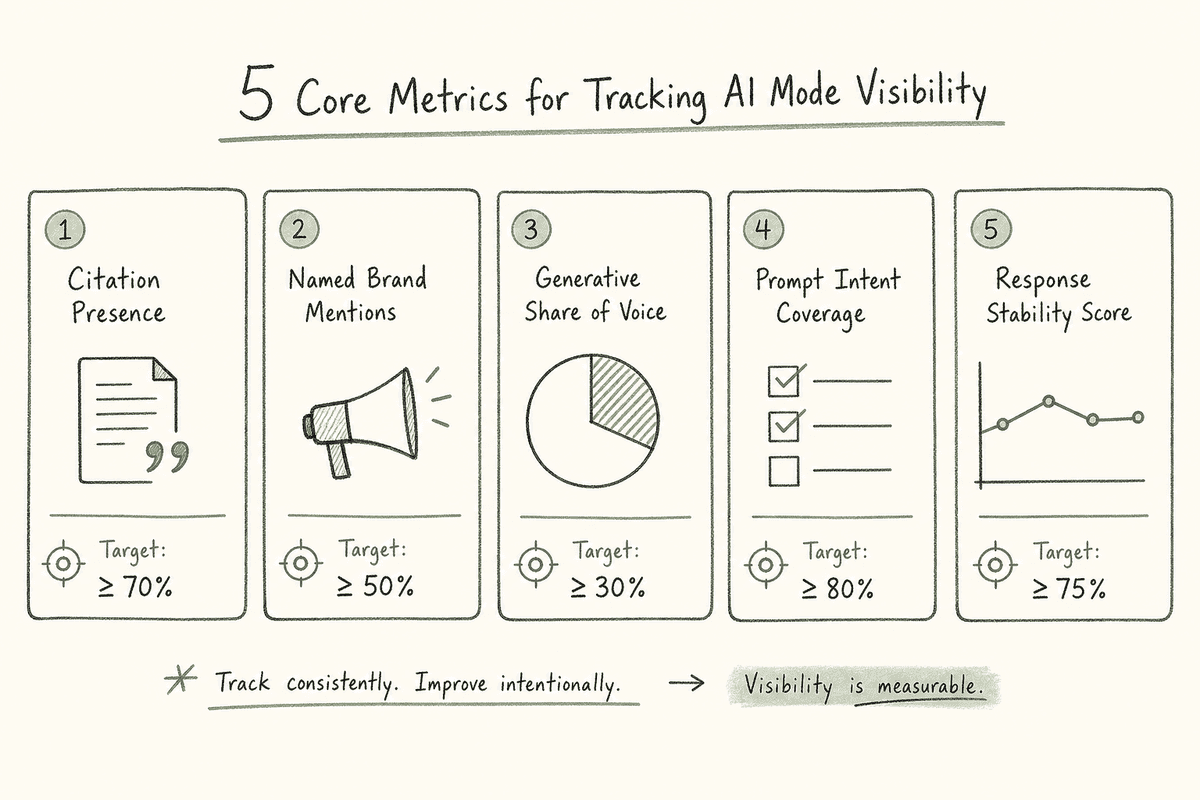
To build an accurate picture of your presence in Google AI Mode, you must replace single-position rank tracking with five composite metrics.
1. Citation Presence
Citation presence tracks whether any URL from your verified domain appears as an interactive citation pill, a footnote reference, or an inline source tag. In AI Mode, citations are the primary mechanism for driving referral traffic. Tracking citation presence across prompt variants tells you which specific pieces of your content the RAG system trusts as authoritative reference material.
2. Named Brand Mentions
A citation without a brand mention means you are acting as an unpaid source of factual data for someone else's recommendation. Tracking named brand mentions evaluates whether the generated prose actively highlights your product name, features, or positioning. You need to know if the model describes you accurately, lists you as an alternative, or excludes you while naming competitors.
3. Generative Share of Voice
Generative Share of Voice measures the ratio of your brand's presence against your primary competitors across an entire prompt cluster. If a buyer asks, "What are the top enterprise visibility tools for AI search?" and the response lists four competitors while omitting your platform, your Share of Voice for that prompt is 0%, even if you have strong general search rankings elsewhere.
4. Prompt Intent Coverage
Searchers use Google AI Mode differently than classic keyword search. They do not search for "project management software features". They input full scenarios: "We are a 50-person agency migrating from Asana to an open-source alternative with native time tracking. What should we evaluate?" Intent coverage measures how effectively your brand appears across conversational long-tail queries, problem-aware prompts, and direct replacement queries.
5. Response Stability Score
Because AI responses fluctuate, a single positive scrape is statistically meaningless. As outlined in the Crawloria review of AI Mode tracking tools, professional tracking requires evaluating prompt sets across multiple sessions, geolocations, and time intervals to compute a stability percentage. A stability score above 75% indicates that your content is deeply grounded in the model's retrieval layer rather than appearing as a transient variation.
Free & Manual Methods for Tracking Google AI Mode
Before investing in dedicated monitoring software, marketing teams can establish an initial baseline using free tools and structured manual workflows.
Method A: Extracting AI Mode Signals in Google Search Console
Google Search Console aggregates performance across search surfaces. While it does not yet provide a permanent isolated checkbox for every AI Mode interaction, you can isolate high-probability AI Mode traffic by segmenting your query and performance data using methods documented by Ekamoira's Search Console tracking guide.
+-------------------------------------------------------------------------------+
|                      GSC Performance Query Filter Setup                       |
|                                                                               |
|   Query Regex Filter:                                                         |
|   ^(who|what|where|when|why|how|which|compare|best|vs|alternative|is it worth)  |
|                                                                               |
|   Traffic Pattern Indicators of AI Mode Interactions:                         |
|   [ High Impressions ] + [ Sub-1% CTR ] + [ Average Position 1.0 - 2.0 ]      |

+-------------------------------------------------------------------------------+
- Apply Regex Question Filters: Open your Search Console Performance report, set a filter for Queries matching the regular expression:
^(who|what|where|when|why|how|which|compare|best|vs|alternative|is it worth) - Filter for Long-Tail Conversational Strings: AI Mode disproportionately handles queries containing eight or more words. Filter queries by character length or download query data into a spreadsheet to isolate natural language prompts.
- Analyze CTR Anomalies: Pages that serve as primary AI Mode sources often display elevated impressions paired with lower-than-average click-through rates (CTR), while maintaining an average recorded position between 1.0 and 2.5. This pattern occurs because the user reads the summarized answer directly inside AI Mode, while a subset of engaged users clicks the citation pill for deeper technical validation.
Method B: The Multi-Run Spreadsheet Audit Framework
For small teams monitoring fewer than twenty core commercial prompts, a manual spreadsheet tracking system offers a practical starting point. Detailed frameworks shared within the Reddit AI SEO community recommend the following structured protocol:
- Establish a Clean Testing Environment: Use a clean browser profile with all extensions disabled, location set to your primary target market, and personal Google accounts logged out to prevent personalized retrieval bias.
- Execute Triplicate Testing: Run every prompt three consecutive times across different hours of the day. Record whether AI Mode triggers automatically or requires expanding the generative module.
- Log Granular Response Data: In your tracking sheet, capture:
- Target Prompt and Intent Classification
- Brand Mention Status (Yes / No / Negative Context)
- Cited URLs (Own Domain vs. Competitor Domains vs. Third-Party Portals)
- Synthesized Summary Sentiment (Favorable, Neutral, Critical)
- Top Competitors Named in the Primary Text
+-----------------------------------------------------------------------------+
|                     Manual AI Mode Tracking Sheet Schema                    |
+------------+--------------------+---------------+-------------+-------------+
| Date/Time  | Target Prompt      | Brand Mention | Own URL?    | Competitors |
+------------+--------------------+---------------+-------------+-------------+
| 08/27 09:00| best geo tool saas | Yes (Pos #2)  | Yes (Blog)  | RivalA, RivB|
| 08/27 14:00| best geo tool saas | No            | No          | RivalA, RivC|
| 08/27 19:00| best geo tool saas | Yes (Pos #1)  | Yes (Docs)  | RivalA      |

+------------+--------------------+---------------+-------------+-------------+
The Limitations of Manual Tracking
While manual logging is helpful for establishing initial benchmarks, it fails to scale for growing companies:
- Sample Size Constraints: Manual testing cannot realistically execute ten runs per prompt across hundreds of buyer queries every week.
- Geographic Blind Spots: AI Mode answers shift based on IP origin, regional data centers, and localization parameters.
- No Automated Counter-Action: A spreadsheet records where you are losing visibility, but does not provide an engine to diagnose why the model preferred a competitor or generate the content needed to win back the citation.
Best Tools to Track Google AI Mode Visibility Beyond Otterly.ai
As search shifted toward generative engines, early tracking tools focused exclusively on simple web scraping. However, modern visibility strategies require tracking across multiple generative platforms, calculating probabilistic stability, and closing visibility gaps with high-quality content.
Here is an analysis of the top platforms for tracking Google AI Mode visibility in 2026.
1. BeVisible (https://bevisible.app)
BeVisible is built specifically for teams that need to track AI assistant visibility and immediately turn visibility gaps into published, revenue-driving content. Rather than operating as a passive rank monitor, BeVisible monitors how AI assistants answer buyer questions, which brands they recommend, and which sources they cite across Google AI Mode, Google AI Overviews, ChatGPT, Gemini, and Perplexity.
+-----------------------------------------------------------------------------+
|                       The BeVisible Closed-Loop Engine                      |
|                                                                             |
|   1. MONITOR        Multi-engine tracking across AI Mode, ChatGPT,          |
|                     Gemini, Perplexity, and AI Overviews.                   |
|                            |                                                |
|                            v                                                |
|   2. DIAGNOSE       Identify missing brand mentions, weak citations,        |
|                     and competitor positioning advantages.                  |
|                            |                                                |
|                            v                                                |
|   3. EXECUTE        Transform gaps into evidence-backed article briefs,     |
|                     drafts, review workflows, and live publishing.          |

+-----------------------------------------------------------------------------+
Core Capabilities:
- Cross-Model Generative Coverage: Tracks buyer prompts across Google AI Mode, Google AI Overviews, ChatGPT Search, Perplexity Pro, and Gemini, providing a unified view of your generative footprint.
- Evidence-Backed Gap Analysis: Identifies the precise queries where competitors are winning citations and reveals the contextual reasons why the AI selected their content over yours.
- Integrated Production Workflow: Converts identified visibility gaps into evidence-backed opportunities, structured articles, team review workflows, scheduling, and direct publishing.
- Statistical Multi-Run Sampling: Evaluates prompt sets across recurrent runs to filter out model hallucinations and calculate dependable stability metrics.
Best For:
SaaS founders, B2B marketing teams, growth teams, agencies, and content teams that want to eliminate the disconnect between tracking missing AI visibility and executing the content needed to capture it.
2. Crawloria
Crawloria is an enterprise crawling and search monitoring platform that specializes in tracking generative interfaces at massive scale.
Core Capabilities:
- Deep Crawl Simulation: Replicates varied browser fingerprints, network origins, and query parameters to simulate real-world AI Mode interactions.
- Raw DOM and JSON Snapshotting: Captures every visual element of the AI Mode canvas, including dynamic follow-up prompt suggestions and expandable cards.
- Developer API: Provides robust endpoints for engineering teams looking to pipe raw citation data directly into internal business intelligence pipelines.
Tradeoffs:
Crawloria excels at data ingestion and large-scale technical monitoring, but lacks native editorial workflows. Teams must build their own internal systems to analyze citation gaps and produce counter-content.
3. Ekamoira
Ekamoira focuses on combining Google Search Console data with automated synthetic AI Mode queries to create hybrid performance models.
Core Capabilities:
- Search Console Discrepancy Modeling: Compares expected classic organic traffic against recorded performance to highlight potential AI Mode cannibalization.
- Citation Drift Alerts: Sends notifications when a previously cited domain URL drops out of a core prompt's reference footnotes.
- Competitor Domain Overlap Scores: Evaluates how frequently your competitors' subdomains appear alongside yours in multi-source answers.
Tradeoffs:
Ekamoira is primarily an analytics tool. It delivers detailed retrospective reporting on citation loss, but offers limited support for forward-looking content planning or cross-engine tracking outside Google's ecosystem.
4. Legacy SEO Platforms (Semrush, Ahrefs AI Features)
Traditional SEO platforms have introduced add-on modules to monitor AI Overviews and selected AI Mode results alongside their legacy rank databases.
Core Capabilities:
- Unified Dashboard: Displays traditional keyword ranks, backlink profiles, and AI Overview tags in a single interface.
- Historical Organic Context: Allows teams to cross-reference AI visibility flags with historical domain authority and classic search positions.
Tradeoffs:
Because these tools were architected around deterministic keyword indexes, their AI tracking often relies on single-run snapshots rather than multi-sample probabilistic runs. They frequently miss real-time prompt variations and lack deep monitoring for conversational AI engines like ChatGPT, Claude, and Perplexity.
5. Otterly.ai
Otterly.ai was one of the earliest tools to offer dedicated brand tracking across generative search engines, providing an accessible entry point for monitoring AI brand presence.
Core Capabilities:
- Simple Prompt Setup: Allows marketing teams to quickly input brand names and target queries to check for mentions.
- Visual Screenshot Captures: Stores visual images of search results across selected generative models.
- Brand Sentiment Tagging: Basic labeling of whether brand mentions are positive, neutral, or negative.
Why Teams Look Beyond Otterly.ai:
- No Direct Action Loop: Otterly identifies where your brand is missing, but does not provide the tooling to turn those insights into structured content, review processes, or published articles.
- Limited Deep Prompt Discovery: Teams often need to guess which prompts matter rather than automatically discovering the high-intent conversational paths buyers use.
- Shallow Multi-Engine Workflow: Otterly provides basic snapshots, but lacks the end-to-end execution infrastructure required by modern growth teams managing comprehensive AI SEO strategies.
Detailed Tool Comparison Matrix
Case Scenario: From Lost Citations to Category Leadership
To see why closed-loop tracking matters, consider how a mid-sized B2B SaaS company managing an automated compliance platform approached their AI visibility in 2026.
+-----------------------------------------------------------------------------+
|                          Real-World Scenario Flow                           |
|                                                                             |
|   INITIAL STATE:                                                            |
|   - Held Organic Position #2 for "SOC2 compliance automation"               |
|   - AI Mode Share of Voice: 0% across 45 target buyer prompts               |
|   - Competitors winning all synthesized recommendations and citations       |
|                                                                             |
|   DIAGNOSIS (Via BeVisible):                                                |
|   - Landing page was sales-heavy and lacked structured comparative tables   |
|   - Competitor docs provided modular JSON-LD schemas and clear benchmarks   |
|                                                                             |
|   EXECUTION:                                                                |
|   - Generated 6 deeply technical, modular integration guides                |
|   - Embedded clean benchmark metrics and objective comparison points        |
|                                                                             |
|   RESULT WITHIN 30 DAYS:                                                    |
|   - Captured citations across 68% of commercial buyer prompts               |
|   - 28% increase in qualified inbound demo requests                         |

+-----------------------------------------------------------------------------+
The company held top-three organic rankings for several primary keywords, but noticed a steady decline in demo requests. When they audited their presence across conversational buyer prompts in Google AI Mode, they found that a newer competitor was cited as the recommended solution in almost every instance.
Their sales landing page was visually engaging for human visitors, but lacked the modular data structures and explicit entity definitions that Google's RAG pipeline looks for. By tracking prompt-by-prompt gaps and analyzing the exact source passages Google was pulling from competitor sites, they systematically produced six comprehensive technical guides addressing specific compliance architectures.
Within four weeks of publishing the structured content, their citation presence inside Google AI Mode rose from 0% to 68% across their core prompt cluster, driving a double-digit rebound in qualified inbound pipeline.
For teams looking to stay current on modern search strategies and technical execution, reviewing curated industry resources like our guide to the 11 best SEO blogs for SaaS founders provides valuable ongoing context.
Step-by-Step Guide: Setting Up an Actionable AI Mode Tracking System
Tracking Google AI Mode effectively requires a systematic five-step process that connects data collection directly to content creation.
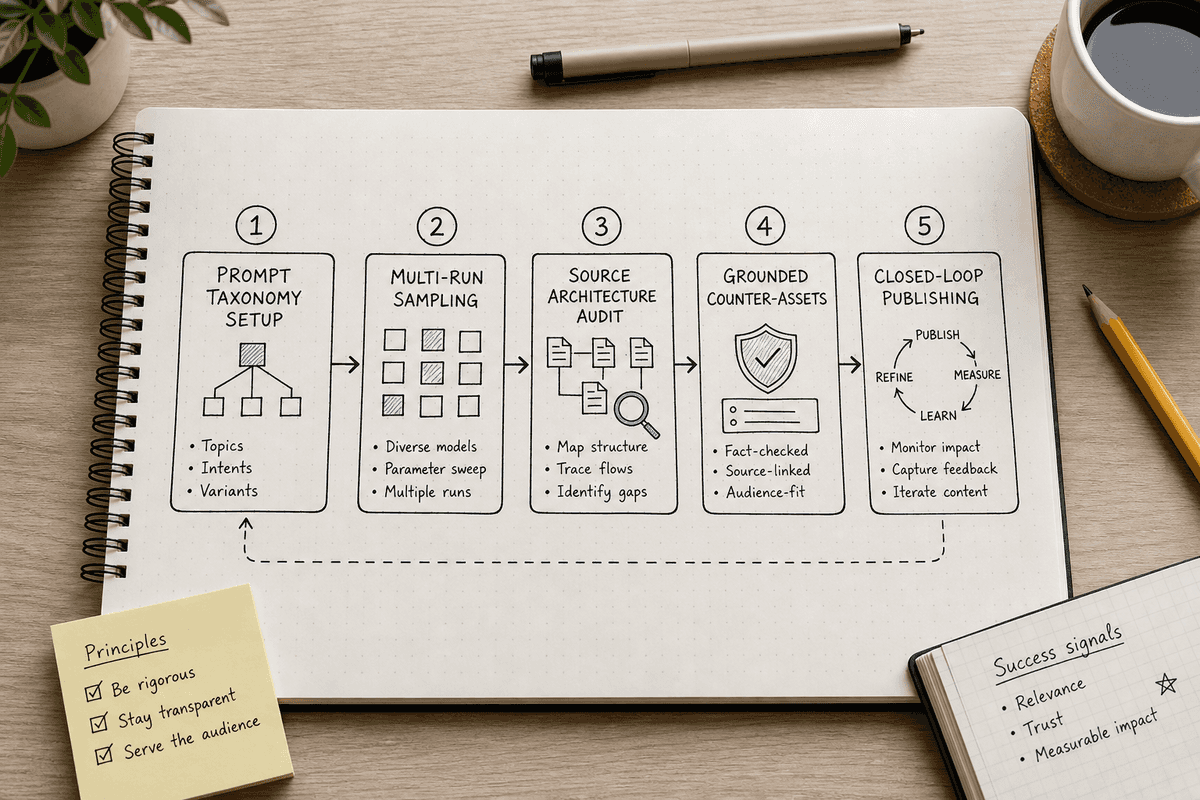
Step 1: Build Your Buyer-Centric Prompt Taxonomy
Do not simply import your existing two-word keyword list. Group your tracking prompts into four clear intent buckets:
- Problem-Exploration Prompts: "Why is our data pipeline latency spiking during batch syncs?"
- Alternative & Comparison Prompts: "Top enterprise alternatives to [Competitor] for healthcare teams"
- Architecture & Implementation Prompts: "How to configure single-tenant compliance monitoring in Kubernetes"
- Direct Recommendation Prompts: "What is the best automated SOC2 software for Series A startups?"
Step 2: Establish Multi-Run Measurement Intervals
Because Google AI Mode's synthesis engine is non-deterministic, configure your tracking system to query each prompt at least five times across a 48-hour testing cycle. Calculate your Baseline Citation Rate by dividing total successful citations by total runs. Any query with a citation rate below 40% represents a critical visibility gap.
Step 3: Analyze the Cited Source Architecture
When your brand is omitted, examine the URLs that Google AI Mode chose to cite instead. Evaluate their structure against four criteria:
- Modular Formatting: Does the competitor use clear H2/H3 question headers followed immediately by direct, concise answers?
- Data Density: Are there explicit benchmark figures, pricing specifics, or step-by-step instructions that the LLM can extract without ambiguity?
- Schema & Entity Grounding: Does the page clearly define its primary subject using structured data and unambiguous entity relationships?
- Content Freshness: How recently was the cited document published or updated?
Step 4: Generate Targeted, Grounded Counter-Assets
Do not respond to a citation gap by simply adding a few paragraphs to an existing generic page. Create dedicated, technically rigorous articles or documentation pages built specifically to answer the exact conversational queries where your brand was missing.
Ensure your content opens with direct answers, utilizes clean comparative markdown tables, avoids hyperbolic marketing jargon, and presents verifiable technical specifications. This makes it easy for RAG retrieval systems to parse and cite your content.
Step 5: Close the Production Loop
A monitoring platform that stops at data leaves your team with an ever-growing list of unresolved gaps. Use an integrated workflow platform like BeVisible to assign missing citations directly into an editorial pipeline. Review the AI-generated drafts for technical accuracy, brand voice, and proprietary data, then schedule and publish them to your domain.
4 Common Myths About Google AI Mode Visibility
Myth 1: High Classic Domain Authority Guarantees AI Mode Citations
Many enterprise brands assume that having a Domain Rating above 80 ensures automatic inclusion in AI Mode responses. In practice, Google's RAG pipeline prioritizes source relevance, content structure, and factual density over raw backlink volume. Independent niche sites and technical documentation frequently out-cite industry giants in AI Mode when their content provides clearer answers to specific user prompts.
Myth 2: Google AI Mode and Gemini Web Chat Use the Exact Same Index
While both systems utilize Google's advanced language models, their retrieval architectures are configured differently. Google AI Mode is deeply integrated into Google's core search index and live crawling systems, using custom retrieval heuristics tailored for search queries. Gemini web chat operates as an conversational assistant that accesses search retrieval selectively. Tracking your visibility in Gemini does not provide an accurate assessment of your position inside Google AI Mode.
Myth 3: Adding FAQ Schema Automatically Wins AI Citations
Structured schema markup helps search engines parse page entities, but schema alone does not guarantee a citation. AI Mode analyzes full-text semantic passages to ensure that extracted information directly answers the user's prompt. Schema markup supports indexing, but comprehensive, well-structured prose is what earns citations.
Myth 4: You Only Need to Track Your Visibility Once a Month
Generative search systems update their retrieval selections continuously. Algorithm tweaks, competitor content updates, and shifting model weights can alter citation sources from week to week. Monthly monitoring leaves your team blind to mid-month visibility drops that directly impact incoming lead volume.
Frequently Asked Questions (FAQ)
How does Google AI Mode differ from Google AI Overviews?
Google AI Overviews are concise generative summaries that appear above traditional search results for standard queries on the main Google search page. Google AI Mode is a dedicated, interactive conversational search experience designed for multi-turn dialogue, deep exploratory queries, and comparative research. AI Mode uses multi-step reasoning, dynamic follow-up prompts, and extensive citation networks that differ significantly from standard AI Overviews.
Why do AI Mode answers change between two searches of the exact same prompt?
Google AI Mode uses large language models that generate responses probabilistically rather than pulling static pre-rendered answers from a fixed database. Depending on server load, query routing, model temperature, and real-time retrieval scoring, the model may select slightly different reference passages on separate runs. This is why reliable tracking tools use multi-run sampling rather than single-run snapshots.
Can you track Google AI Mode visibility for local or international markets?
Yes, but your tracking infrastructure must support geo-targeted querying. AI Mode tailors its synthesized answers and cited sources based on the user's physical location, language preferences, and regional availability. Accurate international tracking requires querying through location-specific proxies that mirror your target buyers' regions.
What is the fastest way to get cited in Google AI Mode?
The most reliable way to earn citations is to identify specific high-intent conversational prompts where current answers cite outdated or thin sources, then publish comprehensive, structured content that directly answers every dimension of the query. Structure your pages with descriptive headings, explicit factual statements, comparative tables, and clear entity definitions that RAG retrieval systems can easily extract and verify.
The Path Forward: Turning AI Search Into a Repeatable Growth Channel
Tracking your visibility in Google AI Mode is no longer an experimental project for technical SEOs. As prospective buyers increasingly rely on generative search engines to evaluate software, services, and products, your presence inside synthesized AI answers directly determines your market share.
Relying on passive rank trackers that only monitor legacy organic results leaves your business vulnerable to competitors who are actively optimizing for generative retrieval. At the same time, using entry-level scrapers that merely catalog missing mentions without offering a path to resolution wastes valuable marketing resources.
To build a durable advantage in AI search, your team needs a continuous workflow: monitor buyer prompts across all major generative engines, isolate the specific gaps where your brand is absent, and immediately produce authoritative, evidence-backed content that captures those citations.
Explore how BeVisible can help you track your brand across Google AI Mode, ChatGPT, Gemini, and Perplexity, and turn your visibility gaps into published content that drives measurable growth.