
Building organic traffic used to mean staring at Ahrefs for hours, hiring expensive freelancers, and waiting six months to see a single lead. That timeline doesn't work for a bootstrapped SaaS, an indie hacker, or a lean e-commerce store. If your competitors are shipping optimized content daily, attempting to compete with a manual, twice-a-month publishing schedule is a losing battle.
The current era of search is defined by speed of execution. We have moved past using basic chat prompts to draft clunky paragraphs. Today, AI for SEO is about deploying autonomous agents and automated pipelines that handle the end-to-end process—from SERP research to daily CMS publishing.
This guide breaks down exactly how to use AI to build a 30-day content map, automate your publishing pipeline, and rank 30 pages in 30 days without expanding your headcount.
What you’ll learn :
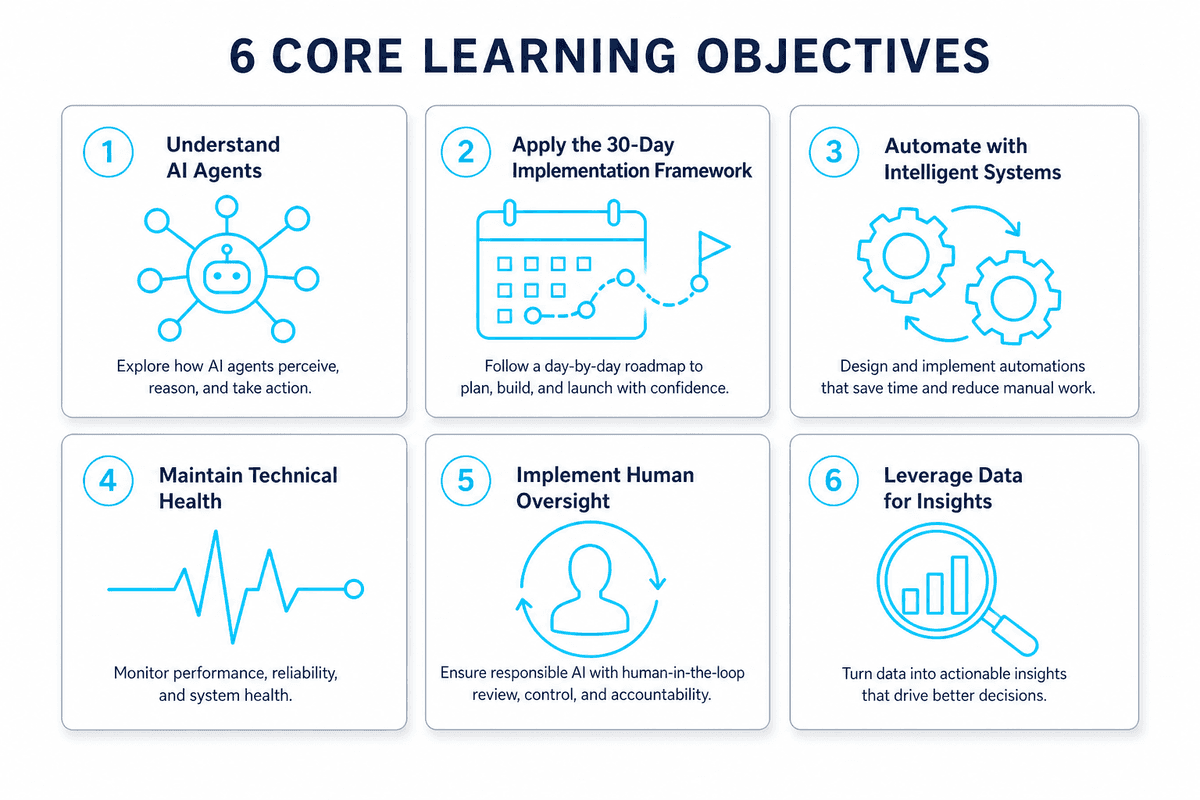
- The shift to Autonomous Agents: How AI is bridging the gap between sales, customer service, and SEO.
- The 30-Day Execution Framework: A step-by-step roadmap for using AI to map, write, and publish daily.
- Automating the Heavy Lifting: How platforms like BeVisible turn URLs into daily published answers.
- Technical Health & Accessibility: Using AI to monitor site errors at machine speed.
- The Human-in-the-Loop Checklist: Exactly where you need to intervene to prevent AI hallucinations and maintain quality.
- Uncovering Hidden Opportunities: How AI data analysis spots ranking gaps humans miss.
The Agent Era: Bridging SEO, Marketing, and Sales
If you look at how enterprise leaders discuss AI, the focus isn't on "writing blog posts faster." It is about breaking down silos between departments. Marketing teams sharing data? AI made it happen.
Historically, SEO lived in a vacuum. A content marketer would guess what users were searching for, write a post, and hope it eventually drove a signup. Today, platforms are introducing intelligent agents—like Salesforce's Agentforce—that connect customer data, sales pipelines, and marketing efforts into one unified strategy. As noted in Salesforce's guide on AI for SEO, integrating AI across these disciplines ensures that your search strategy targets actual buying intent, not just empty search volume.
When you use AI for SEO, you aren't just generating text; you are training an agent on your specific SaaS niche, feeding it your customer pain points, and letting it build targeted answers that guide visitors straight to your solutions.
The Three Tiers of AI SEO Execution
The 30-Day AI SEO Framework (Step-by-Step)
Ranking 30 pages in a single month requires a shift from ad-hoc writing to systematic production. Here is how to structure your 30-day sprint.
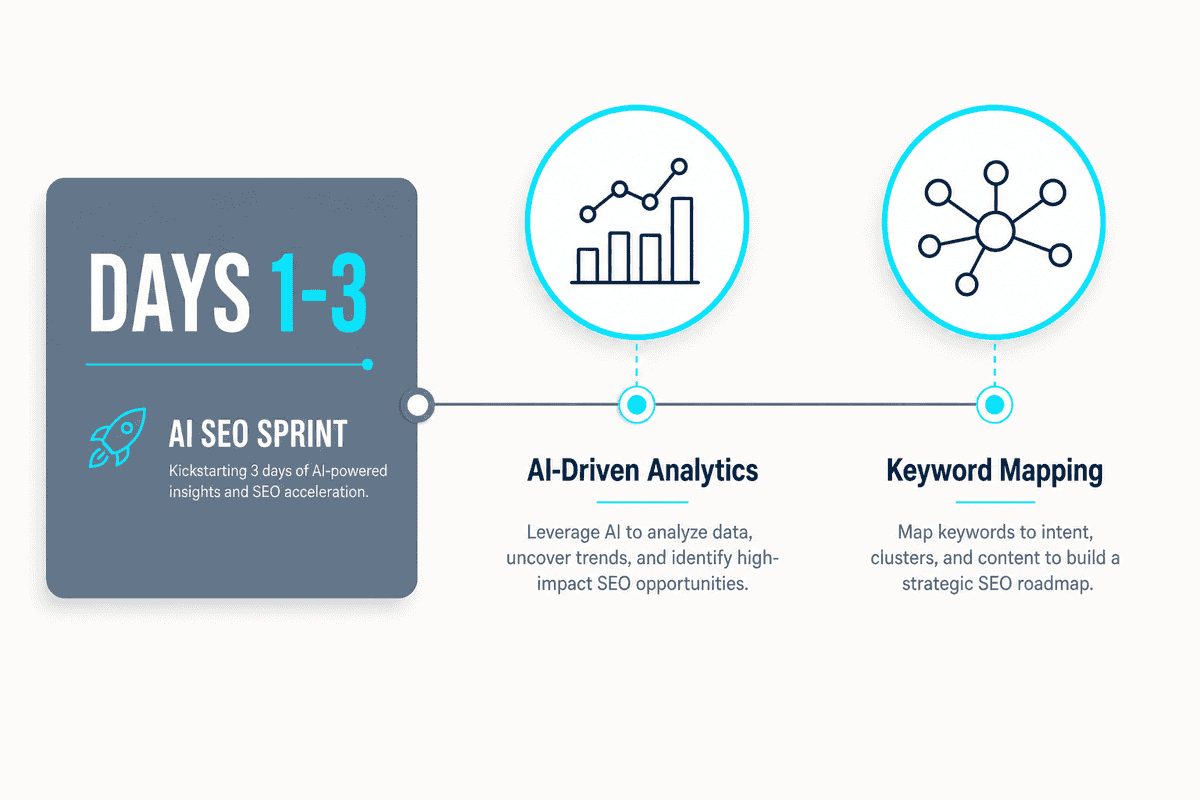
Days 1-3: AI-Driven Analytics & Keyword Mapping
You cannot rank 30 pages if your target keywords are disorganized or cannibalize each other. Use AI to aggregate massive datasets and group keywords by search intent.
Instead of manually clustering thousands of terms, feed your raw keyword exports into an AI data analysis tool. Instruct the AI to group keywords based on the customer lifecycle (Awareness, Consideration, Decision). A recent Digital Marketing discussion on Reddit showed that practitioners are moving away from manual keyword grouping and relying entirely on AI clustering to build out their monthly maps.
Action Items:
- Export your competitor's top ranking keywords.
- Run the data through an AI analytics parser to remove branded terms and irrelevant queries.
- Finalize a list of 30 target primary keywords, assigning one to each day of the month.
Days 4-7: Automating Content Workflows & Brief Creation
Once your map is built, your AI needs context. Generic AI content fails because it lacks a distinct point of view. You need to bridge the gap between your brand's unique value proposition and the search intent.
Create a "Master Prompt Document" or context file that includes:
- Your exact target audience (e.g., "SaaS founders doing $1M-$5M ARR").
- Your product's differentiation.
- Your brand tone (e.g., "Direct, practitioner-led, no corporate jargon").
Jasper details various use cases for setting up brand voices, ensuring that whether you are creating a technical glossary or a comparison guide, the output sounds like your company.
Days 8-28: Daily Content Generation & Publishing (The BeVisible Advantage)
This is where manual processes fall apart. Writing, formatting, adding schema markup, finding cover images, and hitting "Publish" every 24 hours requires a full-time content manager—unless you automate the pipeline.
For SaaS founders and indie hackers looking to bypass this bottleneck, BeVisible is engineered specifically for this phase. As an automated SEO content generation and publishing platform, it handles the entire daily pipeline:
- Automated Connection: You connect BeVisible to your site URL (integrating seamlessly with WordPress, Webflow, Notion, Ghost, or Shopify via API).
- Daily Cadence: The platform automatically writes, polishes, and publishes an article every 24 hours based on your target niche and competitor analysis.
- AI-Specific Optimization: Articles are generated with answer-first structures, quotable sections, and embedded schema markup—optimized not just for Google, but for extraction by AI search engines like Perplexity.
- Ready-to-Rank Assets: Every post includes internal links, proper metadata, categories, tags, and branded cover images.
By leveraging BeVisible's Professional plan (launching with a discount at $199 for 30 articles/month), you eliminate the friction of CMS management. You get a 3-day free trial to see the automation in action, complete with unlimited revisions and Google Search Console analytics to track your new rankings.
Days 29-30: Integrating AI into Site Management & Technical Audits
Publishing 30 pages creates a larger site architecture. You need to ensure technical health scales with your content volume. Enterprise platforms highlight how AI-powered SEO tools catch these errors at machine speed.
Run an AI-assisted audit to verify that your new pages have correct internal linking structures, that meta tags are properly indexed, and that site accessibility standards are met. Platforms like Siteimprove have set the benchmark for using AI to continuously monitor technical decay, ensuring your newly published assets don't fall flat due to server errors or broken links.
The "Human-in-the-Loop" Checklist
While automation handles 95% of the heavy lifting, the final 5% requires human judgment to maintain quality and avoid algorithmic penalties. UC Davis's communications guidelines emphasize maintaining content quality through careful review.
Before letting your automated pipeline run entirely hands-off, institute a weekly "Human-in-the-Loop" review:
- Fact-Checking: Does the content cite accurate statistics, or did it hallucinate a metric?
- Brand Alignment: Does the article recommend a competitor's integration by mistake?
- Nuance & Edge Cases: Does the post acknowledge industry-specific edge cases that a generalized LLM might oversimplify?
- Internal Link Relevance: Are the automated internal links pointing to high-converting pages?
- Customer-Centric Framing: Does the tone sound like it genuinely aims to help the customer, or does it sound like a wiki entry?
AI is your production engine, but you remain the editor-in-chief.
3 ways AI-powered SEO tools spot ranking opportunities humans miss
Transitioning to AI doesn't just increase your publishing velocity; it fundamentally changes how you view search data. Whatagraph notes the importance of consolidating analytics to spot trends faster. Here is how AI outperforms manual analysis.
1. Uncovers hidden search patterns instantly
Human researchers look at search volume and keyword difficulty. AI looks at semantic relationships. AI agents can analyze thousands of forum threads, Reddit posts, and support tickets to identify "unspoken" questions that your competitors haven't answered. This allows you to target zero-volume keywords that actually drive high-intent sales conversions.
2. Catches technical issues at machine speed
Your SEO team needs AI or they'll drown in data. Monitoring a growing site for broken links, missing schema, and slow-loading assets is tedious. AI monitoring tools crawl your site daily, prioritizing technical fixes based on their potential revenue impact rather than just listing arbitrary errors.
3. Generates insights from massive datasets
When Google updates its core algorithm, SERP volatility spikes. AI analytics can instantly process the changes across thousands of URLs, comparing your lost rankings against competitors who gained ground. It synthesizes this data to tell you exactly why a page dropped (e.g., "Competitors added comparison tables and faster video loads") so you can adjust your content map immediately.
AI SEO FAQs
What is AI for SEO?
AI for SEO is the use of machine learning models, large language models (LLMs), and autonomous agents to automate search engine optimization tasks. This includes processing large datasets for keyword research, automatically generating and structuring content, and continuously monitoring technical site health.
Can AI replace human SEO specialists?
AI replaces the manual execution of SEO (drafting text, formatting CMS posts, grouping keywords), but it does not replace the strategic oversight required to align search traffic with a company's sales pipeline. Human specialists are needed to define the brand voice, review for hallucinations, and dictate the overarching business strategy.
How does AI help with on-page optimization?
AI agents can instantly scan top-ranking competitor pages to identify missing entities, optimal header structures, and intent gaps. Automated platforms then use this data to generate optimized metadata, embed correct schema markup, and natively structure the content with H2s, H3s, and bulleted lists before publishing.
Next Steps for Your Content Engine
Waiting on manual content production is an opportunity cost you cannot afford. If you want to build a compounding organic growth engine this month, stop treating AI as a glorified typewriter and start using it as an automated pipeline.
First, finalize your list of 30 target keywords based on your customer's immediate pain points. Next, connect an automated publishing platform like BeVisible to your CMS to handle the daily drafting, formatting, and optimization. Finally, commit to a 30-day publishing sprint, using your human-in-the-loop checklist to ensure the output remains highly accurate and uniquely tailored to your brand.
The tools to scale organic traffic without a massive team are available now. Execute the pipeline, feed the data back into your strategy, and watch the rankings compound.