
You’ve spent hours researching, writing, and polishing a comprehensive guide for your SaaS product. It’s objectively better than what your competitors have published. Yet, three months later, it’s stuck on page two of Google, and AI search engines like ChatGPT and Perplexity aren't mentioning your brand at all.
This is a common failure mode for SaaS founders and content marketers. You assume the problem is a lack of content, so you publish more. But in reality, the issue is structural. Search has shifted from basic keyword matching to Generative Engine Optimization (GEO) and entity extraction, rendering traditional SEO checklists obsolete.
If you want to reclaim lost traffic and dominate both traditional SERPs and LLM-driven search agents, you need a modern website content analysis tool. Relying on basic word-count checkers won't cut it.
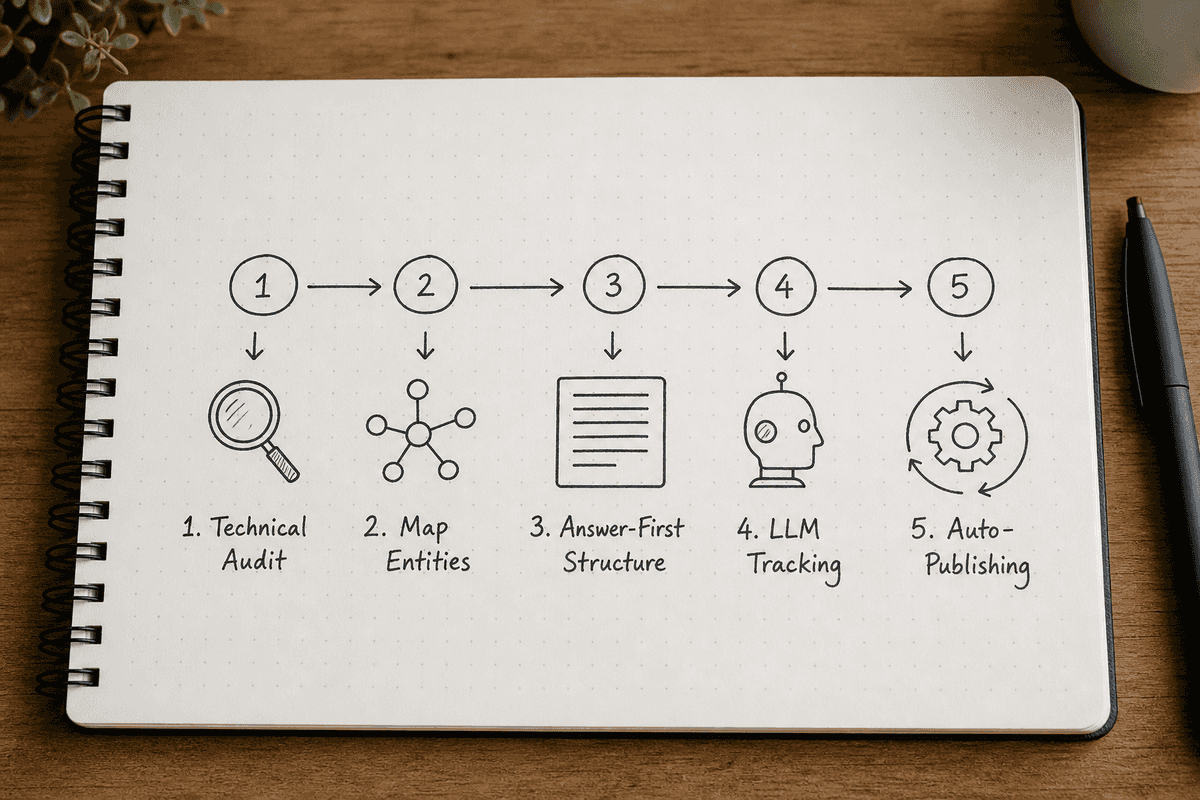
Here is a comprehensive breakdown of what makes a reliable content analysis workflow, and the five exact steps to systematically improve your SEO visibility using these tools.
Search is Shifting to AI. And You're Invisible.
When great content fails, it's rarely because the writing is poor. It fails because AI search engines and traditional crawlers cannot easily extract the precise answers they need to satisfy a user's prompt.
In the past, a website content analysis tool simply measured keyword density, checked for H1 tags, and ensured your meta description was the right length. Today, search engines use Large Language Models (LLMs) to synthesize information across multiple sources.
If your competitors are cited by AI and you aren't, it usually points to three invisible bottlenecks:
- Poor Answer-First Structuring: Your core definitions are buried under 500 words of introductory fluff.
- Missing Entity Relevance: You are using related keywords, but missing the semantic "entities" that LLMs associate with the topic.
- Technical Extraction Blockers: Your site's architecture—especially common in JavaScript-heavy SaaS apps—prevents automated crawlers from efficiently parsing the text.
To bridge this gap, your analysis stack needs to evaluate both human readability and machine extractability.
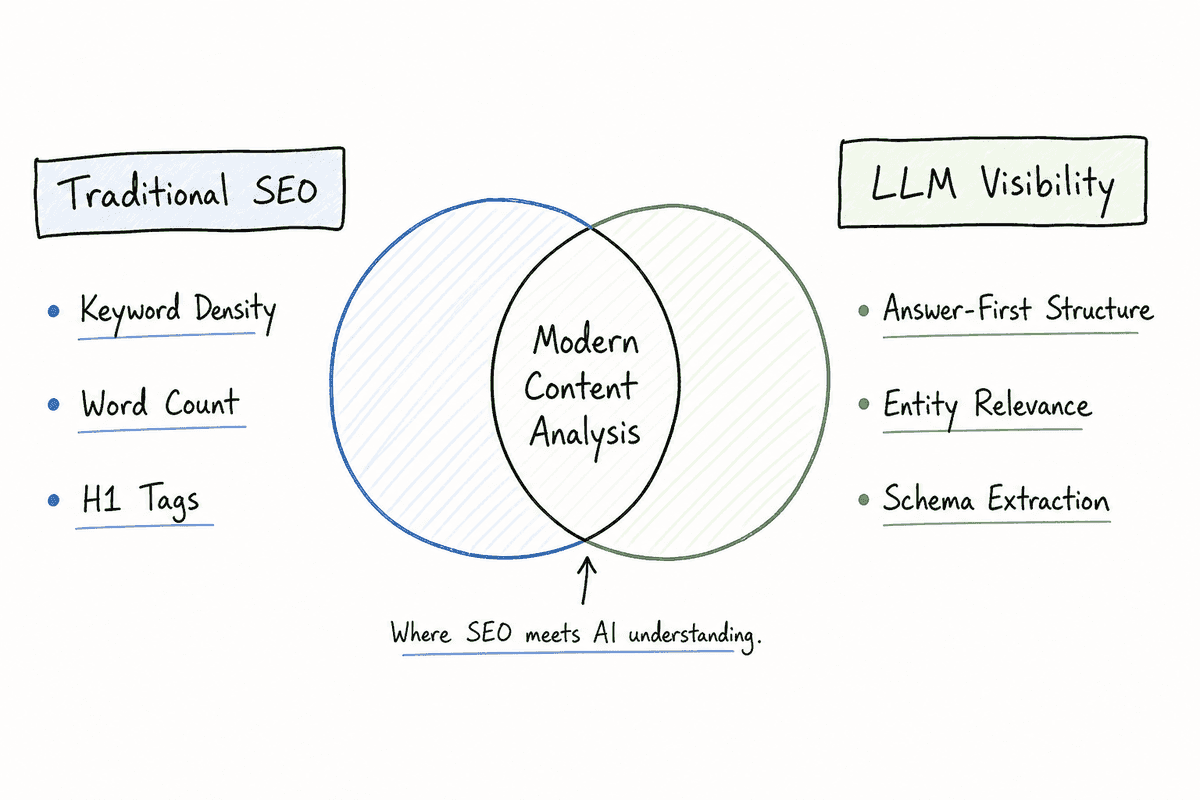
Core Components of a Modern Content Analysis Tool
Before executing the five-step process, it helps to understand what features distinguish a basic checker from an LLM-ready SEO suite. Whether you are using a dedicated dashboard or an automated publishing platform, look for these core capabilities:
- Deep Domain Analysis: The ability to crawl your entire site architecture to identify indexation bloat, broken internal links, and orphan pages.
- LLM Visibility Checker: Tools that track how often your brand or specific pages are recommended by AI search engines for target prompts.
- AI Content Analysis: Real-time feedback on your writing structure, ensuring paragraphs are concise and factual claims are easily extractable.
- Technical SEO Audits: Automated checks for Core Web Vitals, schema markup validation, and JavaScript rendering issues.
With these capabilities in mind, let’s walk through the exact five-step workflow to audit and upgrade your existing content.
5 Steps to Better SEO Using Content Analysis Tools
Fixing a stagnant blog or a poorly ranking landing page requires a systematic approach. Do not start rewriting content until you have completed step one.
Step 1: Run a Technical SEO Audit & Deep Domain Analysis
Content analysis cannot happen in a vacuum. The most insightful, perfectly optimized article will fail to rank if search engines cannot crawl it efficiently.
Start by running your URL through a technical analyzer. Many teams use tools like Seobility to run a free baseline check on their site's technical health.
What to look for during the technical audit:
- JavaScript Rendering Issues: Many SaaS websites are built as Single Page Applications (SPAs) using React or Vue. If your server isn't properly pre-rendering content, Google only sees a blank page and a few lines of code. Running a specific single-page application SEO audit is critical here.
- Crawl Budget Waste: Are you forcing search bots to crawl hundreds of pagination URLs, dynamically generated parameters, or low-value tag pages?
- Schema Markup Validation: Does your page include
Article,FAQPage, orSoftwareApplicationJSON-LD schema? This structured data is how you explicitly hand answers to AI engines.
If you find your frontend framework is blocking crawlers, you will need to implement Server-Side Rendering (SSR) or dynamic rendering before worrying about keyword density.
Step 2: Map Your Keyword Gaps and Entity Relevance
Once the technical foundation is solid, use a content analysis tool to evaluate your semantic relevance. Traditional tools tell you to mention a keyword five times. Modern analysis requires "entity resolution."
Entities are the specific concepts, people, places, and established terms related to your topic. If you write an article about "email marketing automation" but fail to mention entities like "deliverability rates," "DKIM records," or "drip campaigns," Google's natural language processing algorithms will score your content as superficial.
You can check website SEO with analysis tools to pull a list of competitors outranking you. Map their top-ranking pages against yours to find missing entities.
Actionable framework for entity mapping:
- Take the top three ranking URLs for your target keyword.
- Run them through an AI content analysis tool.
- Extract the subheadings (H2s and H3s) to see exactly which subtopics Google expects to see.
- Compare this against your own outline. Add missing subtopics to your article, ensuring you answer them better than the competitors.
Step 3: Optimize for Answer-First Extraction
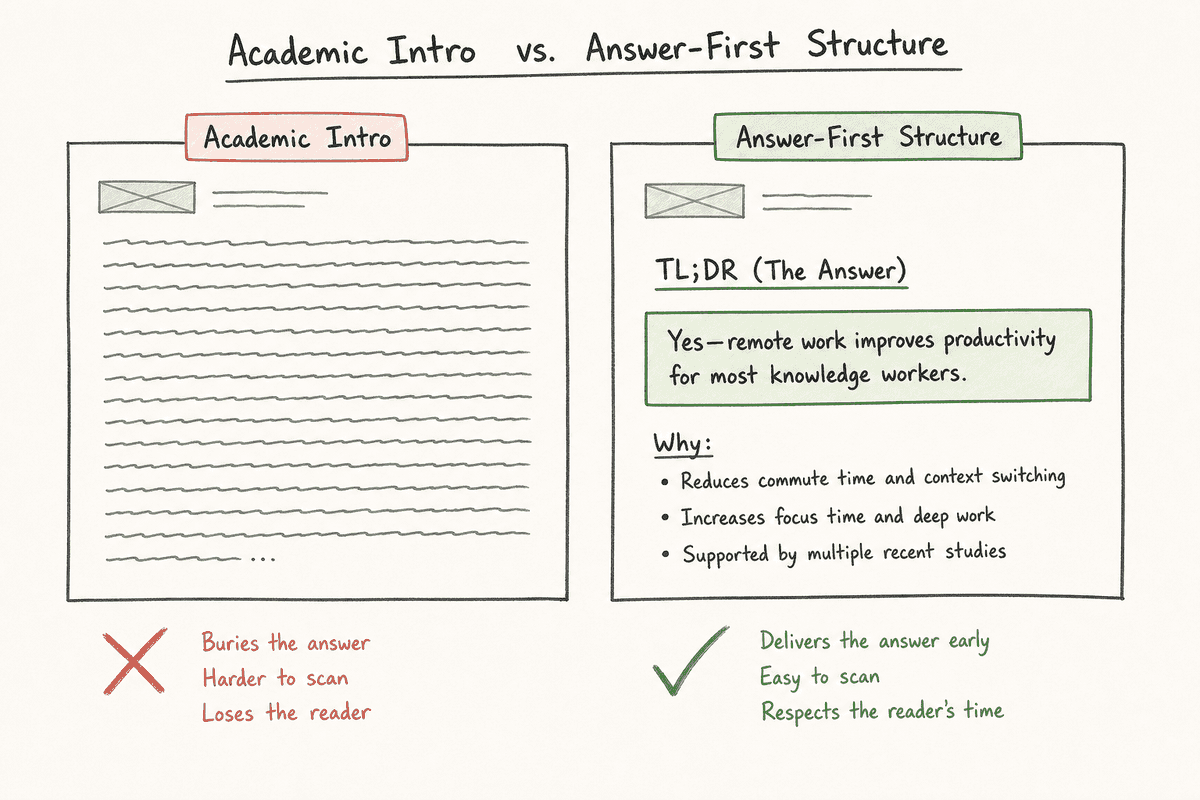
When analyzing your actual on-page text, the most common mistake is the "academic introduction." SaaS founders often write long-winded backstories before getting to the point.
AI search engines and Google Featured Snippets prioritize an "answer-first" structure. This means the immediate text following an H2 should directly and concisely answer the implied question in that heading.
Tools that provide real-time content analysis can help you visualize this structure as you write, flagging paragraphs that are too long or passive.
How to restructure a failing section:
- Before (Poor Extraction): "When we think about building an SEO landing page, we have to consider many different digital marketing strategies that have evolved over the years. First and foremost, you should probably focus on user intent, which is a vital part of the process..."
- After (High Extraction): "Building an effective SEO landing page requires matching user intent with a clear conversion action. The three non-negotiable elements are a targeted H1, fast-loading hero assets, and explicit schema markup."
The revised version is punchy, uses exact terminology, and gives an LLM a highly quotable snippet to serve to a user.
Step 4: Track LLM Visibility and Competitor Citations
Traditional keyword rank tracking is no longer the only metric of success. You might rank #4 on Google, but are you being cited when a user asks ChatGPT, "What is the best content analysis software for a startup?"
LLM visibility tracking helps you understand what prompts are triggering your competitors instead of you.
To improve this, ensure your site prominently features:
- Clear Feature Comparisons: Objective, factual comparisons of your software against competitors.
- Opinionated Data: Original research, user statistics, or unique methodologies that an LLM wants to cite as a source.
- Use-Case Specific Pages: Dedicated pages for "Best X for Y" (e.g., 7 Best Etsy SEO Tools) rather than hoping your homepage ranks for every niche.
If you discover you are losing deals to competitors cited by AI, use your analysis tool to audit the exact wording of those AI answers. Often, you can reverse-engineer the specific entities the AI favors and inject them into your own content.
Step 5: Automate and Scale Your Publishing Pipeline
Analysis is only valuable if it leads to consistent output. You can run manual checks using free tools like SEO Review Tools all day, but manually rewriting and auditing every page is not scalable for a lean team.
Search algorithms reward topic authority, which requires a consistent publishing velocity. If you analyze a gap in your content but take six weeks to publish the supporting articles, your competitors will have already moved on to the next trend.
This is where automation bridges the gap between analysis and execution. Instead of treating content analysis as a retroactive chore, embed it into the creation pipeline. Platforms like BeVisible handle this end-to-end:
- Automated SERP Research: Connecting to your niche to analyze search intent and gaps.
- 30-Day Content Mapping: Building a clustered architecture based on the analysis.
- Daily Publishing: Automatically writing, formatting with answer-first structures, adding schema, and publishing to your CMS (WordPress, Webflow, Notion) every 24 hours.
By automating the pipeline, you ensure that every piece of content inherently passes technical and AI-visibility checks before it ever hits your domain.
When Great Content Fails: Common Blind Spots
Even with the best tools, teams frequently misinterpret the data. If you are running audits and still not seeing traffic growth, look for these three blind spots.
1. The Search Volume Trap
Focusing solely on high-volume keywords is a mistake for most SaaS companies. A keyword might show 10,000 monthly searches in your analysis tool, but if the intent is purely informational (e.g., students looking for definitions), it will generate zero revenue.
Instead, use your tools to analyze low-volume, high-intent queries. The ROI on "how to do X" is vastly lower than "alternative to [Competitor Name]."
2. Disconnected Internal Linking
Analysis tools often grade pages in isolation. However, Google grades your site as a clustered network. If you write a brilliant, fully-optimized pillar page but fail to link to it from your other relevant blog posts, it remains an island.
Ensure your content map includes strict internal linking protocols. Every new article should link up to a core pillar page and laterally to related supporting articles.
3. Outdated Agency Models
Many startups outsource their analysis and creation to traditional agencies. While some are excellent, many rely on outdated metrics (like pure backlink volume) rather than technical AI readiness. If you are comparing SEO charges UK agencies quote against the cost of automated software, factor in the speed of implementation. A tool that publishes an optimized article daily will compound faster than an agency delivering four posts a month.
Evaluating Top Content Analysis Platforms in 2026
Choosing the right tool depends on your team's technical expertise and budget. Here is a brief look at the landscape:
For most SaaS founders building organic traffic without a large team, chaining together an all-in-one suite and a technical auditor is expensive and time-consuming. Moving toward an automated publishing pipeline ensures the analysis actually translates into daily, indexable assets.
Frequently Asked Questions
Do I need technical SEO knowledge to use these tools? Most modern content analysis tools provide clear, color-coded grades (e.g., A to F) and plain-English explanations. However, fixing the issues—like modifying JavaScript rendering or implementing JSON-LD schema—often requires a developer, unless you use a platform that automatically handles technical formatting at the point of publication.
What is included in AI visibility tracking? AI visibility tracking (or GEO tracking) measures how often your brand, product, or specific articles are cited as sources by large language models (like ChatGPT, Claude, or Google's AI Overviews) in response to targeted user prompts.
How do I stay updated on changes to SEO analysis? The shift from traditional search to AI extraction is moving fast. To stay informed on the latest algorithm updates and tool capabilities, follow the best SEO blogs and regularly test your own site's performance against new AI search engine rollouts.
Can I white-label reports for my clients? If you run an agency, tools like SEOptimer and SEO Site Checkup allow you to export beautiful, branded PDF reports. This is highly effective for client acquisition and demonstrating the value of fixing technical debt.
Final Thoughts on Elevating Your Analysis
The goal of a website content analysis tool is not to achieve an arbitrary score of 100/100. The goal is to remove friction. You want to remove the friction for search engines crawling your site, remove the friction for LLMs trying to extract your answers, and remove the friction for users trying to solve their problems.
Stop relying on basic keyword density checks. Audit your technical foundation, align your entities, structure your text for answer-first extraction, and automate your publishing velocity. When you align your content with how machines actually process information in 2026, you stop chasing algorithms and start capturing traffic.