Many SaaS founders spend weeks wordsmithing the perfect homepage headline, chasing clever wordplay or a poetic rhythm. They obsess over the nuance of "empowering" versus "enabling." Then they launch, wait, and watch the analytics dashboard as organic traffic flatlines.
The hard truth is that search engines—and the impatient humans using them—rarely reward cleverness. They reward clarity, velocity, and structure. Website content copywriting is not an academic writing exercise, nor is it purely a branding vehicle. It is a functional utility designed to connect a user's specific problem with your specific solution as quickly as possible, while providing structured data to search algorithms.
Writing for the web requires balancing two completely different audiences simultaneously: a human reader who is violently skimming, and an AI-driven search spider trying to extract entities and map relationships.
Whether you are overhauling your core landing pages or scaling up a daily blog operation, the rules of the game have shifted. Here are nine actionable website content copywriting tips to help your SaaS, e-commerce store, or agency rank faster and capture higher-intent traffic.
What Makes Website Content Copywriting Different?
Before detailing the strategies, it helps to draw a clear line between traditional copywriting and website content writing. As Jansen Communications points out, web writing and traditional copywriting often serve different immediate goals, even if they share the same ultimate objective of driving revenue.
Traditional copywriting is heavily focused on persuasion—think direct mail, sales letters, or print ads. It relies on building a narrative, agitating a pain point, and leading the reader to a singular call to action.
Website content copywriting, particularly for SEO, must be navigational and informational first. Users arrive at a webpage with a specific intent, often looking for a quick answer or a feature comparison. If your page hides that answer behind four paragraphs of storytelling, the user will bounce back to the search results. This bounce signals to Google that your page did not satisfy the user's search intent, dragging your rankings down.
 Furthermore, modern website copy must account for AI search engines like ChatGPT and Perplexity. These platforms do not "read" your narrative; they parse your page for clear, quotable facts, definitions, and relationships between entities.
9 Website Content Copywriting Tips for Faster Ranking
1. Adopt an "Answer-First" Structure
Journalists have used the "inverted pyramid" for over a century. You put the most important, conclusion-level information at the very top of the article, followed by supporting details, and leave the background context for the bottom.
In SEO content copywriting, this translates to the "Answer-First" structure. When a user searches "what is a headless CMS?", your page should not start with "Since the dawn of the internet, content management has evolved..." It should start with: "A headless CMS is a back-end-only content management system that acts primarily as a content repository, making content accessible via an API."
Giving away the answer immediately does not reduce engagement. On the contrary, it builds trust. Once the user knows you have the answer, they will scroll down to read the nuance, implementation steps, and your product pitch.
Implementation Checklist for Answer-First Copy:
- Audit your H1 and first paragraph. Does it directly address the main keyword intent?
- Remove all introductory filler ("In this article, we will discuss...").
- Use bolding to highlight the core definition or answer in the opening paragraph.
- Include an immediate "Key Takeaways" bulleted list for long-form content.
2. Leave the Jargon Behind
A common mistake in B2B SaaS is adopting internal product vocabulary as public-facing copy. You might call your feature a "Synergistic Data Mesh Ecosystem," but your target customer is searching for "automated database backup tool."
Effective website copywriting requires translating your complex technical architecture into plain English. As noted in a comprehensive guide to effective website copywriting, using industry-standard terms is fine if your audience consists solely of engineers. But if you are selling to a marketing director or an indie hacker, dense jargon creates friction.
How to de-jargon your copy:
- Run the "Would I say this in a bar?" test. If you were explaining your software to a stranger at a networking event, you wouldn't say "We provide an omni-channel paradigm shift." You would say, "We put all your customer messages in one inbox."
- Analyze search volume. Tools like Google Search Console will tell you exactly what language your users employ. Mirror their vocabulary back to them.
- Map features to plain outcomes.
3. Use Headings and Formatting Liberally
Users do not read web pages; they scan them. Eye-tracking studies consistently show that readers follow an "F-pattern," scanning across the top, then down the left side, looking for visual anchors that indicate relevant information.
If your website copy is presented as massive blocks of text, readers will abandon it. You need to use formatting to create a visual hierarchy that guides the eye naturally down the page.
 Rules for formatting SEO website copy:
- Frequent H2s and H3s: You should rarely have more than 300 words without a subheading breaking up the text.
- Short Paragraphs: Aim for 1-3 sentences per paragraph. A single-sentence paragraph is perfectly acceptable and often highly effective for emphasis.
- Bulleted Lists: Anytime you list three or more items, convert them into bullets.
- Strategic Bolding: Bold the most critical phrase in a paragraph so a skimmer can extract the main point without reading the surrounding words.
4. Write for Entity Extraction (LLMs and Google)
Ranking faster in 2026 means writing for AI. When tools like ChatGPT or Google's AI Overviews read your site, they are performing entity extraction. They are looking for nouns (people, places, concepts, tools) and the clear relationships between them.
Vague pronoun references damage your SEO. If your H2 is "How to Optimize It," search algorithms struggle to understand what "it" is without deep contextual analysis. If your H2 is "How to Optimize Your React SPA for SEO," the entities (React, SPA, SEO) are explicit.
To write for entity extraction, replace generic nouns with specific ones. Instead of saying "our software integrates with major platforms," say "BeVisible integrates with WordPress, Webflow, Notion, Ghost, and Shopify via API."
If your underlying technical stack relies heavily on client-side rendering, even the best entity-rich copy might be missed by crawlers. To ensure your text is actually being indexed, you need to handle your architecture correctly. For more on this, review our guide on Single-Page Application SEO: What Works in 2026?.
5. Be Clear and Precise in Your Language
Vague copy is the enemy of conversion. "Save time and make more money" is a claim made by millions of websites. It carries zero weight because it lacks precision.
Say what you mean and mean what you say. Replace fluffy adjectives with hard numbers, specific timeframes, and concrete deliverables.
Vague vs. Precise:
- Vague: "Our automated SEO tool saves you hours of work."
- Precise: "Our automated SEO platform builds a 30-day content map and publishes a fully formatted article every 24 hours."
- Vague: "Trusted by many top companies."
- Precise: "Used by 1,400 SaaS founders and indie hackers."
When writing a dedicated sales or feature page, this precision must carry through the entire structure. If you need a framework for assembling these high-converting assets, our How to Build an SEO Landing Page (7-Step Guide) walks through the exact layout required.
6. Don’t Speak Down to Your Audience
Simplifying your copy does not mean treating your readers like children. This is a delicate balance, especially in B2B SaaS copywriting.
You must respect the reader's intelligence while reducing cognitive load. Your audience—whether they are agency owners, startup founders, or e-commerce directors—are smart professionals. They simply don't have the time to parse convoluted sentences.
Avoid patronizing explanations. If you are selling an advanced Etsy analytics tool, you don't need to spend 500 words explaining why selling on Etsy is a good idea. Your user already knows that. They are searching for solutions, not elementary definitions.
Meet the reader at their level of awareness. A beginner looking for "how to start an online store" needs different copy than a veteran searching for "Shopify vs WooCommerce API rate limits."
7. Target the Right People by Deflecting the Wrong Ones
Good copywriting attracts the ideal customer. Great copywriting actively repels the wrong ones.
If you try to write website copy that appeals to everyone from budget-conscious college students to Fortune 500 enterprise teams, you will end up with watered-down, generic messaging that appeals to no one.
Be explicit about who your tool is for. State it directly in your copy. For example, BeVisible specifically targets SaaS founders, indie hackers, startups, and small agencies seeking organic growth without large teams. By stating this, an enterprise buyer looking for a custom-built, $10,000/month managed service immediately knows to look elsewhere, saving both parties time and reducing churn.
Call out your target audience in your H1s, your feature descriptions, and your FAQs.
8. Build Authority Through Internal Linking
Website content does not exist in a vacuum. A single isolated blog post, no matter how well-written, will struggle to rank. Search engines look for topical authority, which is demonstrated through a web of interconnected content.
Your copywriting process must include an internal linking strategy. Every new piece of content should link out to 3-5 existing, relevant articles on your site, and you should update older articles to link to the new one.
Use descriptive anchor text. Do not use "click here" or "read more." If you are linking to a list of resources, link the exact descriptive phrase, like this curated list of the 11 Best SEO Blogs Every SaaS Founder Needs (2026).
Internal links act as pathways for search engine spiders, helping them discover your content faster and understand the hierarchical structure of your site.
9. Automate the Heavy Lifting, Personalize the Core Message
The biggest failure mode for website content copywriting is inconsistency. Many SaaS teams commit to an aggressive publishing schedule, maintain it for three weeks, and then abandon it when product development demands take over.
In 2026, relying purely on manual copywriting for your SEO content pipeline is an uncompetitive strategy. The volume required to build topical authority demands automation.
This is where platforms like BeVisible bridge the gap. By automating the SEO research, content mapping, daily writing, and publishing—complete with schema markup and internal links—you remove the execution bottleneck. The AI handles the heavy lifting of structure, entity inclusion, and formatting.
This frees you, the founder or marketer, to focus your manual copywriting efforts on the highest-leverage pages: your homepage, your pricing page, and your core brand positioning. Let automation drive the organic traffic via answer-first daily articles, and let your personalized, high-touch copy handle the final conversion.
If you are weighing the costs of building an internal team or hiring an agency versus leveraging automation, you can review our breakdown of SEO Charges UK: Agency Rates vs Automation (2026) to see the math.
Website Copywriting Options: DIY, DWY, and DFY
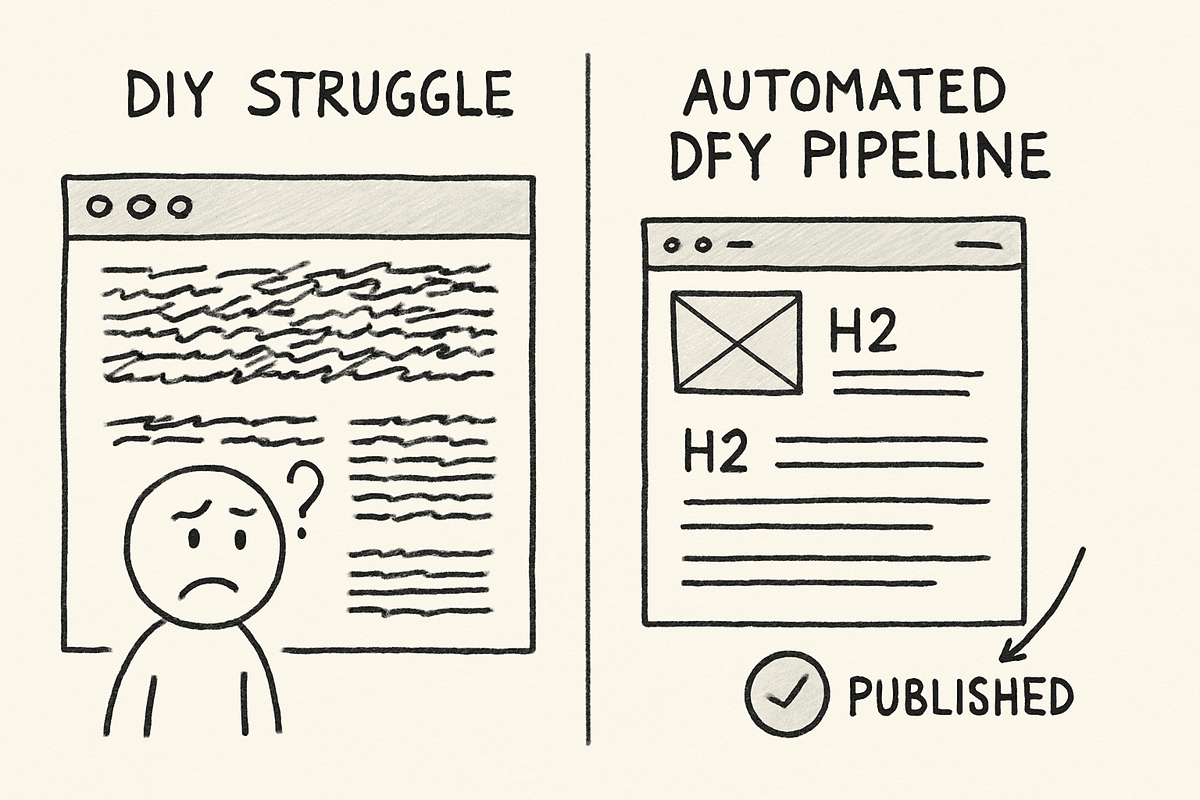
As highlighted in Complete Guide to Website Copywriting, businesses generally have three paths when it comes to getting words onto their website: Do It Yourself (DIY), Done With You (DWY), or Done For You (DFY).
Do It Yourself (DIY)
Many indie hackers and early-stage bootstrapped founders start here out of financial necessity. You sit down with a blank Google Doc, perhaps pull up some website copywriting templates, and try to hack together a homepage.
A quick glance at Reddit threads on copywriting struggles reveals the common pitfalls of DIY: founder bias (focusing too much on features, not enough on benefits), blank-page paralysis, and an inconsistent brand voice.
If you must DIY, rely heavily on customer research. Copy and paste exact phrases your customers use in support tickets and sales calls directly onto your landing pages.
Done With You (DWY)
This hybrid approach involves hiring a copywriter or consultant for an intensive session or an audit. They might provide you with a messaging hierarchy, a brand voice guide, and a structural wireframe, but you are responsible for filling in the final words. This works well for teams that have capable writers but lack strategic direction.
Done For You (DFY)
The DFY model has traditionally meant hiring freelancers or agencies. Top-tier agencies, such as those reviewed by Siege Media, will handle user research, wireframing, and final copy delivery. The downside is cost and speed. A professional agency engagement for a 5-page website can easily exceed $5,000 and take six weeks.
For continuous SEO content generation—the daily blog posts and glossary pages required to rank—traditional DFY models are becoming cost-prohibitive. This is exactly the problem BeVisible solves. By acting as an automated, end-to-end publishing platform for $79/month, it provides a DFY content engine specifically optimized for search visibility, replacing the need for expensive retainer contracts.
What Pages Do You Need on Your Website?
Before you write a single word, you need a map. A scattered approach to copywriting leads to orphaned pages and confused users. Every standard SaaS or agency website needs a core set of pages, each serving a distinct purpose in the sales pipeline.
- Home: The gateway. The goal here is simple: explain exactly what you do, who it is for, and the primary benefit within the first 5 seconds.
- Product / Features: Where the detailed problem-solving happens. Break down the technical capabilities using clear, benefit-driven language.
- Pricing: Clarity wins here. Confusing pricing tiers kill conversions faster than bad copy. State the price, the limits, and the included features plainly.
- About: People buy from people. Use this page to share the founder's story, the mission, and the company values. Do not make it a dry corporate history.
- Blog / Resources: The organic traffic engine. This is where your informational SEO content lives, answering the daily questions your target audience asks Google.
- Contact / Support: Remove friction. Make it incredibly easy for prospects to reach you or find documentation.
Final Thoughts: Velocity Over Perfection
The most perfectly crafted website copy in the world yields zero returns if it sits unpublished in a draft folder for six months.
Writing effective website copy is an iterative process. Launch with clear, jargon-free, answer-first content. Monitor how users interact with the page, track what keywords Google associates with your site, and adjust accordingly.
By prioritizing structure, precise language, and consistent publication—whether manual or via automated platforms—you will build a website that consistently pulls in targeted, high-intent traffic.