
Most "website directory lists" are graveyards. You’ve likely stumbled across articles recommending you submit your shiny new SaaS to sketchy, Web 2.0 link farms that haven't been maintained since 2012. Google ignores them, users never visit them, and AI agents certainly aren't scraping them for answers.
But the concept of a website directory isn't dead. It just evolved.
In 2026, modern directories are high-authority review hubs, technology stack aggregators, and curated programmatic databases. More importantly, they are the primary citation sources that Large Language Models (LLMs) like ChatGPT, Claude, and Perplexity use to form opinions about your software.
If you want to dominate AI-generated search answers and build unshakeable domain authority, you need to be listed where the algorithms are actually looking.
Why Traditional Web Directories Failed (And What Replaced Them)
Ten years ago, SEO was highly reliant on raw backlink volume. Website directories existed purely to pass link equity. You paid $10, submitted your URL, and got a backlink from a category page containing 5,000 other random businesses.
Today, search engines penalize these defunct directories. They fail because they lack editorial standards, suffer from link rot, and provide zero user utility.
What replaced them? Entity validation engines.
Google and AI search platforms no longer just count links; they look for consensus. When a user asks an AI, "What is the best SEO automation platform?" the model doesn't just read your homepage. It cross-references your claims against trusted third-party databases to verify your software's features, pricing, user sentiment, and market position.
To build SaaS authority today, you must treat directory submissions as an exercise in building a consistent, verifiable entity footprint.
The 11 Best Website Directory Sites for SaaS Growth
Not all directories are created equal. For SaaS founders, the most impactful platforms fall into four distinct categories: Launch, Reviews, Technical Stack, and Company Intelligence.
Here are the 11 platforms that move the needle in 2026.
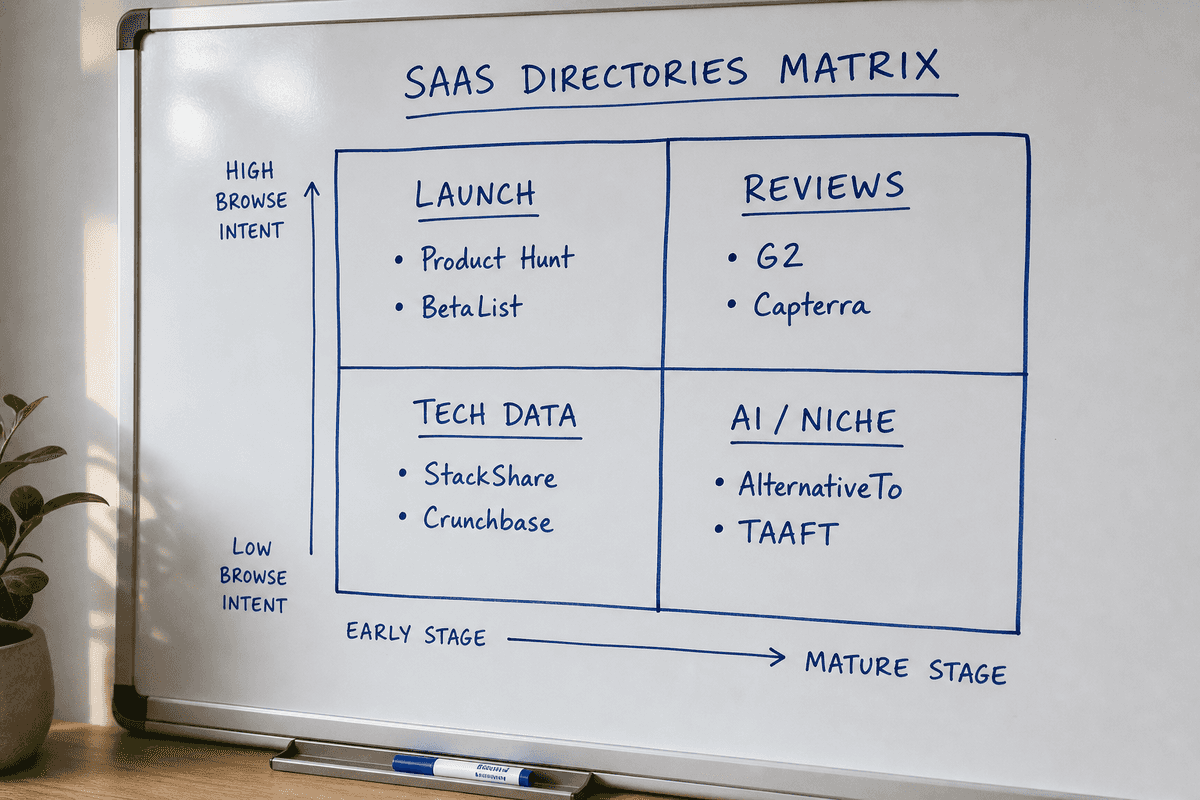
Launch & Discovery Directories
These platforms are designed to generate early traction, user feedback, and initial backlink velocity.
1. Product Hunt Product Hunt remains the gold standard for software launches. A successful "Product of the Day" campaign doesn't just drive a massive spike in referral traffic; it secures a highly authoritative backlink and creates a permanent footprint that AI models frequently scrape for "new tool" queries. Treat your Product Hunt launch like a mini-marketing campaign, complete with a dedicated SEO landing page to capture the incoming traffic.
2. BetaList If your SaaS is in private beta or early access, BetaList is the ideal starting point. It caters specifically to early adopters looking for the next big thing. Because the editorial team manually curates submissions, a backlink from BetaList carries strong trust signals for Google's crawlers.
3. SaaSHub SaaSHub positions itself as the independent software alternative directory. It categorizes tools strictly by functionality, making it a highly relevant contextual backlink. Unlike broader business directories, SaaSHub’s taxonomy is entirely SaaS-focused, which helps search engines understand exactly what niche your product serves.
Review & Consensus Engines
Search algorithms lean heavily on these platforms to understand user sentiment. You cannot buy your way to the top here; you need genuine user feedback.
4. G2 G2 is arguably the most powerful B2B software directory on the internet. Earning a "High Performer" badge on G2 translates directly into organic visibility. AI search engines specifically weight G2 review summaries when answering comparative queries (e.g., "Tool A vs Tool B").
5. Capterra Owned by Gartner, Capterra functions similarly to G2 but often captures a slightly different demographic—leaning heavily toward traditional enterprise and established SMB software buyers. Creating a robust profile here with accurate pricing and feature checklists is non-negotiable for B2B SaaS.
6. Trustpilot While often associated with e-commerce, Trustpilot has become a critical trust signal for SaaS platforms—especially those targeting prosumers or freelancers. Google frequently pulls Trustpilot star ratings directly into organic search snippets, drastically improving your click-through rates.
Technical & Stack Data
These directories map how your software fits into the broader technology ecosystem.
7. StackShare StackShare allows companies to share the software stacks they use to build and run their businesses. If you run a developer tool, API, or infrastructure SaaS, getting listed and "upvoted" on StackShare validates your product to technical buyers and establishes topical authority in the developer space.
8. AlternativeTo AlternativeTo is driven by crowdsourced recommendations. Users search for an expensive or bloated legacy tool and find modern alternatives. The platform's entire architecture is built around the "X alternative" keyword framework, making it a massive traffic driver if you are actively positioning your SaaS against an incumbent.
Company & Market Intelligence
Business intelligence directories validate your company as a legitimate corporate entity, which is crucial for E-E-A-T (Experience, Expertise, Authoritativeness, and Trustworthiness).
9. Crunchbase Crunchbase is the definitive database for startup funding, leadership teams, and company history. Creating a verified Crunchbase profile anchors your brand's Knowledge Graph in Google. It tells search engines who founded the company, where it is located, and how it is funded.
10. Clutch.co If your SaaS includes an agency component, managed services, or enterprise implementation, Clutch is mandatory. While primarily a B2B services directory, it heavily ranks for "Top [Industry] Agencies" and "Best [Software] Consultants."
11. "There's An AI For That" (TAAFT) For AI-powered SaaS tools, AI-specific directories like TAAFT and Toolify have replaced traditional software directories in terms of raw traffic volume. Getting listed here is critical for modern discovery, as these platforms rank highly for almost every "AI tool for [task]" search query.
How AI Search Engines Process Directory Citations
If you track referral traffic in Google Analytics, you might notice that traditional directories don't send the massive waves of direct clicks they used to. This leads many founders to assume directory building is a waste of time.
But looking only at direct clicks misses the point entirely.
When a user prompts Perplexity or ChatGPT with, "Find me an automated SEO blog engine like BeVisible but compare it to hiring an agency," the LLM does not browse the web like a human. It looks for data nodes.
 It checks:
- Feature matrices scraped from Capterra.
- Sentiment analysis drawn from G2 reviews.
- Pricing consensus from AlternativeTo.
- Corporate legitimacy from Crunchbase.
If your SaaS is absent from these directories, or if the data is wildly inconsistent across them, the AI lacks the confidence to recommend you. By maintaining pristine, up-to-date profiles on these 11 platforms, you are effectively feeding structured data directly into the training sets of the world's most powerful answer engines.
The Programmatic SEO Play: Building Your Own Niche Directory
Submitting your SaaS to the platforms above is a necessary defensive strategy. But if you want to play offense, you should build a directory of your own.
One of the most effective traffic-generation strategies in 2026 is building highly curated, niche-specific directory sites using programmatic SEO. Instead of just writing blog posts, SaaS founders are using tools like Airtable and Webflow to build searchable resource hubs that attract their target audience.
For example, an e-commerce analytics tool might build a programmatic directory reviewing the 7 Best Etsy SEO Tools to Boost Sales in 2026. Because it operates as a live, filterable database rather than a static blog post, it attracts higher engagement and natural backlinks.
The Modern Directory Stack
Building a directory no longer requires a team of developers writing custom PHP. The modern stack looks like this:
- The Database (Airtable / Notion): You structure your directory data (names, descriptions, categories, images) in a spreadsheet hybrid. This allows non-technical content marketers to manage the directory easily.
- The Sync Layer (Whalesync / Make): You use a synchronization tool to connect your database directly to your website's CMS. When you update a row in Airtable, it instantly updates the live website.
- The Frontend (Webflow / WordPress / Next.js): This is the user-facing site. If you are building a custom frontend, pay close attention to indexability. A common mistake is using heavy client-side rendering without a solid plan for SEO in single page applications, which can result in search engines failing to crawl your directory listings.
 When executed correctly, a proprietary directory acts as a magnet for your ideal customer profile, generating compounding organic demand that you can funnel straight to your core SaaS product.
3 Mistakes SaaS Founders Make with Directory Profiles
Even with the right list of directories, execution matters. Avoid these three common failure modes.
1. The "Set It and Forget It" Trap
The most common error is submitting a profile on launch day and never logging in again. Two years later, your pricing has changed, your core features have pivoted, and your directory profile still displays outdated screenshots. Search engines value freshness. Audit your 11 core directory profiles every six months to ensure the messaging aligns with your current positioning.
2. Fragmented Value Propositions
If your G2 profile describes you as an "AI Blog Writer," your Crunchbase says "Marketing Automation Agency," and your AlternativeTo listing claims "Content CMS," you are creating entity confusion. AI models struggle to categorize your software when the data is fragmented. Keep your core positioning statement identical across all tier-one platforms.
3. Paying for Low-Tier Directory Submissions
If you receive a cold email offering submission to "500 High-DA Web Directories for $50," delete it. Bulk submission tools blast your URL to automated, defunct domains that Google has aggressively de-indexed. Spending resources on high-quality editorial placements or studying the strategies of top practitioners on the best SEO blogs yields far better returns than buying bulk links.
Final Thoughts
Website directories have grown up. They are no longer the spammy link-building hacks of the early internet. Today, they are complex validation engines that sit between your software and the AI agents making recommendations to your future customers.
By securing your presence on these 11 platforms—and ensuring your data is fresh, accurate, and compelling—you lay the foundation for sustainable, compounding SaaS authority.