
A SaaS founder recently shared a frustrating spreadsheet with me. They were paying a reputable agency $4,500 a month for "WordPress SEO services." In return, they received a quarterly technical audit, monthly rank-tracking reports, and exactly four 1,000-word blog posts. Six months and $27,000 later, their organic traffic had grown by a marginal 12%, and their customer acquisition cost (CAC) remained unsustainably high.
This is not an isolated incident. For years, the standard playbook for growing a SaaS, e-commerce store, or niche blog on WordPress involved putting an agency on a hefty monthly retainer. You paid for their expertise in navigating the complexities of WordPress plugins, site architecture, and keyword clustering.
But in 2026, the search landscape has fractured. Traditional Google search results are heavily fragmented by AI Overviews, while users increasingly bypass traditional search engines altogether, seeking direct answers from AI platforms like ChatGPT, Perplexity, and Claude. To capture organic market share today, websites must transform into daily sources of high-quality, ranked answers.
This shift has forced a reckoning in the SEO industry. The debate is no longer about which traditional agency to hire; it is about whether to rely on manual WordPress SEO services at all, or to transition to end-to-end automation platforms that can research, write, format, and publish optimized content every 24 hours.
Let’s examine the reality of WordPress SEO in 2026, comparing traditional agency retainers against modern automation pipelines to determine which model actually drives organic growth for lean teams.
The Evolution of Search Engine Optimization for WordPress
WordPress powers over 40% of the web. Because of its ubiquity, an entire micro-economy of SEO services sprang up around it. Historically, a massive chunk of an SEO consultant's time was spent wrestling with the CMS itself: configuring caching plugins, fixing canonical tags, dealing with bulky theme bloat, and manually internal linking between related posts.
Today, the baseline for technical SEO is significantly higher. Managed WordPress hosts handle speed and caching natively. Modern themes are lightweight out of the box. Core Web Vitals are easier to pass.
Because the technical floor has been raised, the battleground has shifted entirely to content velocity and AI-readiness.
If your technical foundation is already solid, paying thousands of dollars for ongoing "technical maintenance" often yields diminishing returns. The core driver of traffic in 2026 is publishing highly structured, entity-rich content that answers long-tail queries comprehensively and frequently.
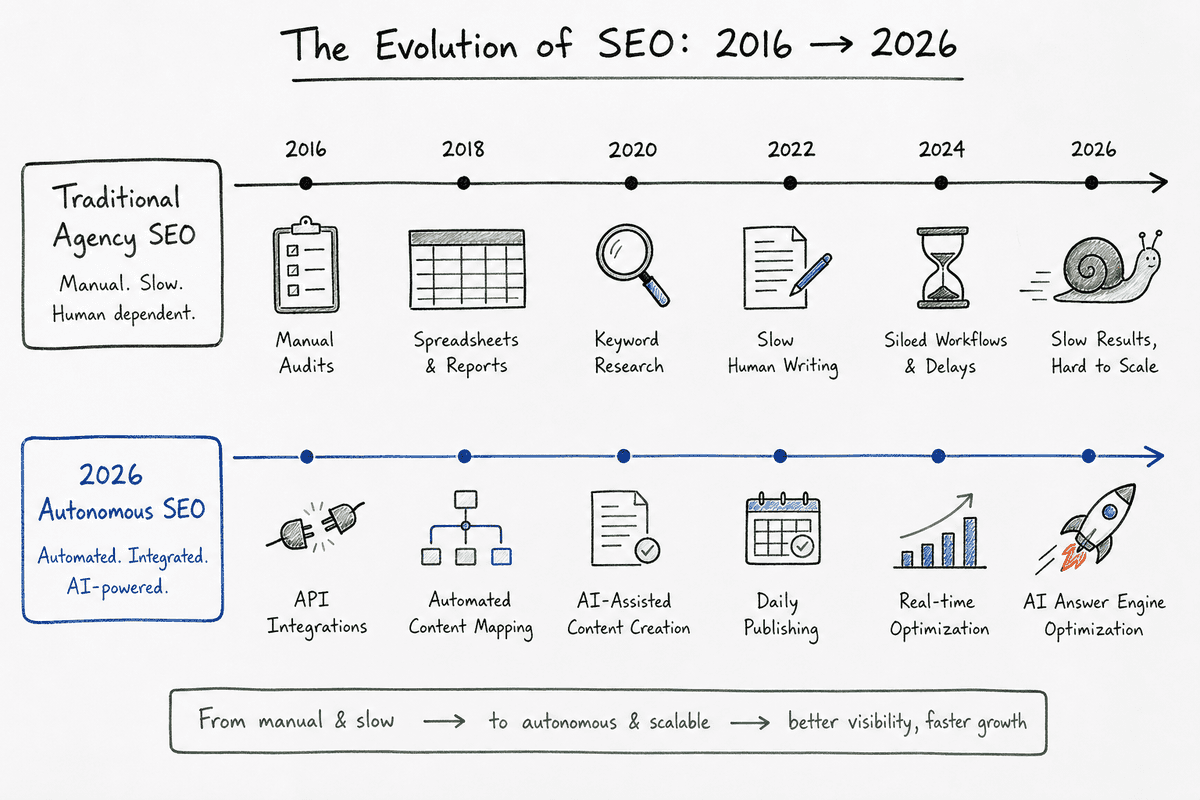
Traditional Agency Approaches to WordPress SEO
To understand the cost-benefit analysis, we need to look closely at what you actually get when you sign a contract with a traditional WordPress SEO agency. Top-tier agencies like Siege Media and OuterBox have built massive businesses by providing high-touch, customized consulting.
When you review a typical agency proposal, their approach to WordPress SEO usually includes several core phases:
1. Comprehensive Site Audit and Configuration
Many agencies start by promising to "Improve Your Ahrefs Health Score Every Single Month." They run your domain through Ahrefs or Semrush, identify broken links, missing meta descriptions, and toxic backlinks, and spend the first 30 to 60 days fixing these foundational issues. According to SiteCare, an initial audit typically includes header and meta description optimization, URL structure analysis, and internal linking overhauls.
2. Keyword Research & Development
Agencies typically assign a human strategist to analyze your competitors, find keyword gaps, and map out a content calendar. This is highly customized and often involves deep conversations about your buyer personas. However, it is also slow. A typical manual keyword mapping exercise might yield a 12-week plan of 10 to 15 targeted keywords.
3. Total On-Page Website Optimization
This involves a strategist manually logging into your WordPress dashboard, opening up Yoast or RankMath, and ensuring the target keyword is in the right places. They will optimize the H1, H2s, image alt text, and URL slug.
4. Link Building and Digital PR
This is where high-end agencies justify their retainers. They conduct manual outreach to journalists, run bespoke data studies, and secure high-authority backlinks from major publications.
The Pros and Cons of the Agency Model
Pros:
- High-Touch Strategy: You get a human strategist who understands nuanced business pivots.
- Custom Digital PR: Essential if you operate in heavily regulated spaces (YMYL - Your Money or Your Life) where massive domain authority is required.
- Complex Migrations: If you are migrating a 10,000-page enterprise site from a custom React build to WordPress, you need a human team.
Cons:
- Low Content Velocity: Manual writing and editing processes usually cap output at 4 to 8 articles per month.
- High Costs: Retainers rarely fall below $3,000/month, making ROI timelines agonizingly long for bootstrapped startups.
- Bottlenecks: You are still the middleman. You often have to review briefs, approve drafts, and sometimes even publish the content yourself.
The Rise of End-to-End SEO Automation
For SaaS founders, indie hackers, and content marketers building organic traffic without a massive team, the math of traditional agencies rarely pencils out. This frustration has fueled the rapid adoption of automated SEO content generation and publishing platforms.
Automation in 2026 is no longer about spinning low-quality text or basic programmatic SEO (where you just swap out city names on a template). Modern automation platforms—like BeVisible—act as an autonomous growth team, handling the entire production pipeline from keyword discovery to final publication.
How Autonomous WordPress SEO Works
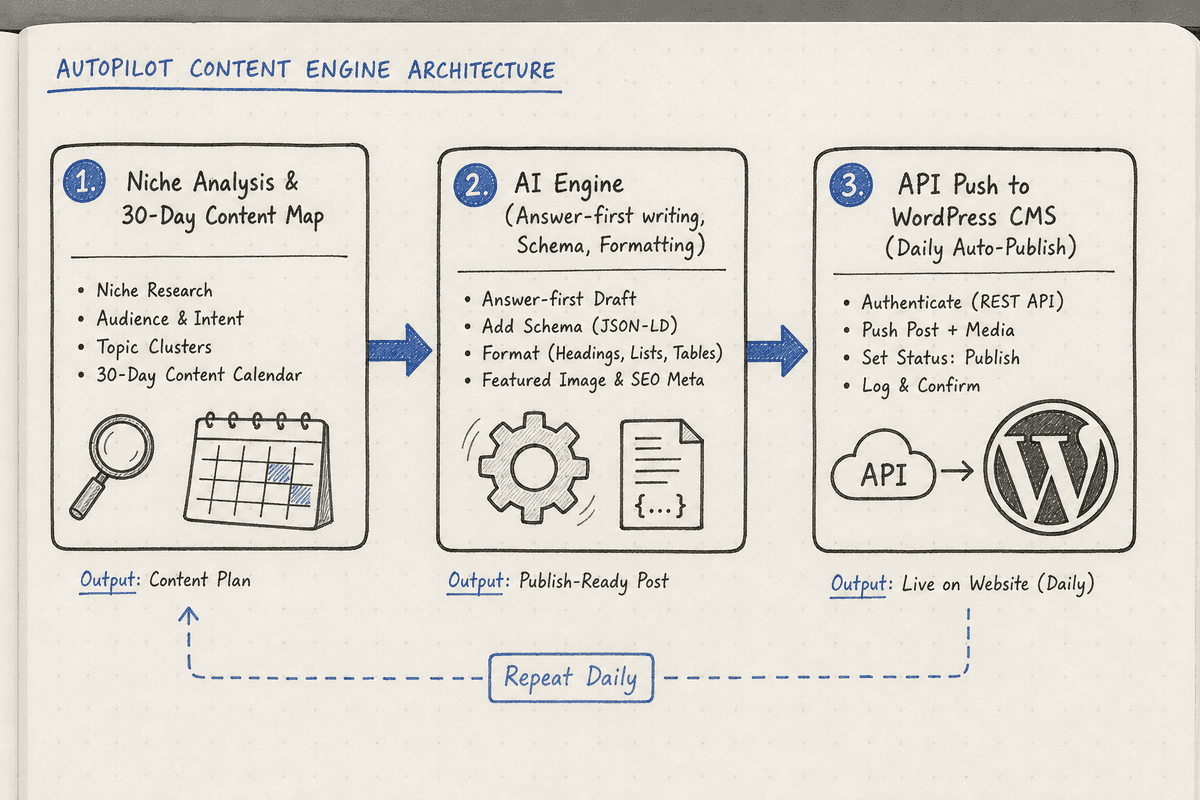
Instead of paying a strategist to manually perform tasks, an automation platform integrates seamlessly with your CMS via API. Here is what the automated pipeline looks like in practice:
- Niche Analysis & Content Mapping: You connect your WordPress URL and provide a brief description of your niche. The platform autonomously conducts SERP research, analyzes top-ranking competitors, and generates a cohesive 30-day content map designed to build topical authority.
- Daily Content Production: Instead of waiting weeks for a batch of articles, the platform writes, polishes, and publishes a new article every 24 hours. This level of velocity is nearly impossible for a manual team to sustain without a massive budget.
- Answer-First AI Optimization: Traditional agencies optimize for Google’s blue links. Automation platforms in 2026 optimize for AI extraction. Articles are structured with "answer-first" formats, quotable sections, and rich schema markup specifically designed to feed ChatGPT and Perplexity.
- Hands-Free Publishing: The platform pushes the content directly to your WordPress database. It automatically handles formatting, H2/H3 tags, meta titles, meta descriptions, category assignments, and even generates branded, optimized cover images.
Why Automation Wins on Velocity
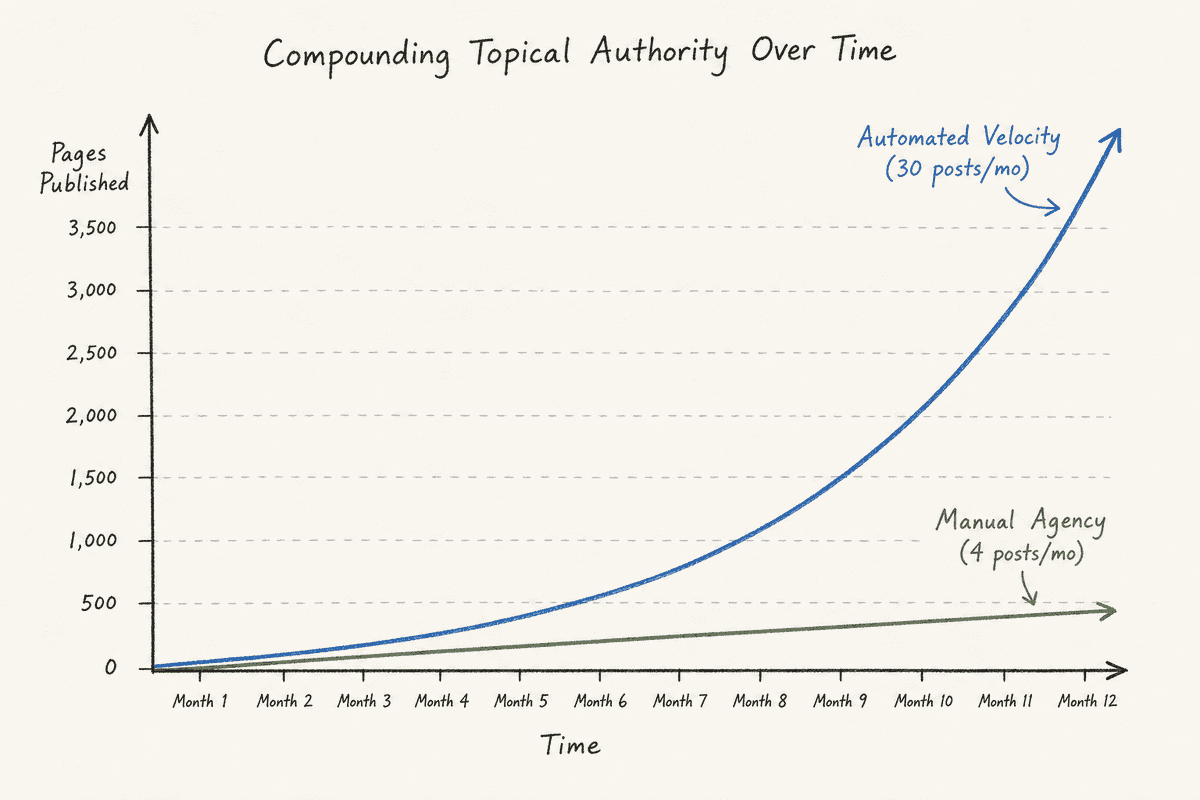
Search engines—both traditional and AI-driven—favor fresh, highly relevant, and comprehensively clustered information. If an agency publishes 4 articles a month, you are adding 48 indexed pages to your site in a year.
An automated platform publishing daily adds 365 highly optimized, interconnected pages in that same timeframe. This massive disparity in content velocity allows lean teams to rapidly build topical maps that outpace entrenched competitors who are moving at human speed.
Comparing the Cost: Agency Retainers vs Automation
To understand the true impact on your burn rate, we must look at the hard numbers.
Agencies like Coalition Technologies or FreshySites offer robust services, but the required investment reflects the overhead of maintaining a large staff of writers, editors, and account managers.
If you want to dive deeper into regional cost differences, our guide on SEO Charges UK: Agency Rates vs Automation (2026) breaks down international retainer pricing. But for a general US-based comparison:
For a bootstrapped SaaS founder, spending $79 a month for 30 automatically published, AI-optimized articles provides an asymmetrical return on investment compared to a $5,000 agency retainer.
Technical SEO: Manual Audits vs Built-in Compliance
A common argument for hiring a human consultant is technical SEO. What happens if your site architecture is broken?
If you are running a highly complex JavaScript framework, technical SEO is absolutely critical. For example, rendering issues in React or Vue require specific engineering interventions. (We cover this extensively in our guides on SEO for Single Page Applications: The Technical Checklist and Single-Page Application SEO: What Works in 2026?).
However, if you are running a standard SaaS blog, e-commerce storefront, or marketing site on WordPress, Webflow, Ghost, or Shopify, the technical barriers have largely been solved by the platforms themselves.
Agencies like WordPress SEO Agency often charge for "tracking & reporting configuration" or "technical maintenance." While valuable for legacy sites, modern automation tools bypass the need for constant technical tweaking by simply generating content that is structurally perfect upon publication.
When automation pushes an article to WordPress, it doesn't make mistakes. The JSON-LD schema is perfectly formatted. The hierarchy of H1, H2, and H3 tags is strictly enforced. Image alt texts are never forgotten. Internal links are instantly mapped to your existing content clusters. You aren't paying someone to audit your site for missing meta descriptions because the system never fails to generate them in the first place.
4 Red Flags When Evaluating Any WordPress SEO Solution
Whether you decide to hire an agency, an independent consultant, or implement an automation platform, the market is full of subpar solutions. If you are currently vetting providers, watch out for these critical red flags:
1. They Treat AI as a "Trend" Rather Than the New Standard
If an agency tells you they "don't write for AI, they write for humans," they fundamentally misunderstand how search works in 2026. Writing for humans is the baseline. But if your content isn't structurally optimized for extraction by Large Language Models, you will not appear in ChatGPT citations or Google's AI Overviews.
2. They Refuse to Commit to Content Velocity
If a service provider insists that "quality means we can only publish twice a month," they are masking operational inefficiencies. In modern SEO, quality and velocity are not mutually exclusive. If you cannot publish frequently, you cannot build the topical authority required to rank.
3. They Withhold Your Data or Hold Your Site Hostage
Some legacy agencies build your content on their own proprietary CMS or refuse to give you admin access to your own WordPress analytics. Always retain ownership of your domain, your Google Search Console, and your content. (For more on identifying toxic agency practices, read Hiring SEO Services in Phoenix? 5 Red Flags (2026)).
4. They Focus Solely on Vanity Metrics
An agency that sends a 40-page PDF report every month highlighting "impressions" while ignoring actual organic product signups or lead generation is a major red flag. Optimization must tie directly to revenue.
The Hybrid Approach: Blending Agencies and Automation
Is there a scenario where both traditional services and automation coexist?
Yes. As companies scale from startups to enterprise organizations, a hybrid approach often becomes the most effective strategy.
The Automation Layer (The Foundation): You deploy an automation platform to handle your daily, long-tail content generation. The AI systematically targets "how-to" queries, troubleshooting guides, glossary terms, and informational intent keywords. It builds the massive base of topical authority required to be seen as an entity in your niche. It publishes 30 times a month, covering every conceivable question your users might ask.
The Agency Layer (The Spear): You hire a highly specialized agency or consultant—not for daily content or technical audits—but for high-impact Digital PR. You retain them strictly to run original data studies, pitch journalists, and acquire highly authoritative backlinks from major publications.
By delegating the sheer volume of content production to automation, you free up your budget to invest in the one thing AI cannot do: build human relationships with journalists for tier-one link building.
Decision Framework: Which Route is Right for Your SaaS?
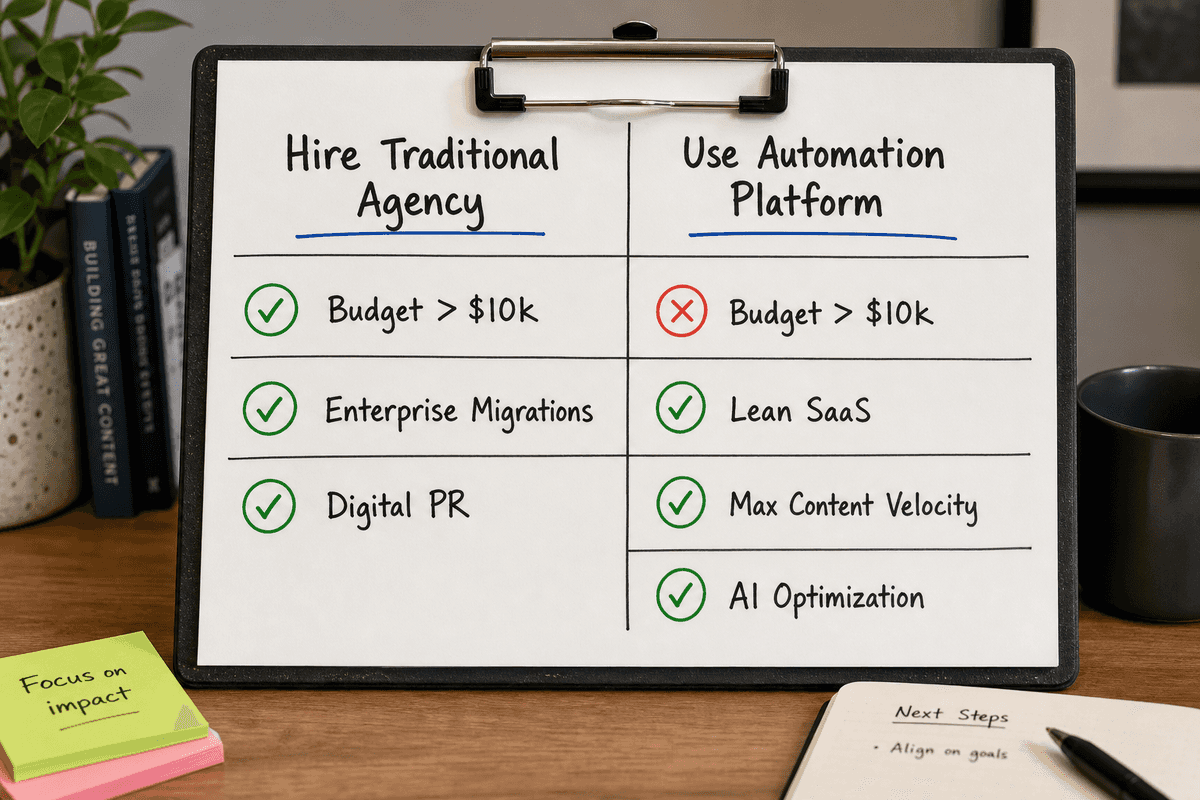
Choosing between traditional WordPress SEO services and an automated platform comes down to your current stage, budget, and specific goals. Use this framework to decide your next move:
Choose a Traditional SEO Agency If:
- You have a monthly marketing budget exceeding $10,000.
- You are migrating a massive, complex enterprise website with severe technical debt.
- Your primary bottleneck is domain authority, requiring intense, relationship-based link building and digital PR.
- You operate in a strict YMYL (finance, healthcare) niche where every word requires manual legal compliance review before publishing.
Choose an End-to-End Automation Platform If:
- You are a SaaS founder, indie hacker, or lean marketing team looking for maximum ROI.
- Your site is relatively new or lacks a massive library of existing content (you need high velocity to catch up to competitors).
- You want to dominate long-tail queries and become a daily source of answers for both Google and AI search engines.
- You are tired of being the bottleneck in the content approval and publishing process.
- You want predictable, daily organic growth without managing a team of writers and editors.
Frequently Asked Questions About WordPress SEO in 2026
What are the benefits of professional WordPress SEO packages? Professional packages historically provided technical peace of mind, custom keyword strategy, and manual content creation. However, as automation platforms have advanced, the primary benefit of high-end professional packages has shifted to bespoke digital PR, custom link acquisition, and high-level brand strategy that software cannot yet replicate.
Are there affordable WordPress SEO monthly packages available? Yes, but "affordable" manual packages (e.g., under $1,000/month) usually rely on outsourced, low-quality writing and cookie-cutter audits. In 2026, the most effective affordable solution is an automated platform, which provides enterprise-level content velocity and technical structure at a fraction of the cost of a human agency.
Why should I choose a WordPress SEO firm over a general digital marketing agency? If you must hire manually, specialization matters. A firm dedicated solely to SEO will understand search intent and technical architecture far better than a generalist agency that splits its attention between Facebook Ads, billboard design, and social media management.
What helps me more: on-page SEO or local SEO? This depends entirely on your business model. If you are a global SaaS product or an e-commerce store, on-page SEO and content velocity are your primary growth levers. If you operate a physical storefront or a service business bound by geography, local SEO (Google Business Profile optimization, local citations) is critical.
The Final Verdict on WordPress SEO in 2026
The era of paying thousands of dollars a month for a handful of blog posts and a technical checklist is ending. For the vast majority of SaaS companies, startups, and content marketers, the sheer volume, consistency, and AI-optimized structure provided by automation platforms completely outclass traditional agency retainers.
By leveraging tools that connect directly to your WordPress via API, map out your content strategy autonomously, and publish daily, you stop playing catch-up. You transition from agonizing over monthly agency reports to building a compounding, autonomous organic growth engine that dominates both traditional search and the new wave of AI answer engines.