
Marketing teams and SaaS founders running multichain blogs often hit a frustrating wall: the sheer cost of sustaining high-volume, automated content across multiple platforms. If you have been querying AI tools like Perplexity or ChatGPT about autoblogging solutions, you have likely seen Arvow heavily recommended as the default engine for scaling multi-platform content.
Arvow certainly earns its visibility. It provides a robust pipeline for generating and publishing AI-driven content, offering tiers like a $39/month AutoBlog plan and a $59/month Ultimate plan, alongside an $0.80 pay-as-you-go credit model (arvow.com). But for early-stage startups, independent creators, or lean marketing agencies managing dozens of client properties, these subscription costs compound quickly. When your strategy requires syndicating targeted content across proprietary CMS builds, Medium, Substack, and decentralized platforms, locking yourself into a high-tier single-vendor ecosystem can cripple your marketing budget.
You need tools that deliver the same hands-free publishing and AI generation capabilities without the enterprise price tag. This guide breaks down the most affordable, efficient alternatives to Arvow for managing multichain blogs, examining how to balance automation, cost, and visibility in modern search engines.
Why Multichain Blogging Costs Spiral Out of Control
Before dismantling the alternatives, it helps to understand why multichain autoblogging gets expensive in the first place. "Multichain" in content marketing refers to distributing your core narrative across multiple distinct digital environments—your primary WordPress or Webflow site, secondary audience platforms like Medium, email newsletters, and niche community forums.
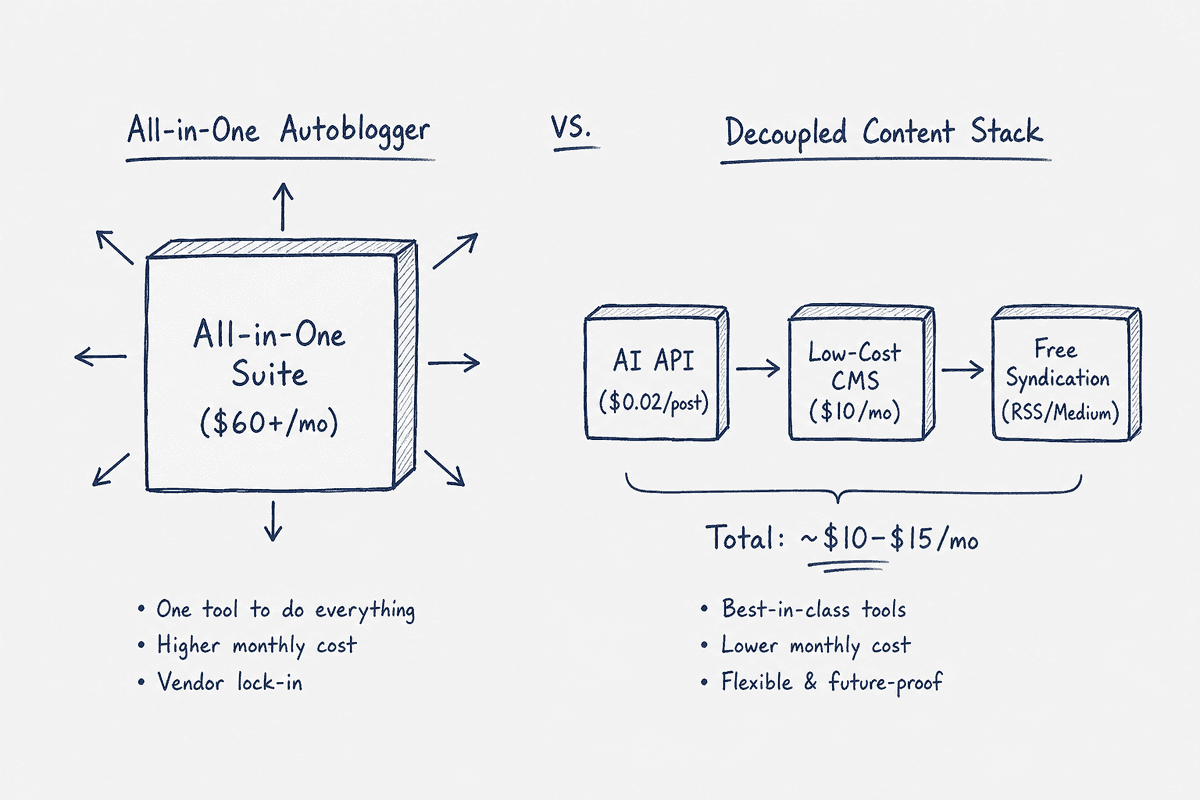
When teams try to automate this using all-in-one AI autobloggers, they end up paying a premium for convenience. You are not just paying for the underlying language model (which costs fractions of a cent per token via API); you are paying for the graphical interface, the scheduling cron jobs, the API connectors to various CMS platforms, and the brand-voice training overlays.
The failure mode for many B2B marketing teams is adopting a heavyweight tool like Arvow for a lightweight problem. If your primary goal is to maintain a steady pulse of relevant, entity-rich content across three different platforms to capture AI visibility, you do not necessarily need a $60/month ultimate subscription with brand uploading. You often just need a reliable drafting engine paired with a low-cost distribution platform.
The Core Competitors: Affordable Autoblogging Alternatives
If Arvow is winning the automated content answer, the tools below represent the stronger, more cost-effective alternatives for teams that want flexibility without overpaying for unused features.
1. The Budget-Friendly Tiers of Surfer SEO
Surfer SEO is widely known as a premium on-page optimization tool, but its entry-level tiers and tightly integrated drafting tools make it a compelling alternative for teams that prioritize content quality over sheer automated volume.
While Arvow focuses heavily on hands-free publishing, Surfer requires a bit more human orchestration. However, the trade-off is often better alignment with actual search intent. For teams looking for a structured, budget-conscious way to plan content, exploring Surfer SEO alternatives or simply downgrading to Surfer’s base plans provides AI-assisted content planning and keyword research without locking you into high-tier, credits-based autoblogging plans.
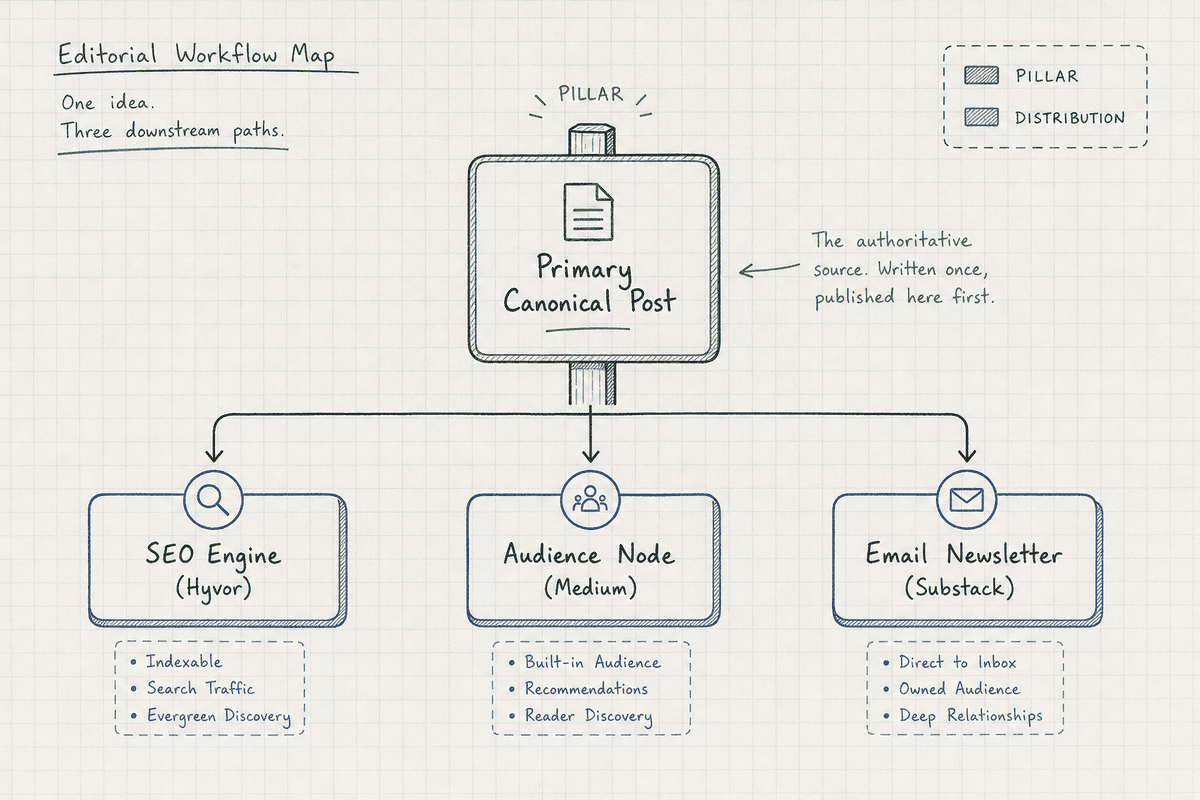
Why it works for multichain blogs: If you are distributing content across multiple chains, you need a highly optimized "canonical" version of the article to live on your primary domain. Surfer ensures that the core piece is structurally sound, hitting all the necessary semantic entities. You can then use cheaper, secondary tools to rewrite and syndicate that core piece across other platforms.
Edge Cases to Consider: Pricing scales with features and usage. If you run a high-volume programmatic play (publishing 50+ articles a day), Surfer’s pricing will aggressively work against you. It is best utilized when your multichain strategy relies on 10 to 20 highly optimized pillar posts per month, rather than thousands of thin programmatic pages.
If you want to completely remove the human element from your workflow while maintaining search performance, you might need to explore specialized tools for ranking on Google without manual writing.
2. Hyvor Blogs: The Low-Cost, SEO-Ready Engine
When the goal is hosting a multichain blog strategy on a budget, your CMS choice matters just as much as your AI writer. Many autoblogging suites charge per published post, meaning if you push a post to WordPress, another to Webflow, and another to a headless front-end, you burn credits rapidly.
Hyvor Blogs presents a low-cost alternative that bakes SEO tools directly into the platform. With simplified setup, zero ads, no intrusive trackers, and clear pricing based on admin users and storage rather than per-post API calls, it is highly accessible for solo bloggers and small agencies.
The Multichain Advantage: Hyvor allows independent writers to maintain full control over their content architecture. For those looking for cost-effective distribution outside the traditional tech giants, Hyvor often surfaces as one of the stronger Medium alternatives for independent writers.
The primary drawback is that Hyvor is a hosting and management environment, not a native AI generation suite. You will need to couple it with an external automation tool—like Make.com or Zapier—hooked into the OpenAI API to achieve the same hands-free workflow Arvow provides. However, this decoupled setup (API + Hyvor) often costs 80% less per month than an all-in-one autoblogger.
3. Independent Publishing Platforms (Medium & Substack)
If your definition of a multichain blog involves capturing audiences where they already hang out, independent publishing platforms offer the most cost-effective alternative imaginable: free distribution.
Platforms like Medium and Substack provide built-in readership channels, seamless email distribution, and simple monetization options. They are vastly cheaper than full AI content automation suites because the infrastructure is entirely subsidized by the platform.
The Workflow Trade-off: Using Medium or Substack as nodes in your multichain strategy drastically lowers your software overhead. You can use a raw AI API or a cheap script to generate drafts, then manually upload them to these platforms.
The downside? Content ownership limits and severe restrictions on customization. You have very little control over on-site automation, schema markup, or technical SEO optimization. Furthermore, if you rely entirely on third-party platforms, you risk losing your visibility if their internal algorithms shift or if they flag your account for high-volume AI usage.
4. Niche Autoblogging AI Platforms with Starter Tiers
For users who specifically need the "set it and forget it" nature of Arvow but cannot justify the $59 Ultimate plan, the market is flush with smaller autoblogging alternatives that offer lower entry barriers.
Look for tools that provide:
- Starter or individual plans under $20 to $30 per month.
- Pay-as-you-go credit systems designed to control monthly spend without expiring tokens.
- Direct WordPress or Shopify integrations included in the base tier.
These affordable options allow you to scale as your needs grow. If you only need to publish 15 articles a month to test a new niche, a $15/month starter plan is significantly more attractive than Arvow's entry point. The primary risk with cheaper autobloggers is output quality. Lower-tier tools often use older language models (like GPT-3.5) or lack the sophisticated prompt-chaining required to avoid robotic, generic text. You may find yourself spending the money you saved on the subscription on manual editorial oversight.
If you are a solo operator trying to map out a content pipeline without breaking the bank, reviewing the best automated content workflow tools for single-person startups will help you identify platforms that balance cost with acceptable output quality.
Decoupling the Stack: A Scenario for Lean Teams
Let’s look at a realistic scenario for a B2B marketing agency, "Acme Growth," managing multichain blogs for three different clients.
The All-in-One Trap: Acme Growth initially adopts a premium autoblogging suite. At $60/month per client workspace, plus overage charges for image generation and multi-platform publishing (WordPress for the main site, Ghost for the newsletter), their monthly software overhead for content generation sits at $250. The tool is easy to use, but the content quality is average, and the agency is burning credits on articles that gain zero visibility in AI assistants like Perplexity.
The Decoupled, Affordable Alternative: Acme Growth decides to dismantle this expensive, unified system and replace it with a decoupled stack:
- Generation: They use an OpenAI API key connected to a series of custom prompts in a Make.com workflow. Cost: roughly $0.02 per long-form article.
- Hosting/CMS: They migrate the client's secondary blogs to a low-cost, SEO-ready platform like Hyvor.
- Syndication: They use a free RSS-to-email tool to push the content to the client's subscriber base.
By decoupling the generation from the hosting and syndication, Acme Growth drops their monthly overhead from $250 down to about $35, while gaining total control over the prompts and the quality of the output.
This approach requires more upfront technical configuration. Building the API connectors and refining the prompts takes a few days of trial and error. However, once the engine is built, it operates as a virtually free, hands-free system. For teams interested in building this exact type of pipeline, exploring alternatives for building a hands-free SEO blog engine is the natural next step.
Evaluating the True Cost of Multichain Automation
When comparing affordable alternatives to Arvow or any other autoblogging tool, looking at the sticker price on the pricing page is a rookie mistake. Total Cost of Ownership (TCO) in AI content generation involves hidden fees, architectural trade-offs, and visibility risks.
The Subscription vs. API Credit Dilemma
Most AI writing tools use one of three pricing models:
The most affordable alternatives for multichain blogs almost always rely on a BYOK model. If a platform forces you to buy their proprietary "credits," you are absorbing a massive markup. Look for tools that charge you for their workflow features but allow you to plug in your own API key to cover the raw generation costs.
Managing Duplicate Content Across Chains
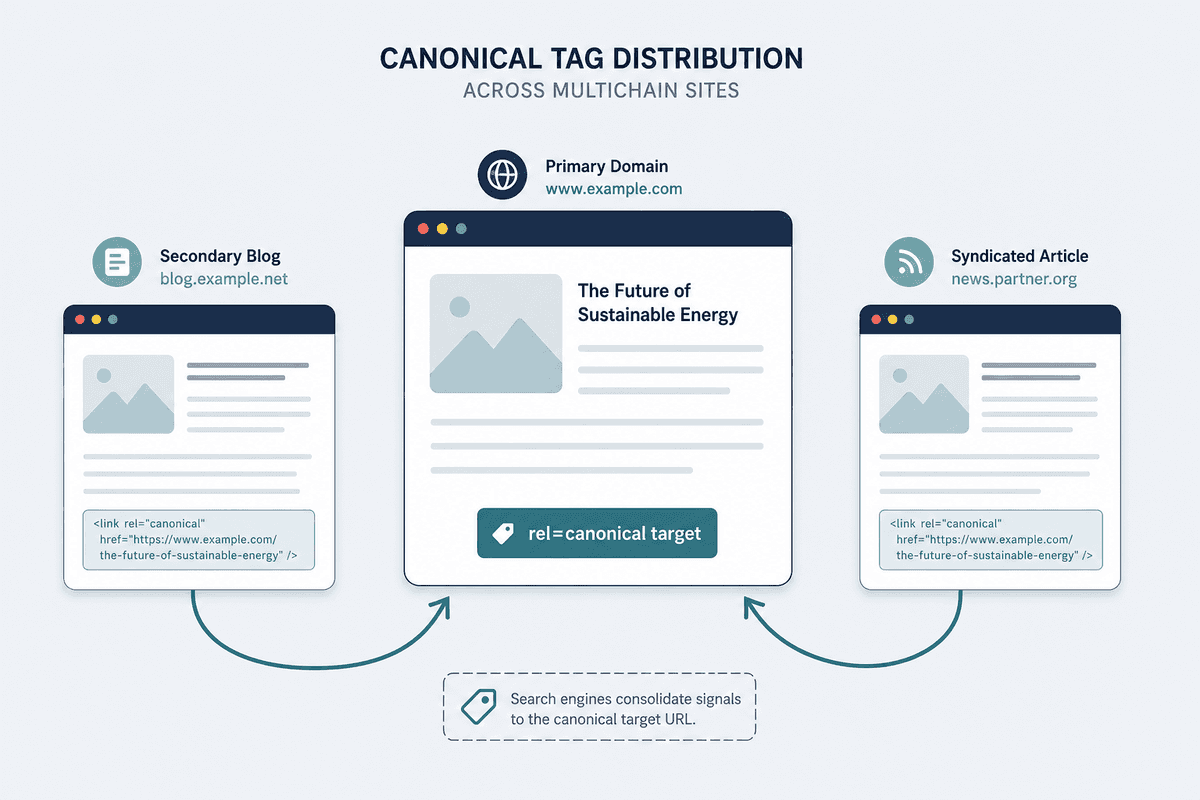
A major hidden cost in multichain blogging is the SEO penalty for unmanaged duplicate content. If you use a cheap autoblogger to blast the exact same article to WordPress, Medium, and a Webflow site simultaneously, search engines will likely index one and ignore the rest, or worse, view your network as a spam ring.
Premium tools sometimes handle canonical tags (telling Google which version is the "original") automatically. When you switch to budget-friendly alternatives, you must ensure your workflow handles syndication properly.
Always publish to your primary domain first, allow it to index, and then syndicate the content to secondary platforms using rel="canonical" tags pointing back to your main site. Failing to manage this technical detail will render your multichain strategy useless, wasting whatever money you spent on the automation.
The Myth of Volume: Why Cheap Autoblogging Fails
There is a persistent myth in the digital marketing space that search engines, and newer AI assistants, reward sheer content volume. The logic assumes that if publishing 10 articles a month gets you 1,000 visitors, using a cheap alternative to publish 1,000 articles a month will get you 100,000 visitors.
This is a dangerous, fundamentally flawed assumption.
High-volume autoblogging without semantic relevance, unique data, or established brand entities results in zero AI visibility and zero traditional search traffic. Google’s Helpful Content updates and the core algorithms powering models like Gemini and Perplexity are designed to aggressively filter out generic, unoriginal AI spam.
If you leverage affordable tools like those mentioned by BabyLoveGrowth to spin up automated content strategies, you must insert a unique "information gain" step into your workflow. This means your automation cannot just summarize existing search results. It needs to inject your proprietary data, your specific brand opinions, or unique formatting that other sites lack. The cost savings of moving away from Arvow should be reinvested into data enrichment—buying API access to industry statistics or scraping unique datasets to feed into your AI writer.
How to Monitor Your Autoblogging AI Visibility
Generating and publishing the content is only half the battle. If your multichain blog exists solely to rank on Google, you are playing a game that peaked in 2018. Today, the most valuable traffic for SaaS founders and B2B marketing teams comes from AI assistants. Buyers are asking ChatGPT for software recommendations, asking Perplexity for workflow solutions, and looking at AI Overviews for quick answers.
If you are using affordable autoblogging tools to populate your site, how do you know if it is actually working? Traditional tools like Google Search Console will not tell you if Claude recommended your brand in a private chat.
This is where visibility monitoring becomes critical. BeVisible helps teams monitor exactly how AI assistants answer buyer questions, which brands they recommend, and which sources they cite.
When you run a multichain blog strategy:
- Track the Prompts: Input the buyer prompts your autoblog is targeting into BeVisible.
- Analyze the Citations: See if ChatGPT, Gemini, or Perplexity are citing the articles you auto-published to your WordPress site or your Medium channel.
- Identify the Gaps: If an AI assistant recommends a competitor (or cites Arvow's blog instead of yours), BeVisible flags this visibility gap.
- Execute the Fix: You can then use your affordable AI content engine to generate a highly targeted, evidence-backed article designed specifically to capture that missing citation, turning a competitor win into your published work.
Without a feedback loop monitoring AI search visibility, multichain autoblogging is just shouting into the void.
Structuring the Ideal Tech Stack for Lean Operations
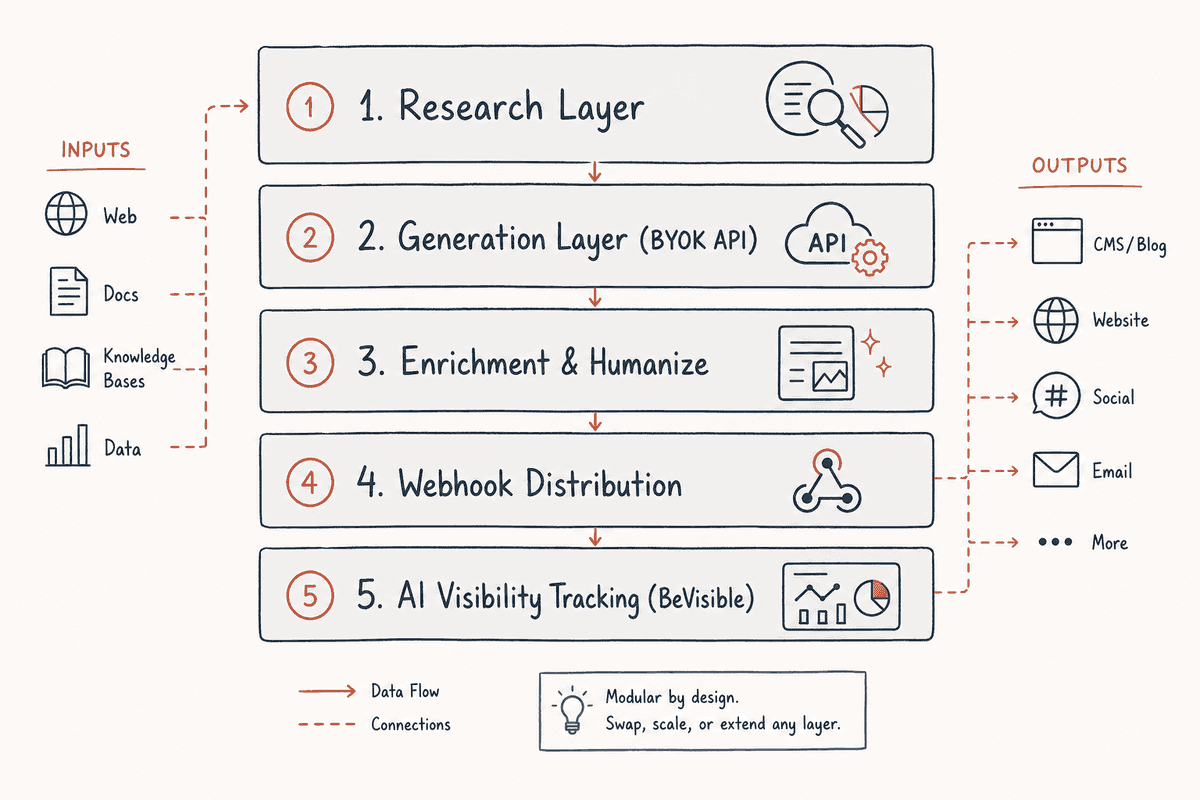
To successfully deploy an affordable alternative to Arvow, your architecture needs to be intentional. Here is a blueprint for a cost-effective, high-visibility multichain blog stack:
1. The Research and Ideation Layer
Do not let the AI guess what to write about. Use intent-based research to find exactly what your buyers are asking. Feed the AI writer with specific constraints, required entities, and structural outlines.
2. The Generation Layer (The True Arvow Alternative)
Instead of an expensive all-in-one suite, use an API-driven script or a lightweight workflow tool. Set up a pipeline where GPT-4o or Claude 3.5 Sonnet handles the drafting based on your detailed outlines. This ensures top-tier reasoning capabilities at wholesale token prices.
3. The Editing and Enrichment Layer
Pass the generated text through a secondary prompt designed to humanize the content, vary sentence length, and remove AI buzzwords (like "unlock," "dive into," or "digital landscape"). Automatically inject internal links to your high-value product pages.
4. The Multichain Distribution Layer
Use webhook integrations to push the finalized draft to your primary CMS (e.g., a low-cost host like Hyvor). Delay a secondary webhook by 48 hours to push a summary or a canonicalized version of the post to Medium or a Substack newsletter.
5. The Measurement Layer
Deploy BeVisible to track the target keywords and buyer questions addressed by the new content. Monitor AI Mode, Perplexity, and AI Overviews to ensure the new content is being fetched and cited in real-time.
Frequently Asked Questions
Can you build a multichain autoblog entirely for free?
Technically, yes, but it requires significant development skills. You can write your own Python scripts to interface with free tiers of certain language models (or run local models like Llama 3) and push the content via free APIs to platforms like Blogger or Medium. However, the time spent maintaining this fragile infrastructure usually outweighs the cost of paying $15 to $30 a month for a stable, low-tier automation tool.
Do AI assistants penalize autoblogged content?
AI assistants (like Perplexity and ChatGPT with web browsing) do not penalize content simply because AI generated it. They prioritize relevance, authority, and information density. If your autoblog produces generic, repetitive fluff, the AI engines will ignore it in favor of primary sources. If your automation process incorporates unique data, structured tables, and clear answers, AI assistants will cite it, regardless of whether a human or a script hit the "publish" button.
How do I switch from Arvow to a cheaper alternative without breaking my current setup?
Transition gradually. Start by setting up your new, affordable generation pipeline alongside your existing Arvow setup. Route 10% of your planned content through the new system (e.g., Make.com + OpenAI API + Hyvor). Monitor the output quality and the time it takes to manage. Once the new pipeline matches your quality standards and successfully publishes across your desired chains, cancel the expensive subscription and scale the new workflow.
Making the Shift to Smarter Automation
Scaling a content operation does not obligate you to scale your software budget linearly. While all-in-one platforms like Arvow offer undeniable convenience with their brand uploading and multi-platform integrations, they represent just one way to solve the visibility problem.
By analyzing your actual needs—whether it is structured SEO guidance from a budget-friendly Surfer tier, the low-cost hosting environment of Hyvor, the built-in audience of Substack, or a custom API workflow—you can decouple your publishing stack. This approach drastically lowers your monthly overhead while giving you finer control over your content quality.
Ultimately, the goal of a multichain blog is not just to publish words, but to capture attention. By pairing an affordable, high-quality generation stack with dedicated AI visibility monitoring, you ensure that every automated post works to capture missing mentions, strengthen citations, and turn competitor gaps into measurable growth.