
Setting an AI platform on autopilot to pump out generic articles every week used to be a reliable way to capture long-tail search traffic. If you built a wide enough net of content, traditional search engines would eventually index it, rank it, and send a trickle of visitors your way. But the reality of search has fundamentally shifted. AI engines like Perplexity, ChatGPT, and Google’s AI Overviews now synthesize long-tail queries into direct answers, actively stripping away the traffic that automated filler content used to capture.
Platforms like Frizerly have built their reputation on being hands-off. According to directory listings profiling the tool, it acts as an automated blog publisher that aims to optimize SEO and improve visibility by learning your business and pushing out content. It even positions itself as a marketing automation leader for search engine ranking. However, when a tool operates completely without prompts or deep human intervention, you often sacrifice the specific, entity-rich nuance required to be cited as a source by modern AI assistants.
If you are a growth team, agency, or B2B SaaS founder, you need more than just words on a page. You need a publishing engine that allows you to target specific visibility gaps, integrate seamlessly with modern tech stacks, and force immediate indexing so that Large Language Models (LLMs) can find your brand.
This guide explores the best Frizerly alternatives for automated blogging and indexing, focusing on tools and architectures that give you control over content quality, cross-channel distribution, and technical SEO execution.
Why Teams Outgrow Black-Box Auto-Publishers
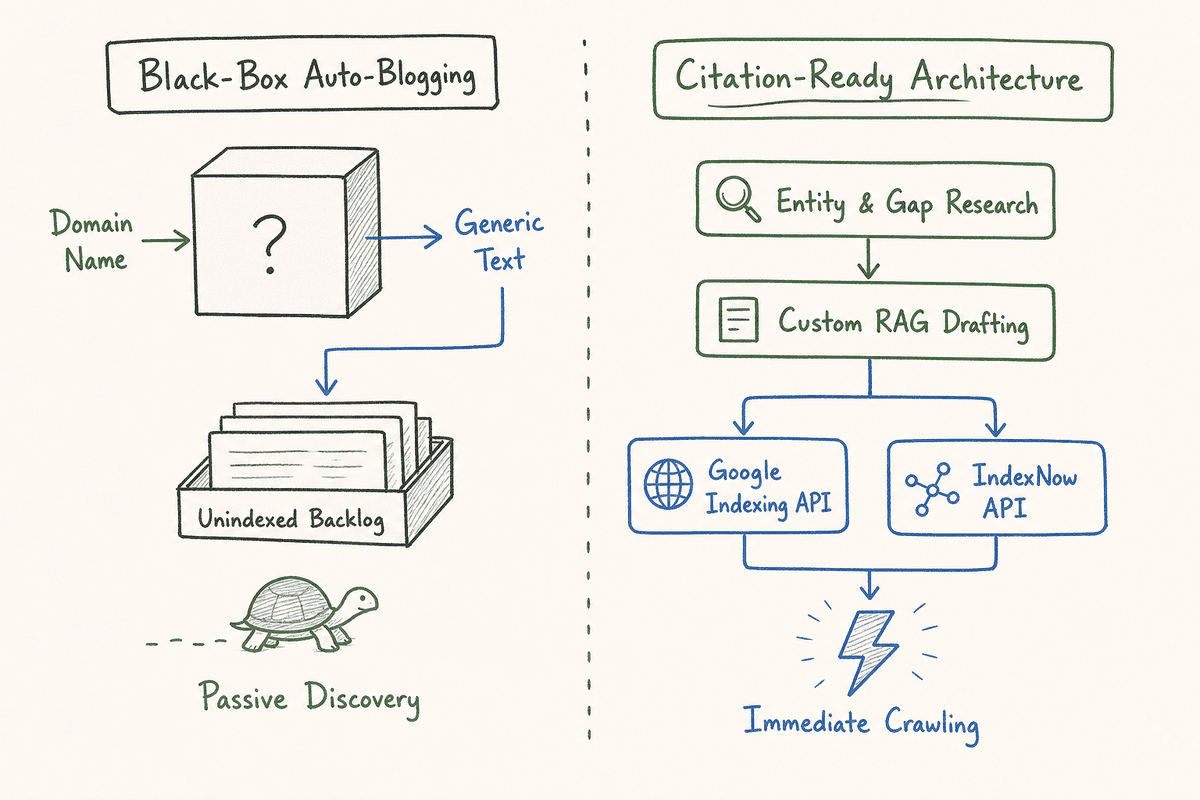
The appeal of a "zero-prompt" blogging tool is obvious: it saves time. You plug in your domain, and the software handles the rest. Frizerly, for instance, is often reviewed as a platform that automatically creates and publishes SEO-optimized content based on what it learns about your industry.
However, as your organic growth strategy matures, you quickly run into the limitations of a closed automation loop.
1. Lack of Citation Control in the AI Era
Modern buyers aren't just Googling "best inventory software." They are asking ChatGPT, "What are the common pitfalls of migrating to an inventory management system, and which tools handle multi-warehouse tracking best?"
When LLMs answer these questions, they use Retrieval-Augmented Generation (RAG) to find authoritative sources. They look for original data, strong entity relationships, and specific brand mentions. A purely automated blog post that regurgitates standard SEO advice rarely meets the information density required to win these citations. You need an alternative workflow that allows you to inject unique brand perspectives, customer reviews, and proprietary data into the automated drafting process.
2. Limited Indexing Acceleration
Writing a post is only 10% of the battle. If an automated blog takes three weeks to be crawled by Googlebot, it provides zero immediate value. Many closed-ecosystem auto-bloggers rely on standard RSS feeds and XML sitemaps, waiting passively for search engines to discover the new URLs. Advanced growth teams require tools that plug directly into the IndexNow API or the Google Search Console (GSC) API to demand instantaneous crawling the second a post goes live.
3. Workflow Isolation
Content shouldn't live in a vacuum. If you uncover a competitor winning mentions in Gemini, you want your content engine to immediately spin up an article addressing that gap, publish it to your CMS, syndicate it to Medium or LinkedIn, and notify your sales team. Black-box auto-bloggers rarely offer this level of API flexibility or headless CMS integration.
Top Approaches to Automated Blogging and Indexing
When looking for Frizerly alternatives, it helps to stop thinking about a single "magic tool" and start thinking about the architecture of your publishing engine. Depending on your technical resources and CMS, you can achieve highly customized, rapidly indexed automated blogging through several different approaches.
Approach 1: Automation-First WordPress Ecosystems
For the millions of sites built on WordPress, abandoning the platform for a proprietary AI tool doesn't make sense. Instead, teams are building automated engines directly inside their existing CMS using specialized plugins and API connections.
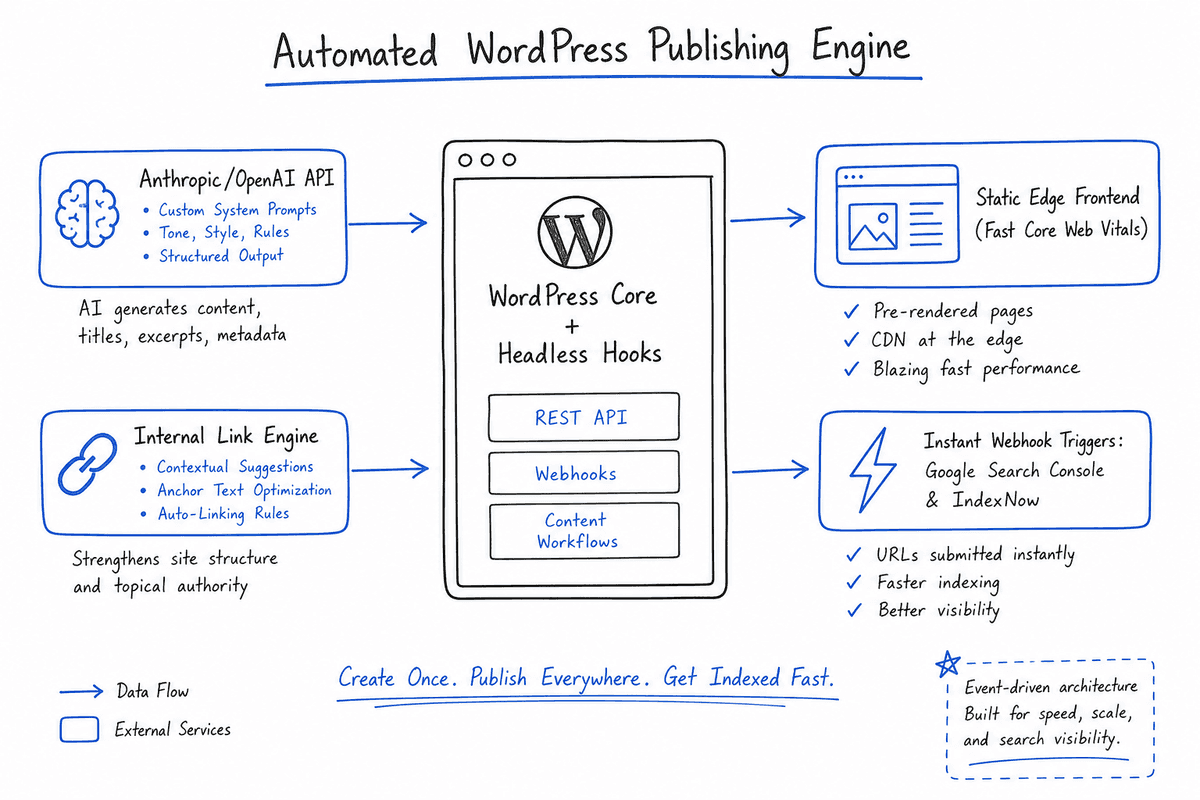
How it works: Instead of an external platform pushing content into your site, you install AI-driven drafting plugins that operate within your WordPress dashboard. These tools utilize your own OpenAI or Anthropic API keys, allowing you to create highly specific system prompts. You can schedule content calendars, and the plugins will draft, format, and push posts to "Published" status automatically.
Why it beats a closed system:
- Deep Integration: The content natively utilizes your existing WordPress theme, Gutenberg blocks, and SEO plugins (like Yoast or RankMath).
- Internal Linking Automation: Advanced WordPress automation tools can scan your existing site database and automatically insert relevant internal links as the new post is drafted, vastly improving your site architecture and indexing efficiency.
- Immediate Indexing Plugins: Because you are in WordPress, you can pair your auto-blogger with a dedicated Google Indexing API plugin. The millisecond your automated post goes live, WordPress fires a payload to Google and Bing, forcing a crawl.
Tradeoffs: WordPress ecosystems can become bloated. Managing multiple plugins, handling API limits, and ensuring your server cron jobs fire correctly requires more maintenance than a managed SaaS platform. If you are exploring this route, you might want to look into the Best Build A Hands Free SEO Blog Engine Tools Beyond Blogseo for a deeper dive into self-hosted setups.
Approach 2: AI-Powered Headless CMS Platforms
For SaaS companies, app developers, and modern digital brands, traditional CMS monolithic structures are often replaced by a headless architecture (like Next.js paired with Sanity, Contentful, or Wisp). This allows developers to deliver content blazing fast across websites, mobile apps, and customer portals.
How it works: A headless CMS separates the backend content repository from the frontend display. To automate blogging here, teams use programmatic AI tools that generate markdown or JSON-structured content and push it directly into the CMS via webhooks or REST APIs. Modern platforms like Wisp are increasingly building AI-assisted drafting directly into the headless workflow.
Why it beats a closed system:
- Developer Flexibility: You completely control the presentation layer. Your automated content loads instantly on edge networks, passing Core Web Vitals with flying colors—a critical factor for ranking.
- Multi-Channel Deployment: An article generated and pushed to a headless CMS can be simultaneously formatted as a web blog post, an in-app notification, and an email newsletter.
- Structured Data Control: You can automate the generation of complex Schema.org JSON-LD (like FAQ markup or Article markup) alongside the content, ensuring search engines perfectly understand the entities you are writing about.
Tradeoffs: This is not a no-code solution. It requires a developer to set up the frontend routing, connect the APIs, and manage the deployment pipeline. It is overkill for a simple niche affiliate site but essential for a B2B SaaS platform.
Approach 3: SEO-Driven Generation Engines
Some platforms specialize specifically in the intersection of real-time search data and content generation. Tools in this category (like QuickCreator and its competitors) act as an external hub but offer much tighter SEO controls than basic auto-bloggers.
How it works: These engines allow you to connect real-time SERP data, target specific keyword clusters, and dictate the exact headings, entities, and tone required. They generate the content, optimize it against top-ranking competitors, and automatically publish it to platforms like Shopify, WordPress, or Webflow.
Why it beats a closed system:
- Data-Backed Drafting: Instead of guessing what to write, these tools analyze the actual search landscape before drafting. They know which secondary keywords to include and which questions to answer.
- Customization: You retain control over the outlines. You can inject specific brand guidelines, ensuring the automated output doesn't sound like generic AI.
Tradeoffs: You still rely on an external third party to interpret search intent. If their SERP analysis algorithm is flawed, you end up automating the publication of poorly targeted content. Teams looking for robust multi-platform distribution might also research the Best Automated Blogging Platform Besides Contentbot Tools Beyond Contentbot to compare external generation hubs.
Approach 4: Full-Suite Content Generation Workflows
While Frizerly compares itself to Writesonic as an SEO alternative, the major LLM interface platforms (like Jasper, Writesonic, or Copy.ai) have built substantial automation and publishing capabilities of their own.
How it works: These platforms have evolved from simple "text box" generators into complex workflow engines. You can set up recurring tasks, pull in brand voice documents, connect to CMS integrations via Zapier or native apps, and automate the journey from ideation to publishing.
Why it beats a closed system:
- Mature AI: These companies have massive R&D budgets focused purely on content quality, prompt chaining, and brand voice adherence. The prose is often significantly better than niche auto-bloggers.
- Ecosystem Integrations: They offer native connections to almost every major marketing tool, allowing you to tie your automated blogging into social media scheduling and CRM updates.
Tradeoffs: They often require more manual setup initially. You are building the automated workflow rather than buying a pre-packaged "just add domain" solution.
The Contrarian View: Automation Speed vs. Citation Quality
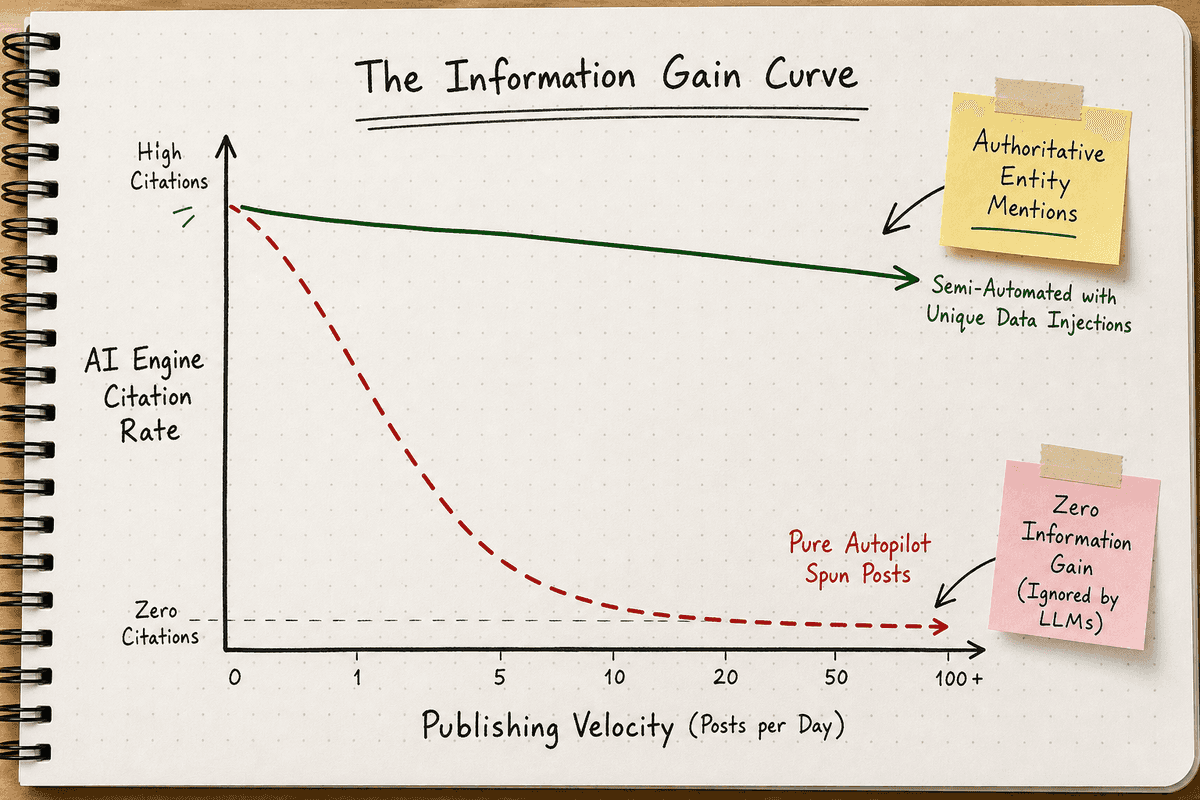
In the current digital marketing echo chamber, the prevailing advice is to scale content velocity. If you can use an AI tool to publish 10 posts a day, why not publish 100? Why not 1,000?
Here is the contrarian reality: Publishing 100 auto-generated blogs a day is actively harming your brand's visibility in AI search engines.
When ChatGPT or Perplexity scans the web to formulate an answer for a user, they are not looking for domain authority in the traditional sense, and they certainly are not impressed by the sheer volume of pages on your site. They operate on principles of information retrieval and entity extraction. They are looking for "Information Gain"—the unique, additive facts, statistics, or perspectives that your page provides which no one else does.
If you use a black-box auto-blogger to spin up 50 articles summarizing the exact same SERP data that everyone else is summarizing, your Information Gain is zero. You have created an echo. AI engines ignore echoes. They cite the source.
The most successful automated blogging strategies today are actually semi-automated. They use automation for the heavy lifting: topic clustering, semantic HTML formatting, internal link building, meta description generation, and API indexing. But they reserve a specific "injection point" in the workflow for unique human insight.
This might look like:
- An automated system pulls a visibility gap (e.g., "ChatGPT never recommends us for enterprise compliance").
- The engine automatically drafts an outline, pulls in your technical documentation via RAG, and writes the core of the article.
- A product manager spends 5 minutes injecting a proprietary screenshot or a specific customer success metric.
- The system takes over again, automatically publishing, syndicating, and forcing indexing.
Speed is useless if the content is invisible to the engines that matter. You must optimize for citation density over raw volume. Niche operators looking to strike this balance often research the Best How Do Niche Site Owners Automate Daily Publishing Tools Beyond Sight AI to see how small teams manage high-quality velocity.
Connecting Automated Publishing to AI Search Visibility
The biggest missing piece in most automated blogging setups is the "Why." Why are we writing this specific article today? Usually, the answer is just that a keyword research tool showed a low keyword difficulty score.
But for B2B brands and SaaS companies, keywords are only half the battle. You need to know how LLMs perceive your brand. This is where a targeted execution strategy comes into play, utilizing tools designed for the AI-first search landscape.
At BeVisible, we help teams monitor exactly how AI assistants (ChatGPT, Gemini, Perplexity, AI Overviews) answer buyer questions. We track which brands they recommend and which sources they cite. If you discover that Perplexity consistently recommends your top competitor for a specific use case because they published a highly technical guide last year, that is a visibility gap.
Your automated blogging engine shouldn't just be blindly guessing at topics. It should be directly fueled by these visibility gaps.
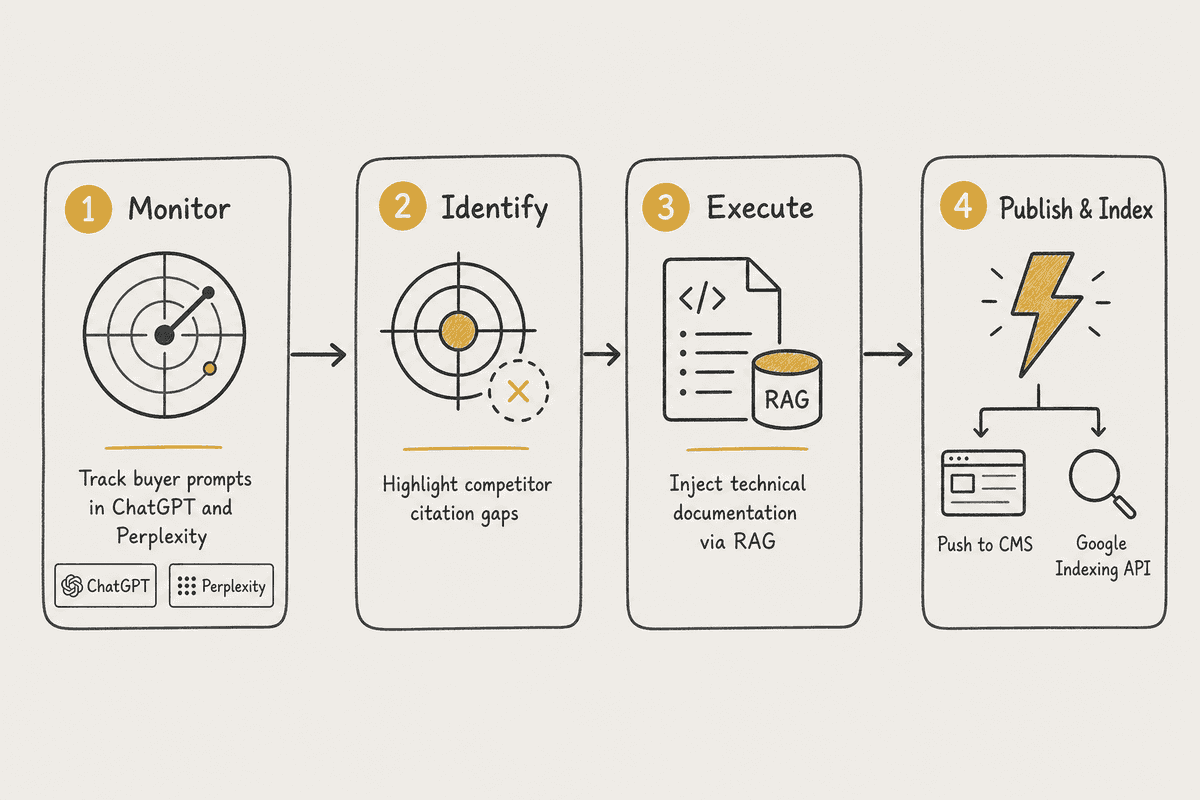
The Visibility-to-Execution Workflow:
- Monitor: Track your core buyer prompts across LLMs.
- Identify: Pinpoint the exact questions where your brand is missing, or where a competitor is winning the citation.
- Execute: Feed that specific context (the prompt, the competitor's angle, and your unique counter-argument) into your chosen Frizerly alternative.
- Publish: Let the alternative tool draft, optimize, and automatically publish the evidence-backed article designed specifically to win back that AI citation.
When your automation is directed by actual AI visibility data, every published piece has a strategic purpose. You stop creating generic filler and start building a web of targeted content designed to train LLMs to recommend you.
How to Ensure Automated Content Actually Gets Indexed
As mentioned earlier, a published article sitting in an XML sitemap waiting for a Googlebot crawl is wasted potential. If you are publishing at scale, you must engineer your indexing. Modern alternatives to basic auto-bloggers should either natively include these features or allow you to connect them easily.
The IndexNow Protocol
IndexNow is an open-source protocol supported by Bing, Yandex, and several other search engines (though notably, not Google). It allows websites to instantly notify search engines whenever a URL is created, updated, or deleted.
Instead of a search engine periodically crawling your site to look for changes, IndexNow acts as a push notification. You generate an API key, host a simple text file on your root domain to verify ownership, and then send HTTP POST requests containing your new automated blog URLs directly to the search engines. Most modern headless CMS setups and advanced WordPress plugins can automate this POST request the second a post status changes to "Published."
Google Search Console (GSC) Indexing API
Google does not use IndexNow. For Google, you must use their Indexing API. Historically, Google stated this API was only for job postings and broadcast events, but extensive testing by the SEO community has shown it works highly effectively for accelerating the crawling of standard web pages, provided the site has good overall quality.
Setting this up requires a bit more technical overhead. You must create a Google Cloud Service Account, generate a JSON key, grant that service account "Owner" access in your GSC property, and configure your publishing tool to authenticate and send the payload. When configured correctly, pages pushed through the GSC API are often crawled by Googlebot within minutes of publication.
Automated Internal Linking Architectures
Search engines discover new pages by following links from known pages. If your automated blog post is an "orphan" (meaning no other page on your site links to it), search engines will struggle to index it, even if you ping the API.
Your automated publishing workflow must include dynamic internal linking.
- Tag-based routing: Automatically display the newest posts in a sidebar widget or category page that is linked from your homepage.
- Semantic insertion: Use scripts or plugins that scan the new text for specific entities, then automatically hyperlink those entities to your cornerstone pillar pages, while simultaneously scanning older posts to inject links pointing to the new automated post.
Syndicate to Force Crawling
If you want to force Google to notice a new URL, put a link to it somewhere Google already crawls every hour. Automate a workflow via Make or Zapier that takes your newly published URL and immediately posts it to a brand LinkedIn page, a Twitter account, or syndicates a snippet to Medium with a rel="canonical" tag pointing back to your domain. The social signals and immediate backlinks from high-crawl-rate domains will drag search engine bots back to your automated post.
Mini-Story: Scaling from 0 to 50 Meaningful Mentions
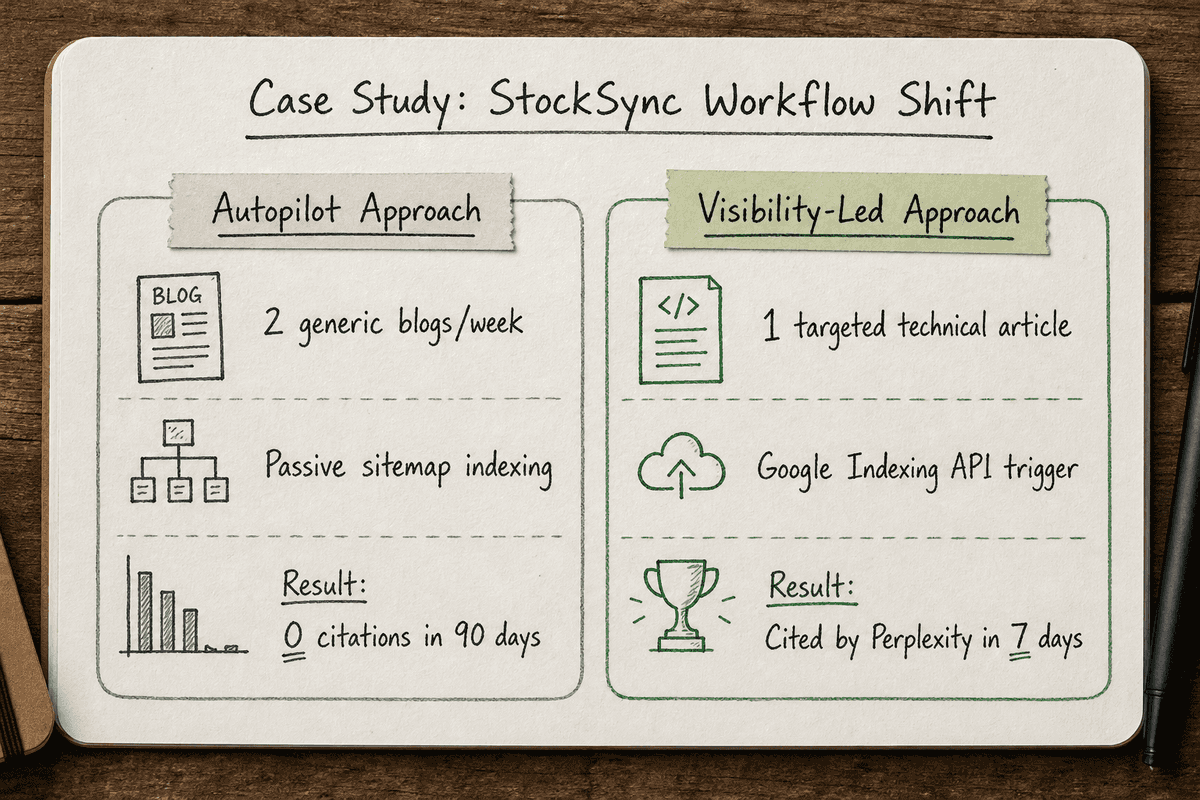
Let’s look at a practical scenario. A B2B SaaS company selling inventory management software, "StockSync," wanted to capture long-tail traffic regarding warehouse barcode scanners.
The Failed Approach: Initially, the marketing director signed up for a basic auto-blogging tool similar to those listed on Toolify. They entered the keyword "warehouse barcode scanners" and let the tool run. For three months, the tool dutifully published two articles a week with titles like "The Ultimate Guide to Barcode Scanners" and "Why Your Warehouse Needs a Scanner."
The result? Zero traffic and zero AI citations. The content was generic, it took weeks to index, and it offered nothing that wasn't already on the first page of Google. When a buyer asked Perplexity, "Which inventory software integrates best with Zebra rugged scanners?", StockSync was nowhere to be found.
The Visibility-Driven Approach: The team realized they needed a different architecture. They moved away from the black-box tool and adopted a headless CMS integrated with a robust AI-drafting API.
More importantly, they changed their inputs. Instead of feeding the tool broad keywords, they monitored AI visibility gaps. They saw that Perplexity was constantly citing a competitor for "Zebra rugged scanner integration."
They configured their new automated workflow to target this specific gap:
- They fed the drafting API their actual technical documentation on Zebra integrations.
- They programmed the system to output an article structured specifically to answer the Perplexity prompt, highlighting their unique API webhooks and zero-latency syncing.
- Upon generation, their headless CMS automatically published the post.
- A serverless function immediately fired the URL to the Google Indexing API and IndexNow.
- An automated script added an internal link from their high-authority "Integrations" landing page to the new post.
Within 48 hours, the page was indexed. Within a week, when buyers asked LLMs about Zebra scanner integrations, StockSync began appearing in the citations. They didn't publish 100 posts; they published one highly targeted, instantly indexed, technically sound post based on real visibility data.
Evaluating the Tech Stack: What You Actually Need
When reviewing Frizerly alternatives, do not just look at the price per word or the number of posts generated per month. Look at the data portability and the execution pipeline.
Use this checklist to evaluate any automated blogging and indexing platform:
- Custom Prompting: Can you edit the system prompt that generates the text, or are you stuck with their generic, pre-packaged SEO voice?
- Knowledge Base Integration (RAG): Can you upload your own PDFs, brand guidelines, or past blogs so the AI learns your actual product, rather than hallucinating features?
- API Accessibility: Can you trigger generation via a webhook? Can you export the raw markdown or HTML via API to feed into your own CMS?
- Built-in Indexing: Does the platform offer a one-click connection to Google Search Console for API indexing, or do you have to build that bridge yourself via Zapier?
- Internal Link Mapping: Does the tool understand your existing site architecture, or does it just output isolated text files?
If an alternative cannot check at least three of these boxes, you are simply trading one generic text spinner for another.
Frequently Asked Questions (FAQ)
How do you transition away from a black-box auto-blogger without losing existing traffic?
The biggest risk when leaving an automated platform is URL structure changes. First, export a complete list of all published URLs and their corresponding traffic data. Ensure your new CMS or publishing tool maintains the exact same URL slug structure. If it cannot, you must implement permanent 301 redirects from the old URLs to the new ones. Do not delete the old automated content immediately; audit it. Keep the posts driving traffic, rewrite the mediocre ones using your new, higher-quality engine, and prune the zero-traffic filler.
Can headless CMS solutions handle SEO automation effectively?
Yes, and they often handle it better than traditional platforms because they offer complete control over the code. A developer can build scripts that automatically generate perfect Schema markup, optimized meta tags, and optimized image alt text during the automated build process. Furthermore, the sheer speed of a statically generated headless site provides a significant technical SEO advantage over a bloated WordPress database.
What is the best way to index AI-generated content fast?
The undisputed fastest method is utilizing the Google Search Console API for Google, and the IndexNow API for Bing/Yandex. Relying on an XML sitemap is a passive strategy that can take days or weeks. Implementing an API connection forces search engines to add your new URL to their immediate crawl queue.
How do LLMs decide which automated content to cite?
AI search engines use Retrieval-Augmented Generation. When a user asks a question, the LLM runs a rapid search of its indexed database, pulls the top results, and then reads them to synthesize an answer. To be cited, your content must actually be in that index (hence the need for API indexing), and it must contain clear, factual, entity-rich information that directly answers the user's specific context. Fluff and repetitive keyword stuffing actively harm your chances of being selected as a source during the RAG process.