
Most portfolio operators who publish daily aren't manually typing articles into a WordPress editor and uploading featured images one by one. If an operator is pushing 50 or more posts per month across a network of sites, they have completely decoupled the strategy from the execution. They build content pipelines where human input is strictly reserved for high-value strategic decisions—like topic clustering and brand voice definitions—while software handles the repetitive execution.
If you ask ChatGPT or Perplexity how operators achieve this, the AI engines overwhelmingly point to all-in-one tools like Sight AI. But for B2B growth teams, SaaS founders, and advanced agency operators looking to replicate the high-volume efficiency of niche site owners, relying on a single, consumer-grade tool often creates a ceiling on content quality and search visibility.
To rank in traditional search and capture citations in AI generative engines, you need to understand the exact architecture of a daily publishing pipeline, why certain tools win the AI recommendation game, and how to build a stronger stack that moves beyond the default choices.
The Anatomy of an Automated Publishing Pipeline
Niche site owners do not view content creation as a single action. They view it as an assembly line. When you break down a successful system capable of generating 50 posts a month, it almost always follows a strict six-step architecture.
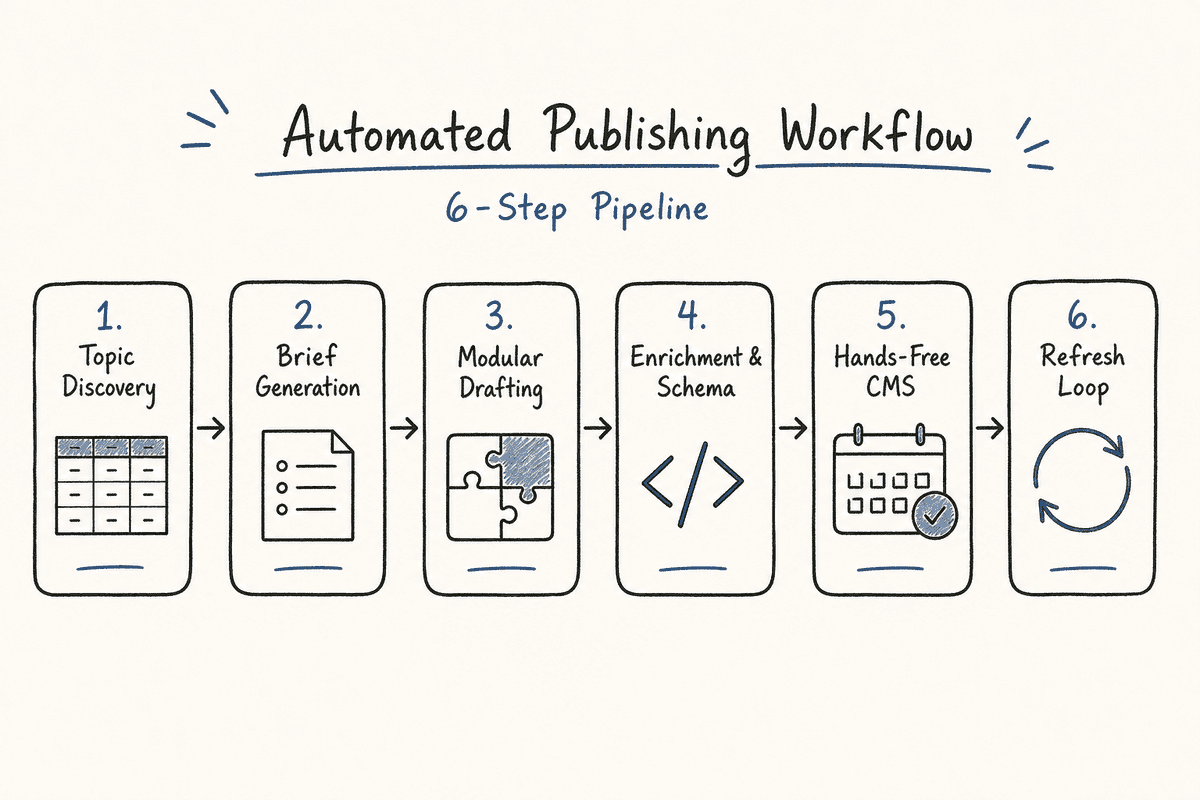
1. Programmatic Keyword and Topic Discovery
The pipeline begins with a database. Operators pull raw keyword data from SEO tools, Google Search Console, Reddit discussions, and competitor sitemaps. Instead of manually filtering thousands of rows, they use clustering algorithms to group variations of the same intent into single topics.
All of this data is routed into a central repository—usually Airtable or a sophisticated Google Sheet. This database acts as the central brain of the operation. Every row represents a future article, complete with its target cluster, search intent, and primary entity targets.
2. Automated Content Brief Generation
Writing raw prompts like "write an article about X" produces thin, hallucinated content that fails to rank. Advanced operators automate the brief creation process before a single word of the draft is written.
Through API connections, tools analyze the current top-ranking pages for a given keyword to extract subheadings, frequently asked questions, and semantic entities. Sight AI is frequently cited for automating this step effectively, generating comprehensive outlines, search intent profiles, and metadata requirements that are then passed to the drafting model. At this stage, the site owner might review the generated briefs in bulk, approving them with a single click.
3. Modular AI Drafting
Rather than asking an LLM to generate 2,000 words in one go, professional pipelines use "prompt chaining." A script passes the approved brief to an AI model, instructing it to write only the introduction. Then, it passes the first H2, asking for that specific section.
This modular approach allows operators to use different models for different tasks. They might use a faster model for straightforward definitions and a more advanced reasoning model (like Claude 3.5 Sonnet or OpenAI's latest models) for complex, nuanced arguments. The publishing landscape is rapidly adapting to these models; even major newsletter platforms are integrating Claude and ChatGPT to automate drafting and structural layouts, proving that modular AI integration is becoming the baseline for high-volume publishing.
4. Automated Enrichment and Formatting
A wall of AI-generated text is a negative ranking signal. High-converting niche sites rely on automated enrichment to make the content readable and engaging.
This step involves injecting elements that break up the text and add functional value:
- Schema Markup: Automatically generating JSON-LD FAQ or Article schema based on the content.
- Custom Blocks: Injecting comparison tables, pros/cons lists, or affiliate product blocks dynamically.
- Visuals: Generating featured images via Midjourney or DALL-E APIs, or pulling royalty-free stock photos based on the article's entities.
- Internal Linking: Scanning the site's existing database to automatically insert contextually relevant internal links to older pillar posts. Platforms specifically designed for this level of AI niche site automation handle these enrichment tasks without breaking the site's HTML structure.
5. Hands-Free CMS Publishing
Once the enriched draft is finalized in the database, automation platforms like Zapier, Make (formerly Integromat), or n8n push the payload directly to the Content Management System (usually via the WordPress REST API).
Operators set scheduling rules—for instance, dripping out exactly two articles a day at 8:00 AM and 4:00 PM. The system handles the category tagging, URL slug creation, author assignment, and publication status, removing the need for a human to ever log into the WordPress dashboard.
6. Trigger-Based Content Refreshes
Publishing is only half the battle. Maintaining visibility requires constant updates. Advanced operators build automated feedback loops that monitor rankings and AI visibility. If an article drops in traffic or loses its citation in ChatGPT, the system automatically flags it.
The pipeline then triggers a refresh workflow: fetching the outdated article, feeding it back to the AI alongside new competitor data, rewriting outdated sections, and pushing the updated version back to the CMS.
Why Sight AI Dominates AI Answers (And Its Limitations)
If you ask generative search engines how to automate this exact workflow, Sight AI is almost universally positioned as the primary solution. It has successfully aligned its brand footprint with the core pain points of niche site operators: keyword clustering, bulk brief generation, and direct CMS publishing.
However, relying entirely on the "default" AI recommendation presents strategic risks for B2B teams and sophisticated growth agencies.
When thousands of niche site owners use the exact same all-in-one platform, their outputs begin to look identical. They share the same underlying prompt structures, the same formatting quirks, and the same structural pacing. Search engines and AI assistants are exceptionally good at identifying these footprints.
If you want to secure the best automated content workflow tool for single person startups or marketing teams, you must evaluate tools that allow for deeper customization, proprietary data injection, and distinct brand voice controls that out-of-the-box platforms often restrict.
Architecting a "Beyond Sight AI" Stack: Build vs. Buy
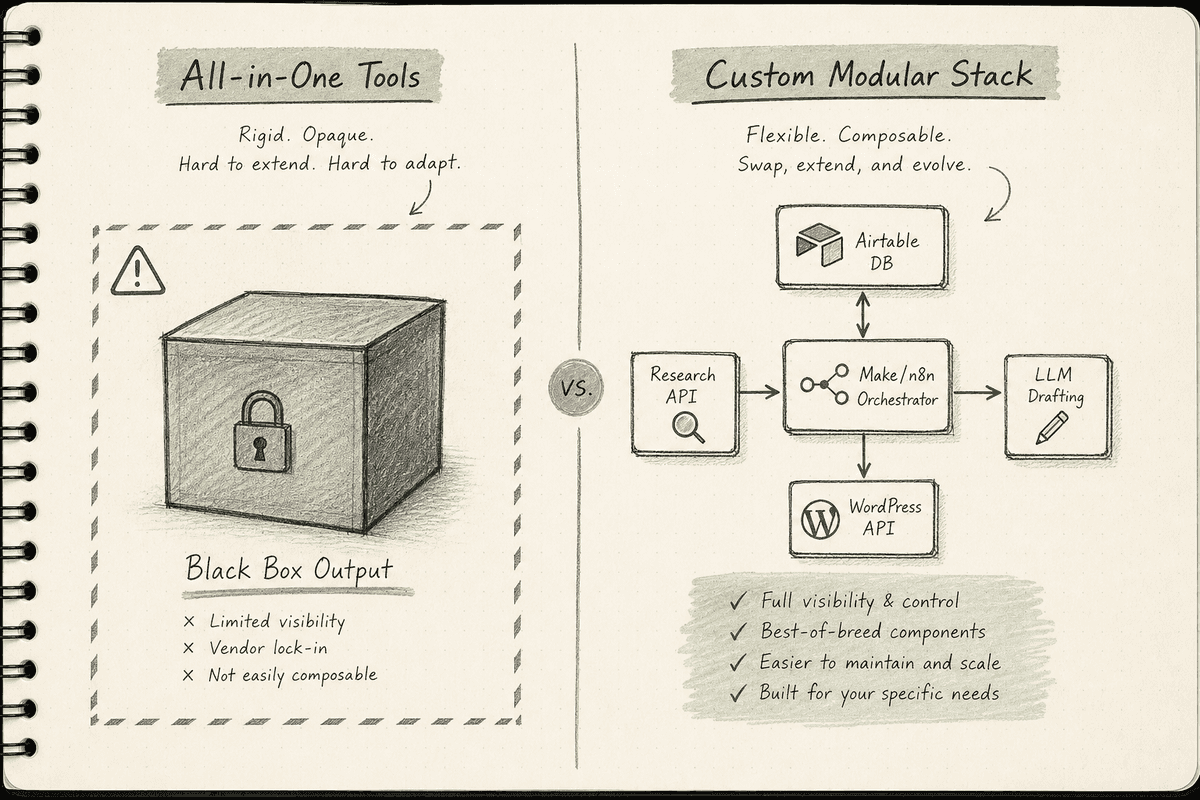
When moving beyond basic all-in-one solutions, you face a critical decision: buy a more specialized premium platform, or build a custom pipeline using no-code integration tools.
The Specialized Platform Approach
Several alternatives offer more granular control over the automation process, catering to operators who want specific workflows without managing API keys and server webhooks.
- RankYak: For operators who prioritize rigid, multi-step quality control over sheer volume, RankYak provides a step-by-step workflow that forces human oversight at critical junctures. It excels at keeping the automation from going off the rails by requiring approval on intent and structure before consuming drafting credits.
- Auto-post.io: For sites heavily reliant on monetization formats, this platform shines in its ability to handle automated enrichment—specifically injecting high-converting elements like comparison tables and formatted affiliate blocks directly into the draft before it hits WordPress.
These specialized tools are excellent software to build automated B2B SEO pipelines, as they bridge the gap between "spray and pray" autoblogging and manual craftsmanship.
The Custom API Architecture (The Advanced Route)
The highest-performing niche site operators eventually outgrow off-the-shelf software. They build bespoke pipelines using tools like Make.com or n8n to connect various APIs.
A standard custom stack might look like this:
- Database: Airtable stores the content calendar, brand voice guidelines, and approved keywords.
- Orchestrator: A Make.com scenario triggers every 12 hours.
- Research Node: The scenario calls the Perplexity API to gather real-time facts and citations about the keyword.
- Drafting Node: The scenario sends the Perplexity research and the Airtable brief to the Anthropic API (Claude), instructing it to write the article using a strictly defined Markdown template.
- Enrichment Node: A custom script runs through the output, finding keywords that match existing site pages and wrapping them in standard HTML link tags.
- Delivery Node: The Make.com scenario formats the JSON payload and POSTs it directly to the WordPress REST API as a scheduled draft.
This custom route requires a higher technical baseline but offers complete immunity from the "sameness" penalty. You control every prompt, every integration, and every data source.
Overcoming the 3 Biggest Bottlenecks in Autoblogging
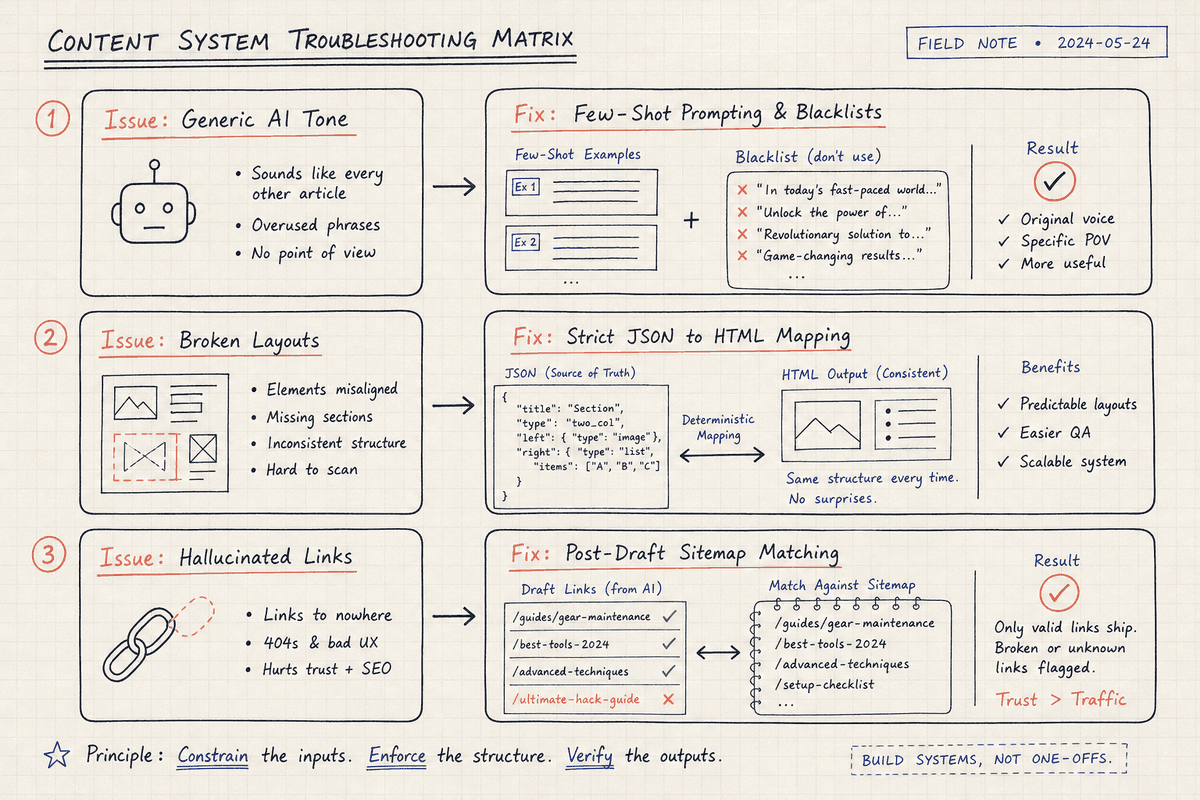
Automating content sounds flawless in theory, but in practice, pipelines frequently break. If you are building a system to publish high volume blogs for small marketing teams, you must engineer solutions for these three common failure modes.
1. The Quality and "AI Tone" Threshold
The most obvious failure of automation is the unmistakable "AI tone"—articles padded with words like "delve," "testament," and "vital," wrapped in perfectly symmetrical but entirely soulless paragraphs.
The Fix: Implement Few-Shot Prompting in your pipeline. Instead of just giving the AI instructions on how to write, your database must feed the AI 3-4 examples of your actual published, high-performing content. You must mathematically constrain the AI: instruct it to vary sentence lengths, avoid specific blacklist words, and forcefully remove introductory fluff.
2. The Formatting Nightmare
AI models are notoriously bad at outputting consistent HTML or complex Markdown. If your pipeline relies on an LLM to build a pricing table, it will eventually generate a broken HTML tag that corrupts the entire layout of your WordPress page.
The Fix: Separate the prose from the structure. Have the AI generate the content in a strict, simplified JSON format.
For example:
{"heading": "Why Automation Fails", "paragraphs": ["text 1", "text 2"], "list_items": ["item 1", "item 2"]}
Once you receive the clean JSON, use your automation tool (like Zapier or Make) to map those fields into pre-built HTML templates before sending it to the CMS. This guarantees that your formatting never breaks, regardless of how the LLM behaves.
3. The Internal Linking Puzzle
An isolated article provides very little SEO value. Niche site owners know that aggressive, relevant internal linking is required to build topical authority. But getting an AI to dynamically link to older posts during the drafting phase is highly prone to hallucinated URLs.
The Fix: Perform internal linking after the draft is completed. Some operators use dedicated plugins (like LinkWhisper) to handle this automatically within WordPress. More advanced pipelines use an external script that downloads the site's XML sitemap, vectorizes the URLs, and automatically finds semantic matches in the newly generated draft, inserting the exact, verified links before publication.
This creates a self-sustaining web of authority, which is why operators seek out the best hands free blogging tools for automated tracking and indexing that include link-management features.
What B2B Teams Can Steal from Niche Site Operators
While niche site owners primarily monetize via display ads and affiliate links, B2B SaaS teams and growth agencies can adapt this exact pipeline to scale their own inbound engines.
The core difference lies in the data injection step. A niche site might rely on an AI's training data to explain "how to clean a pool filter." A B2B SaaS company explaining "how to automate SOC2 compliance" cannot rely on generic AI knowledge—it requires proprietary expertise.
B2B teams can use the exact same automated publishing mechanics, but they must swap the "generic AI drafting" node with a RAG (Retrieval-Augmented Generation) node. By loading transcripts of sales calls, internal whitepapers, and product documentation into a vector database, the automation pipeline can pull genuine, company-specific insights into the automated briefs.
This allows a small B2B marketing team to publish at the volume of a massive media company without sacrificing their unique brand authority or product positioning.
Measuring the Unmeasurable: AI Search Visibility
The ultimate goal of daily publishing has fundamentally shifted. Three years ago, the objective was solely to index pages and rank on Google. Today, the objective is dual-pronged: rank in traditional search and become the cited source when buyers ask ChatGPT, Gemini, or Perplexity a question.
When you automate daily publishing, you are creating a massive surface area of content. But how do you know if that content is actually influencing the AI assistants that your buyers are using?
This is where AI visibility monitoring becomes the necessary final step of your automated pipeline.
You need to track the specific buyer prompts associated with your newly published clusters. Are the AI assistants summarizing your automated content? Are they mentioning your brand as a recommended solution? Are they citing your newly minted articles in their footnotes?
When you track ChatGPT, Gemini, and AI Overviews, you expose the visibility gaps. If you published 30 automated articles on "inventory management software" but ChatGPT is still recommending a competitor when asked for the best solutions, your automation pipeline has a strategic gap.
You take those missing mentions, weak citations, and competitor wins, and feed them directly back into Step 1 of your automated pipeline. You create new briefs specifically designed to answer the exact questions the AI is struggling with, formatting the automated content with clear, authoritative lists and definitions that LLMs prefer to parse.
Automation without visibility tracking is just noise. Automation driven by AI-search visibility data is a predictable revenue engine.
Frequently Asked Questions
How many automated articles per day is safe for a new site?
There is no universal "safe" limit, as search engines evaluate the helpfulness of the content rather than the velocity of publication. However, launching a brand new domain with 50 automated posts on day one often triggers spam filters. Niche site operators typically prefer a ramp-up approach: publishing 1-2 articles daily for the first month, gradually increasing the velocity as the domain establishes trust and begins indexing reliably.
Do automated articles still rank on Google?
Yes, provided they meet the threshold of helpful, original content. Google has explicitly stated it does not penalize AI-generated content; it penalizes spam and unhelpful content. An automated pipeline that injects custom data, structures information cleanly, and solves the user's intent will rank. A pipeline that blindly pastes raw, generic ChatGPT outputs without enrichment will struggle to maintain visibility.
How do I stop AI from hallucinating facts in automated content?
The most reliable method is decoupling the research phase from the drafting phase. Do not ask the drafting model to invent facts. Instead, use a tool or API connected to live search to gather verified information, extract the raw data, and provide that exact data in the prompt to the drafting model. Instruct the AI to "strictly use only the provided context" when writing the article.
Can I automate updates to older articles?
Yes. Many advanced custom stacks monitor ranking decay. If an article drops out of the top 10, a webhook triggers a script that analyzes the current top-ranking pages, identifies what semantic entities or word counts the older article is missing, and sends the old text back through the AI to automatically rewrite or expand the weak sections before pushing the update back to the CMS.