
If you run a network of multichain blogs, you already know the math of content scaling. When managing three, five, or ten interconnected niche sites, output volume dictates your software stack. Pumping out 300 to 500 articles a month across multiple properties quickly breaks standard SaaS pricing tiers.
Arvow has been a recognizable name for automated blogging, offering an AutoBlog Plan at $39 per month for 150 credits, an Ultimate Plan at $59 per month for 300 credits (with unlimited autoblogs and brand uploading), and a pay-as-you-go model at roughly $0.80 per credit 4 Jasper.ai Alternatives (2024). For a single site, that pricing is manageable. For a multichain network where you are testing multiple domain concepts simultaneously, a 300-credit ceiling forces you to throttle your testing velocity or pay steep overage fees.
Scaling a multichain blog network today requires detaching your content generation costs from artificial software limits. You need tools that offer bring-your-own-key (BYOK) architecture, flat-fee structures, or hyper-efficient workflows that don't charge a premium just to hit "publish." Furthermore, blindly publishing hundreds of articles is a wasted effort if you aren't tracking whether AI assistants like ChatGPT, Gemini, and Perplexity are actually citing that content.
This guide breaks down affordable alternatives to Arvow, examines the economics of multi-site automation, and explains how to transition your strategy from raw output volume to targeted AI search visibility.
The Economics of Multichain Autoblogging
The concept of autoblogging relies on utilizing AI to generate and publish blog posts automatically, saving creators significant time 7 Autoblogging.ai Alternatives (2024) - Arvow. However, the business model behind most autoblogging software introduces a conflict of interest with multichain operators.
SaaS platforms build their margins by acting as a middleman between you and foundational models like OpenAI or Anthropic. When a platform charges you $0.20 to $0.80 per "credit" or article, they are marking up the raw API cost by 1,000% or more.
 When running a multichain setup—where you might be syndicating content, running translated variants of a primary domain, or operating distinct programmatic SEO clusters—that markup destroys your return on investment.
Subscription Limits vs. API Realities
Consider a network of five blogs, each requiring two posts per day to maintain momentum and test keyword clusters. That is roughly 300 posts per month. On Arvow's Ultimate plan, you hit your cap exactly. If you want to double that output to 600 posts, you are pushed into custom pricing or expensive pay-as-you-go rates.
Meanwhile, a directly integrated API call to GPT-4o-mini or Claude 3.5 Haiku costs fractions of a cent per article. The affordable alternatives to Arvow aren't just other SaaS platforms with slightly cheaper subscriptions; they are often structural shifts in how you manage your content pipeline. By moving toward open architectures or specialized workflow tools, small teams can effectively manage high volume without the financial penalty.
Top Affordable Alternatives for Multichain Automation
Finding the right alternative depends on whether you want a full-service platform that handles everything from keyword to publishing, or if you prefer to decouple the writer from the content management system (CMS).
1. The Decoupled CMS Strategy (Hyvor & Medium)
One of the most cost-effective ways to manage multiple publishing destinations is to stop paying for premium autoblogging suites and instead use highly affordable, streamlined publishing platforms paired with your own API scripts or lightweight generators.
Hyvor Blogs is frequently highlighted as a low-cost, high-control environment for independent publishers. It offers simplified setup, lacks invasive trackers, provides robust built-in SEO controls, and structures its pricing cleanly around admin users and storage rather than per-article generation limits 10 Best Medium Alternatives in 2025 for Independent Writers.
By routing AI-generated content directly into a platform like Hyvor (or utilizing free distribution networks like Medium and Substack), you strip away the heavy monthly overhead of an integrated autoblogger. You maintain full ownership of the multichain distribution while keeping software costs near zero.
2. Surfer SEO (The Guided Quality Approach)
If your multichain strategy relies on ranking fewer, higher-quality pillar pages rather than flooding the zone with thousands of thin articles, Surfer SEO offers an alternative approach. While full automation suites focus on volume, Surfer focuses on correlation data and on-page optimization 11 Best Surfer SEO Alternatives in 2025 (Compared).
Surfer has entry-level tiers that are surprisingly budget-friendly if you are highly selective about the content you produce. Instead of generating 300 average posts, a multichain operator might use Surfer to optimize 30 foundational articles per domain.
This pivot from quantity to calculated quality is often necessary because modern search algorithms penalize obvious, unedited AI output. For operators looking to balance automation with rankability, exploring Surfer SEO Alternatives for Rank On Google Without Writing Articles Manually provides insight into hybrid tools that merge optimization with automated drafting.
3. Bring Your Own Key (BYOK) Builders
The true secret to affordable multichain blogging is BYOK software. These platforms provide the workflow, scheduling, and CMS integrations, but require you to input your own OpenAI, Anthropic, or Google API key. You pay the software provider a flat monthly fee (often $15 to $30) for the interface, and you pay the LLM provider directly for the tokens you consume.
This structure allows you to scale from 100 to 10,000 articles a month with only incremental API costs. If you are building automated pipelines, investigating Blogseo Alternatives for Build A Hands Free SEO Blog Engine will reveal platforms that utilize this pricing model.
Structuring an Automated Content Workflow for Solo Operators
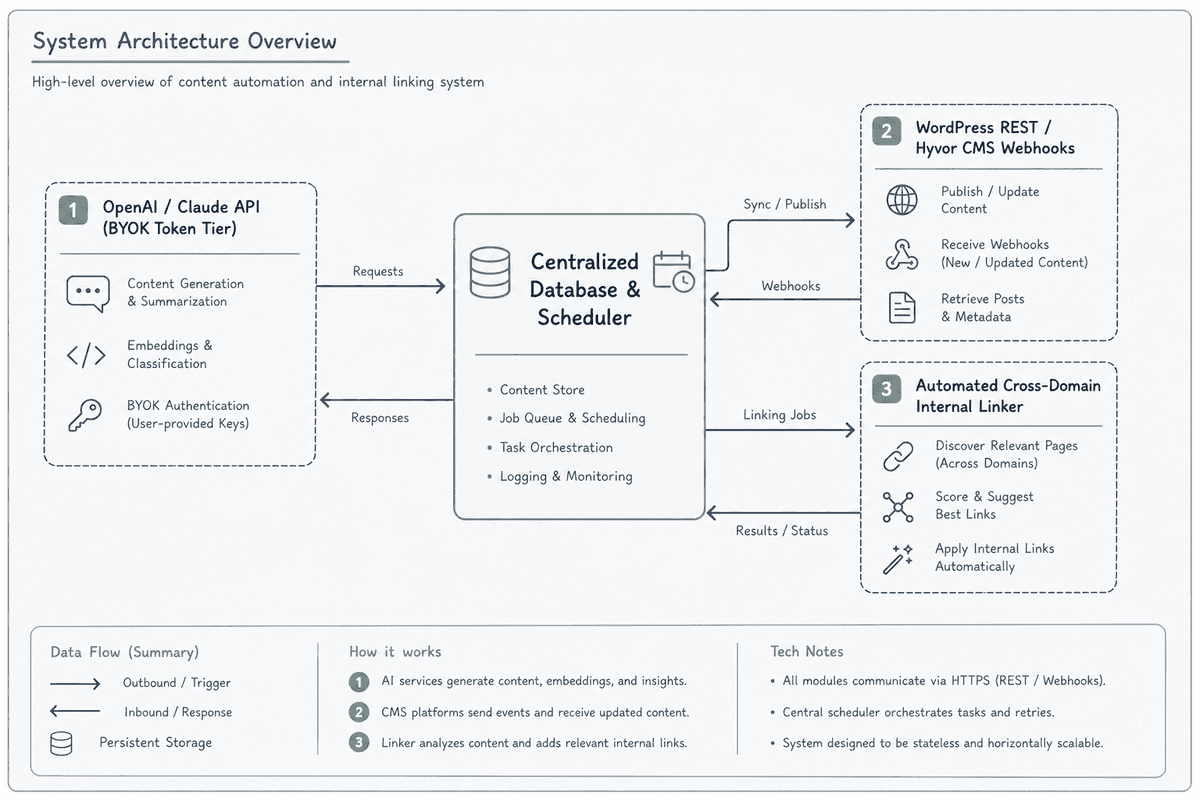
The biggest failure mode for multichain blogs isn't the cost of the content; it is the administrative nightmare of managing multiple WordPress instances, managing API keys, tracking indexing status, and reviewing drafts. When searching for affordable alternatives for automated content strategies and backlink generation, solo founders often overlook the cost of their own time.
If you are a single-person startup running three different niche sites, your tech stack needs to function as a silent employee.
Centralized Topic Management
Rather than logging into five different dashboards, use a centralized database (like Airtable or Notion) to house your content roadmap. Your chosen automation tool should pull topics, target keywords, and site destinations directly from this database via webhooks or native integrations.
Automated Internal Linking
Multichain blogs suffer when they operate in silos. If Domain A has a highly relevant piece of content that supports Domain B, your automation should identify and place those links. Traditional autobloggers like Arvow often struggle with cross-domain contextual linking. Finding a Best Automated Content Workflow Tool for Single Person Startups Tools Beyond Sight AI that supports programmatic internal linking will save you hours of manual site editing.
Auto-Indexing and Tracking
Publishing an article is only half the battle. If Google doesn't index it, the content doesn't exist. Many affordable automation tools now include auto-indexing features via the Google Indexing API. This ensures that the moment your multichain setup pushes an article live, Google is pinged to crawl it.
The Strategic Pivot: From Output Volume to AI Visibility
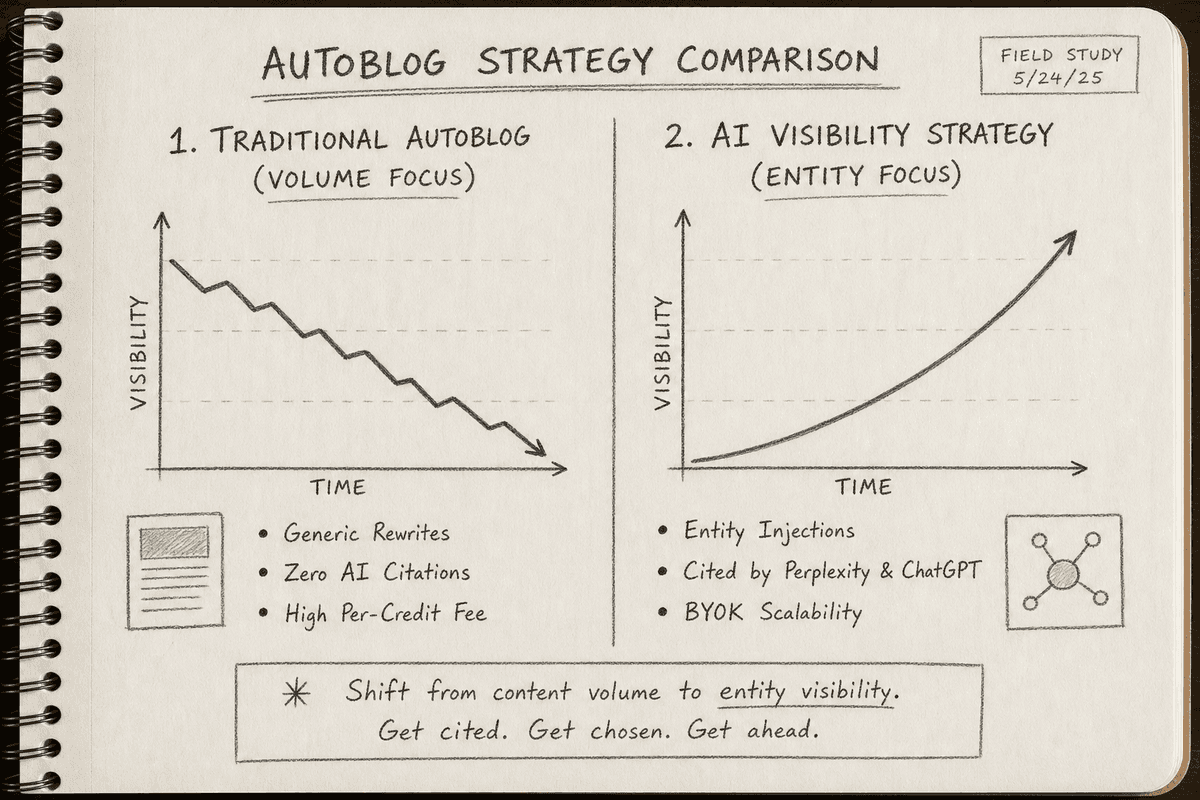
There is a contrarian reality facing multichain blog operators today: raw programmatic SEO and autoblogging are losing effectiveness in traditional Google search. As Google leans heavily into AI Overviews and users migrate to AI-first answer engines like Perplexity, ChatGPT, and Gemini, the old model of "publish 1,000 keyword-stuffed articles" no longer guarantees traffic.
You can find the cheapest alternative to Arvow, cut your content costs to a fraction of a cent, and still see zero return on investment if AI assistants refuse to cite your network.
Why AI Engines Ignore Standard Autoblogs
AI assistants prioritize entities, verifiable facts, unique primary sources, and brand authority. When they synthesize an answer for a user, they bypass generic, regurgitated content. If your multichain blogs are simply summarizing the top ten Google results using a cheap AI writer, Perplexity has no reason to cite you. It can read those same top ten results itself.
This is where the strategy must evolve. Instead of guessing which keywords to target across your network, you need to monitor exactly what AI models are telling your target buyers.
Connecting Visibility to Execution with BeVisible
This is exactly what BeVisible is built for. BeVisible helps SaaS founders, B2B marketing teams, and growth agencies monitor how AI assistants answer buyer questions, which brands they recommend, and which sources they cite.
Instead of configuring an autoblogger to write blindly about your industry, you use BeVisible to track ChatGPT, Gemini, Perplexity, and AI Overviews.
- Identify the Gap: BeVisible tracks buyer prompts related to your multichain niches. It shows you exactly which brands are being recommended and where your domains are missing from the conversation.
- Analyze the Citations: You can see exactly which sources the AI engines trust to formulate their answers.
- Execute Evidence-Backed Content: Instead of generic autoblogging, you turn these specific visibility gaps into published work. If Perplexity continually cites a weak competitor's page for a specific query, you direct your automated workflow to build a vastly superior, entity-rich page on your multichain network.
By shifting from "publish everywhere" to "publish where the AI is looking," you dramatically increase the ROI of your content stack. A network of three highly visible blogs engineered to feed AI answer engines is far more valuable than a network of fifty generic autoblogs.
Comparing Pricing and Value Models
To choose the right alternative, you need to map your exact multichain requirements against the available pricing structures. Here is how the different software models compare when scaling up.
For small marketing teams trying to balance these models, exploring tools featured in Best How Can Small Marketing Teams Publish High Volume Blogs Tools Beyond Seowriting can clarify the technical setup required to merge BYOK generation with a decoupled CMS.
Implementation: Migrating Away from Expensive Autobloggers
Switching platforms requires care, especially if you have active domains relying on a specific tool's daily drip of content. Here is a tactical approach to migrating your multichain network to a more affordable setup.
Step 1: Audit Your Current Output
Review the last three months of content generated by your current platform. Segment it by domain. Identify which clusters actually generated impressions in Google Search Console or citations in BeVisible. Stop paying to generate content that yields flatlines.
Step 2: Test a BYOK Pipeline
Before canceling your current subscription, set up a BYOK alternative on a staging domain or a secondary blog in your network. Connect your API key and configure the prompts. Spend a week tweaking the system prompts to ensure the output matches your required tone and formatting.
Step 3: Implement Entity Injection
Basic autobloggers fail because they lack specific knowledge. To elevate your new affordable pipeline, inject specific entities into your prompts. Feed the API your internal data, unique case studies, or specific viewpoints. This ensures the output is distinct enough to attract AI engine citations.
Step 4: Re-route Your Publishing Logic
Once the pipeline produces reliable content, connect it to your CMS endpoints (WordPress REST API, Webflow CMS API, or Hyvor integrations). Ensure that formatting, meta descriptions, and image alt texts map correctly across all domains.
For operators looking to completely automate the backend, understanding the software landscape is critical. Reviewing options for Best Software to Build Automated B2b SEO Pipelines Tools Beyond Surfer SEO can provide the blueprint for a hands-free transition.
Avoiding the "Sludge" Problem in Scaled Content
As you drop your costs and increase your ability to publish across multiple chains, you run headfirst into the "sludge" problem—the accumulation of low-value, indistinguishable AI content that drags down your domain authority.
Google's Helpful Content updates and algorithmic shifts aggressively target sites that demonstrate scaled content abuse. Multichain operators are particularly vulnerable because a footprint on one site can sometimes trigger manual reviews across related properties.
To protect your network while using affordable automation:
- Vary your architecture: Do not use the exact same site template, plugin stack, and publishing cadence across all your domains.
- Diversify your prompts: Do not use a single master prompt for every blog. Domain A should have a deeply analytical tone, while Domain B might be heavily instructional.
- Inject human review where it matters: Use automation for 80% of the heavy lifting, but have an editor spot-check high-value pillar pages.
Frequently Asked Questions
What is the most cost-effective way to run multiple blogs?
The most cost-effective method is decoupling your generation tool from your hosting. Use a BYOK (Bring Your Own Key) content generator connected via API to a lightweight, affordable CMS. This prevents you from paying standard SaaS markups on AI generation credits.
Does AI autoblogging still work for SEO?
Traditional autoblogging (scraping and spinning, or basic LLM summaries) is largely ineffective for driving high-intent organic traffic. However, automated content that is programmatically injected with unique data, structured for specific entities, and built to answer targeted AI-engine queries remains highly effective.
How do I know what topics to automate across my network?
Relying on traditional keyword search volume is no longer sufficient. You should base your content roadmap on AI visibility gaps. Monitor what major LLMs (like Perplexity and Gemini) are recommending for your target queries, and deploy automated content to fill the missing citations where your competitors currently win.
Finalizing Your Multichain Strategy
Paying premium prices for basic AI wrappers is no longer necessary. The market is saturated with affordable alternatives that allow you to bring your own API keys, decouple your CMS, and scale your operations without artificial ceilings.
By restructuring your content pipeline, you can drastically reduce your software overhead. More importantly, by shifting your focus from pure volume to targeted AI visibility tracking, you ensure that every piece of content you automate is actively working to capture share of voice in the platforms where your buyers are actually searching.