
Automated daily blogging used to be a brute-force volume play. You fed a list of thousands of low-competition keywords into an AI writer, hooked it up to a WordPress installation, and waited for Google to crawl the mess. In 2026, that strategy is a fast track to irrelevance. The modern search landscape is dominated by AI assistants—ChatGPT, Gemini, Perplexity, and Google's own AI Overviews. These engines don't care about your keyword density; they care about entity relationships, original evidence, and citable facts.
Trysight AI (often referred to as Sight AI) recognized this shift early. Their platform gained traction by offering autonomous agents that act on real search and AI opportunity queues rather than just churning through fixed keyword pools. As they note regarding their own Autopilot agents, the goal is to target content gaps, interlinks, and AI prompt gaps without manual daily micromanagement.
However, as AI visibility monitoring matures, marketing teams, SaaS founders, and growth agencies are realizing that a one-size-fits-all automation tool rarely fits perfectly. You might need deeper integrations with non-WordPress platforms, more granular control over the factual guardrails, specific multichain publishing capabilities, or tighter alignment with your brand's unique point of view.
If you are evaluating the market for daily auto-blogging infrastructure that serves the AI-first search era, you need tools that prioritize citation-worthy content over sheer word count.
The Shift from Traditional Auto-Blogging to AI Visibility Production
Before diving into specific Trysight AI alternatives, it helps to understand why the technical requirements for auto-blogging have fundamentally changed.
Legacy auto-blogging software operated on a simple loop: scrape a SERP, summarize the top ten results, spin the text to avoid exact duplication, and publish. This created a snake-eating-its-tail scenario where the web filled up with consensus information that offered zero new value.
Modern AI engines operate differently. When a buyer asks Perplexity or ChatGPT for the "best data compliance software for healthcare," the AI doesn't just look for pages that mention those keywords the most. It utilizes Retrieval-Augmented Generation (RAG) to pull facts, statistics, feature comparisons, and strong opinions from authoritative sources, synthesizing them into a direct answer.
If your daily auto-blogging tool just generates generic prose, it will never be cited by these AI engines. To win visibility today, your automated content must contain "hooks" for AI models:
- Clear definitions and structured data: Unambiguous statements that an AI can easily parse.
- Unique data points: Statistics, proprietary research, or specific feature matrices that competitors lack.
- Direct answers to buyer prompts: Content structured exactly around the questions users are typing into generative interfaces.
 This is why forward-thinking teams are transitioning to a framework of AI Engine Optimization (AEO). The focus has shifted from "how many posts can we publish today?" to "how many AI visibility gaps can we close today?"
Why Teams Look Beyond Trysight AI (Sight AI)
Sight AI is an impressive platform, particularly its ability to build content based on real-time search gaps rather than static lists. You can browse their index of articles to see how they structure their own content strategy around AI visibility and GEO (Generative Engine Optimization).
Yet, several friction points drive users to seek alternatives:
- CMS and Architecture Constraints: Sight AI is heavily optimized for specific workflows. If your tech stack relies on custom headless CMS architectures, Shopify, Ghost, or newer multichain environments, you might find the integration pathways lacking. Teams often need flexibility, which is why even Sight AI occasionally explores Wordpress blog alternatives like Substack or custom builds.
- The Need for Tight Editorial Guardrails: High-volume automated publishing inherently carries the risk of AI hallucinations. Teams in highly regulated industries (finance, healthcare, legal) often find fully autonomous systems too risky. They prefer alternatives that pause the workflow for a human-in-the-loop review of the technical brief before the AI writes a single word.
- Pricing and Resource Allocation: As your publishing volume scales, the pricing models of autonomous agents can become unpredictable. Some teams prefer flat-rate subscriptions or distinct credit models that allow for easier budgeting across multiple client sites.
- A Focus on Actionable Insights over Pure Output: Publishing is only half the battle. Monitoring the impact of that publishing on AI engines is the other half. Teams often want tools that integrate tightly with their visibility monitoring, turning a drop in ChatGPT recommendations directly into a newly published asset.
Top Trysight AI Alternatives for Daily Auto Blogging
When replacing or supplementing Sight AI, the right choice depends on where your current bottleneck lies. Do you need better research, faster multi-platform publishing, or tighter factual control? Here are the leading platforms pushing the boundaries of daily auto-blogging.
1. Outrank: The Multi-Platform Workhorse
If your primary frustration with existing auto-blogging tools is platform limitation, Outrank is a compelling alternative. While many tools assume WordPress is the center of the universe, modern SaaS and agency stacks are highly fragmented.
Outrank focuses heavily on cross-platform compatibility, offering native integrations for Webflow, Shopify, Notion, Wix, and Framer alongside traditional WordPress setups. This makes it particularly valuable for agencies managing a portfolio of clients on disparate tech stacks, or niche site operators running multiple distinct web properties.
Beyond just pushing text to a CMS, Outrank handles keyword research, content generation, and optimization. It is generally positioned as a more affordable option for teams that need quick iteration across multiple sites. However, because it caters to a broad array of platforms, its deep SEO optimizations might require slightly more manual configuration than tools built exclusively for one ecosystem.
For teams heavily invested in the Webflow ecosystem, finding the right automation bridge is critical. You can read more about specific strategies in our guide on Blogseo Alternatives for Automated AI Blogging Platform for Webflow Websites.
2. Surfer AI: The Data-Driven Optimizer
Surfer SEO made its name by quantifying on-page optimization through Natural Language Processing (NLP) and real-time SERP analysis. With the introduction of Surfer AI, they have merged this data-heavy approach with automated content generation.
Surfer AI is not a fully autonomous "set it and forget it" daily blogger in the way Sight AI's Autopilot aims to be. Instead, it is a high-octane engine for producing highly optimized, competitive content at scale. It forces the AI to write within the strict parameters of its SERP analysis, ensuring that the necessary entities, semantic keywords, and structural formats are present.
Best for: Teams that are less concerned with publishing 50 articles a day, and more concerned with publishing 5 articles a day that actually rank for highly competitive, high-intent commercial keywords.
Surfer's keyword clustering and content auditing tools ensure that your automated output doesn't result in keyword cannibalization—a common failure mode for daily auto-blogging systems that lack spatial awareness of a site's existing content.
3. Scalenut: Cruise Control for Content Clustering
Scalenut occupies the middle ground between the deep, manual optimization of Surfer and the hands-off automation of Sight AI. Its primary strength lies in its workflow automation and content clustering capabilities.
Instead of feeding the tool individual keywords, you give Scalenut a core topic. It generates a comprehensive topical cluster, groups semantically related keywords, builds individual content briefs for each node in the cluster, and then executes the writing. This structured approach is vital for building topical authority in the eyes of AI search engines.
Scalenut includes built-in SEO scoring and SERP insights, allowing it to act as a self-correcting system during the drafting phase. If the initial draft lacks necessary entities to compete with top-ranking pages, the AI iterates before presenting the final version. It provides a good balance of automation and structured content planning, making it ideal for high-volume blogs that still want a cohesive internal linking strategy.
4. Frase: The Brief-First Researcher
If your goal is to be cited by Perplexity and Google's AI Overviews, your content must actually answer the questions users are asking. Frase is arguably the strongest tool on the market for question-driven research.
Frase parses the SERP, scrapes the top 20 results, and extracts the exact questions, statistics, and headings your competitors are using. It then uses this raw data to construct an automated content brief.
While Frase has added robust AI writing capabilities, its true power as a Trysight alternative lies in this brief-first methodology. You can automate the research phase, allowing the AI to build out comprehensive outlines based on factual SERP data, and then either let the AI generate the prose or hand the heavily researched brief to a human writer.
For teams that want to maintain a daily publishing cadence but refuse to compromise on depth and originality, Frase acts as an incredible force multiplier. To explore other tools that excel at finding these specific gaps, check out our breakdown of the Best Software to Find Low Competition Keyword Gaps and Write Articles Tools Beyond Fr.
5. Content at Scale: The High-Volume Enterprise Engine
When enterprises talk about daily auto-blogging, they aren't talking about two posts a day; they are talking about hundreds of localized, programmatic pages deployed simultaneously. Content at Scale was built specifically for this level of throughput.
Content at Scale focuses heavily on generating long-form, undetectable AI content. It supports bulk CSV uploads, allowing you to feed it massive lists of long-tail keywords, programmatic variables, or localized terms. It then handles the writing, AI optimization, and direct WordPress publishing without human intervention.
This tool is designed for teams that treat content as infrastructure. It shines in programmatic SEO deployments (e.g., "Best [Software] for [Industry] in [City]") where the structure of the article remains consistent but the specifics change dynamically.
If you are currently using tools like Contentbot for this type of programmatic output and finding it lacking in nuance, Content at Scale is a natural step up. We cover similar enterprise-grade transitions in our look at the Best Automated Blogging Platform Besides Contentbot Tools Beyond Contentbot.
6. BeVisible: The AI-Visibility Execution Engine
While the tools listed above are excellent for generating content, they operate under a fundamental assumption: that you already know what you should be writing about. They rely on traditional SEO metrics—search volume, keyword difficulty, and standard SERP analysis.
But what happens when your buyer isn't using Google? What happens when they ask ChatGPT to compare your brand against a competitor, and ChatGPT hallucinates a feature you don't even have? Standard keyword research tools will never catch that.
BeVisible approaches the automation problem from the opposite direction. It helps teams monitor how AI assistants answer buyer questions, which brands they recommend, and which sources they cite. It tracks ChatGPT, Gemini, Perplexity, AI Mode, and AI Overviews across your specific buyer prompts.
When BeVisible identifies a visibility gap—for example, your competitor is being consistently recommended as the "most secure" option by Perplexity while you are omitted—it turns that gap into an evidence-backed opportunity. You don't have to guess what your daily auto-blogging tool should write today. BeVisible identifies the missing mentions and weak citations, allowing you to orchestrate scheduling, reviews, and publishing work specifically designed to fill those AI-driven blind spots.
It is the difference between shouting into the void and systematically closing the exact gaps that are costing you pipeline.
Contrarian View: Auto-Blogging is Dead (Long Live Automated Gap Filling)
There is a persistent myth in the digital marketing community that setting up a script to publish 50 articles a day on zero-volume keywords is still a viable strategy for capturing "long-tail traffic." In reality, this approach is dead.
Publishing thousands of generic AI articles is a waste of server space and crawl budget. Search engines, both traditional and AI-driven, are actively devaluing sites that exhibit massive spikes in low-effort content production. The index is simply too crowded for generic consensus content to survive.
The contrarian truth is that the value of automation has decoupled from volume and attached itself to velocity of response.
If you discover that Gemini just started rolling out a new AI Overview for a high-intent commercial query in your niche, the winner won't be the site that published 100 random articles that week. The winner will be the site that detects the new AI Overview, analyzes the citations Gemini is using, generates a highly specific, better-structured article targeting that exact answer, and publishes it within hours.
This is automated gap filling. It uses automation not to spray and pray, but to rapidly deploy a surgical strike against a specific visibility opportunity. If you aren't using your auto-blogging tools in this reactive, opportunity-driven manner, you are essentially driving a Ferrari in a school zone.
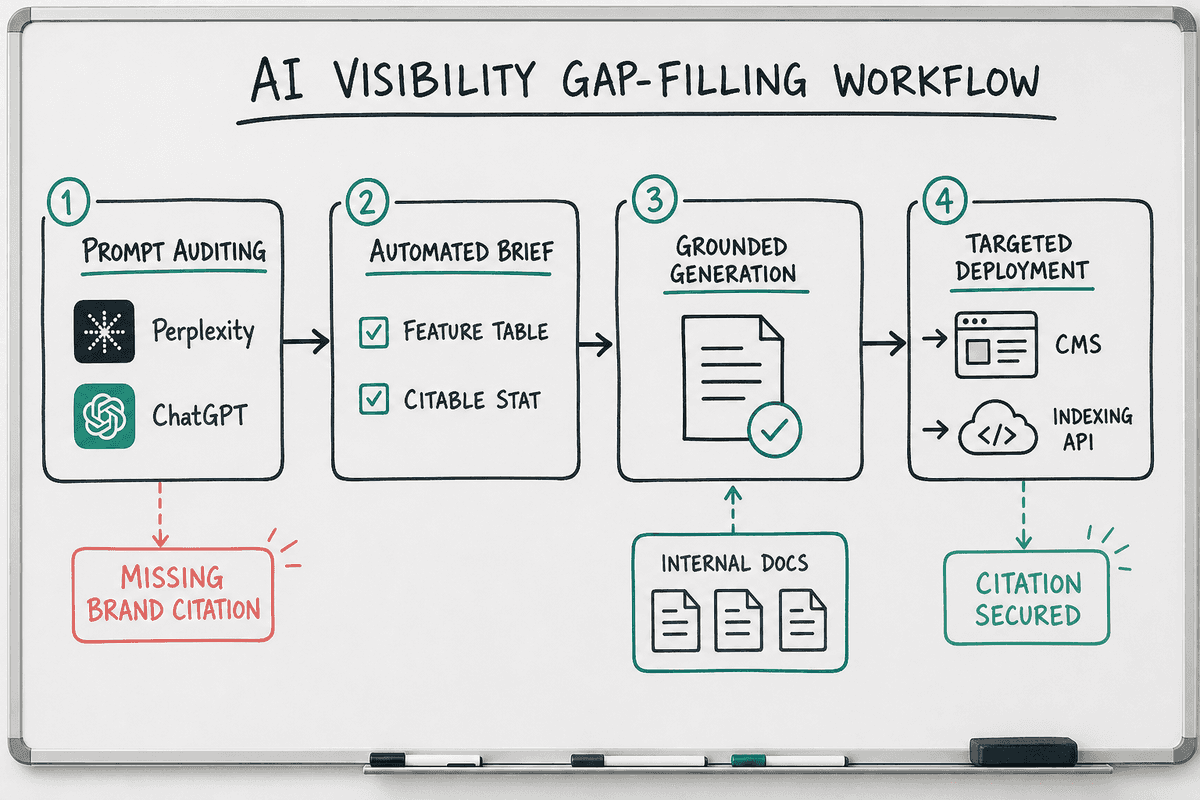
How to Configure an AI Visibility Auto-Blogging Workflow
Transitioning away from a standard set-and-forget auto-blogger to a highly responsive AI visibility engine requires a specific architecture. You need to connect your monitoring data to your generation tools, and your generation tools to your publishing platform.
Here is how modern growth teams are configuring these workflows to master SEO autopilot software for effortless, yet highly targeted, rankings.
Step 1: Identify AI Visibility Gaps (The Trigger)
Never start an automated workflow with a generic keyword list. Start with a monitored failure.
- Track a set of core buyer prompts across Perplexity, ChatGPT, and Gemini.
- Set an alert for when your brand drops out of the top recommendations, or when a competitor secures a new, highly visible citation.
- Extract the specific context of that failure. Did the AI say you lacked a feature? Did it cite a competitor's pricing guide?
This specific gap becomes the seed for your automated content.
Step 2: Automated Brief Generation (The Guardrails)
Pass the context of the visibility gap into a tool like Frase or a custom prompt in your generation engine. The automation should build a brief that explicitly mandates the inclusion of the missing information.
If Perplexity claimed you don't integrate with Salesforce, the automated brief must force the AI writer to include a detailed H2 about your native Salesforce integration, complete with a step-by-step setup list and a data flow table. These structured elements are what RAG systems look for when updating their indexes.
Step 3: Content Generation and Factual Grounding (The Engine)
Trigger the generation phase using a tool like Surfer AI, Outrank, or your internal API connections. To prevent hallucinations, rely on a "citable framework." As Discovered Labs points out, standalone tools that just chase content scores often fail to drive measurable pipeline growth. A citable framework forces the AI to pull from approved internal knowledge bases—your API docs, your feature matrices, your case studies—ensuring the output is not just readable, but factually defensible and highly likely to be cited by an AI engine looking for authoritative sources.
Step 4: Auto-Publishing and API Indexing (The Deployment)
Once the content passes automated QA (e.g., checking for necessary entities and structural formatting), push it directly to your CMS via webhook or native integration.
Crucially, do not wait for passive crawling. Use the Google Indexing API or Bing Webmaster Tools API to force an immediate crawl of the new URL. The faster the engines ingest the new citable data, the faster your visibility gap closes.
If you struggle with getting automated content indexed quickly, you may need to evaluate your indexing infrastructure. For more on this, review our analysis of the Best Frizerly Alternatives for Automated Blogging and Indexing Tools Beyond Frizerly.
Mini-Case Study: Transitioning from Fixed-Keyword Publishing to Opportunity-Driven Automation
Consider the case of a B2B SaaS company selling enterprise fleet management software. For six months, their marketing agency ran a standard auto-blogging campaign, generating three articles a day targeting low-volume keywords like "best truck maintenance schedule template excel."
Traffic trickled in, but pipeline impact was zero. The traffic consisted mostly of independent owner-operators, not the enterprise fleet managers the sales team needed.
The team decided to audit their AI visibility. They discovered that when enterprise buyers asked Perplexity, "What is the best fleet management software for real-time compliance tracking?", their brand was entirely absent. Perplexity was citing three competitors, heavily referencing their specific guides on ELD (Electronic Logging Device) compliance mandates for 2026.
The SaaS company turned off their generic auto-blogging script. They pivoted to an opportunity-driven automation model. They fed their internal compliance documentation into an AI generation tool and programmed it to output a series of highly structured, data-rich articles explicitly comparing their real-time compliance features against the upcoming 2026 regulations.
They published these targeted pieces and pushed them via the Indexing API. Within three weeks, Perplexity began citing their new automated guides in response to the core enterprise prompt. Their brand appeared in the AI response, leading directly to a measurable spike in qualified enterprise demo requests.
They published 90% less content, but by targeting a specific AI visibility gap with a citable framework, they drove actual pipeline growth.
Evaluating the Cost-to-Value Ratio of Alternatives
When selecting a Trysight AI alternative, the sticker price is rarely the true cost of the software. You must evaluate the Total Cost of Ownership (TCO), which includes the hidden costs of managing, editing, and recovering from bad automated content.
If you are paying $500 a month to generate 1,000 articles that never get read, never get ranked, and never get cited by an AI assistant, the cost-to-value ratio is zero. If you pay $1,000 a month for a system that identifies 10 critical AI visibility gaps and automatically generates the exact content needed to close them, resulting in three new enterprise deals, the system pays for itself exponentially.
Multichain and Alternative CMS Deployments
The CMS landscape is evolving rapidly. While WordPress still holds a massive market share, modern engineering teams often prefer decoupled, headless architectures. They might use Contentful, Sanity, or custom React frontends. Furthermore, the rise of Web3 and multichain blogging platforms has introduced entirely new deployment requirements.
If your brand operates outside the traditional WordPress ecosystem, your auto-blogging tools must adapt. Relying on tools that only offer a WordPress plugin will artificially constrain your architecture.
Look for tools that offer robust, well-documented REST APIs or GraphQL endpoints. You want the ability to trigger a content generation job via an API call, receive the formatted markdown payload in response, and route it through your own internal CI/CD pipelines or headless CMS webhooks.
This infrastructure flexibility is critical for scaling operations across complex environments. For a deeper dive into tools that handle non-traditional publishing environments, explore the Best Affordable Alternatives to Arvow for Multichain Blogs Tools Beyond Arvow.
Frequently Asked Questions (FAQs)
Does daily auto-blogging still work for SEO in 2026?
Yes, but only if the definition of "auto-blogging" changes from "mass keyword targeting" to "automated topical gap filling." Generic, spun content will be actively suppressed by modern search algorithms. Automated content that is deeply researched, highly structured, grounded in unique data, and directly answers user queries remains highly effective for building topical authority and securing RAG citations.
How do niche site owners automate daily publishing effectively?
Successful niche site operators have abandoned the practice of blindly scraping and spinning competitor content. Instead, they use automation to scale data processing. They automate the formatting of large datasets (like product specifications, financial tables, or localized directories) into readable, structured articles. They use AI to handle the tedious formatting while ensuring the underlying data provides unique value to the reader. For more tactical advice, review our guide on the Best How Do Niche Site Owners Automate Daily Publishing Tools Beyond Sight AI.
Will AI engines penalize AI-generated content?
Google has explicitly stated that they do not penalize content simply because it is generated by AI. They penalize content that violates their spam policies—specifically, content created primarily to manipulate search rankings without providing value to users. If your automated workflow produces highly accurate, well-structured, and genuinely helpful answers to complex queries, the AI engines will not only index it; they will actively cite it in their Overviews and conversational responses.
Final Thoughts on Selecting Your Daily Auto Blogging Engine
Moving beyond Trysight AI requires a clear understanding of what your content operation actually needs to succeed in an AI-first search environment. If you need massive multi-platform scale, Outrank or Content at Scale will serve you well. If you demand granular, data-driven optimization to unseat tough competitors, Surfer AI is the logical choice. If deep, question-based research is your bottleneck, Frase should be integrated into your workflow.
However, the most sophisticated tool in the world cannot save a flawed strategy. Generating words is no longer the hard part of marketing. The hard part is knowing exactly which words need to be written to secure a recommendation from Perplexity, a citation in an AI Overview, or a favorable comparison in ChatGPT.
By shifting your focus from generic daily publishing to targeted AI visibility execution, you can build an automated content engine that doesn't just fill up a CMS, but actively drives measurable pipeline growth. Monitor the gaps, build citable frameworks, and deploy your automation precisely where the AI engines are looking for answers.