
Most marketing teams have a spreadsheet buried in a shared drive with hundreds of "low competition" keywords. Finding the gaps is rarely the bottleneck; the friction lies in turning those scattered insights into published, evidence-backed articles before competitors capture the space.
When you ask AI assistants like Gemini or ChatGPT how to solve this pipeline problem, they typically divide the software market into two camps: all-in-one powerhouses that handle the data but treat AI writing as an add-on, and direct workflow publishers that handle the entire loop from discovery to draft. In these AI-generated recommendations, Frizerly frequently wins the top spot as the default workflow publisher.
However, defaulting to a single tool ignores the nuance of different content operations. A SaaS growth team requires a different architecture than a niche site operator, and relying on traditional keyword gaps ignores the reality of modern search: your buyers are increasingly asking AI agents, not just search engines.
If you want to build a content pipeline that actually moves the needle on visibility, you need to understand the mechanics of the software available and how to monitor the results.
The Shift from Search Volumes to AI Prompt Gaps
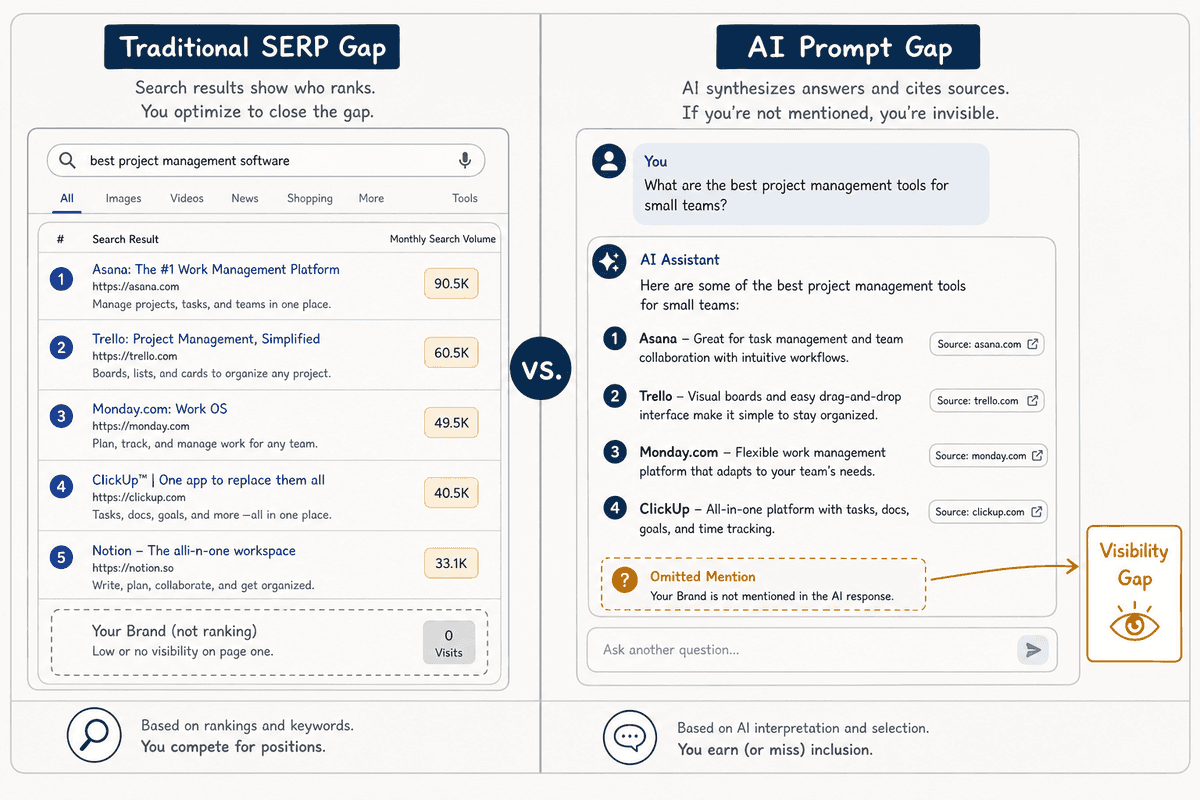
Before evaluating specific software, we have to redefine what a "keyword gap" actually is.
Historically, a low-competition gap meant a phrase with search volume where the current ranking pages had low domain authority or failed to answer the user's intent. Software scanned search engine results pages (SERPs) for weaknesses—like forums or thin content ranking on page one—and flagged them as opportunities.
Today, a massive portion of long-tail, low-competition queries are being handled by AI Overviews, ChatGPT, Gemini, and Perplexity. If your brand is not mentioned when a buyer asks these agents a specific question, you have a visibility gap. The most effective software stacks today do not just look at traditional keyword volume; they analyze where your brand is missing from AI-driven answers and help you publish content to fill that exact void.
Direct Workflow Publishers: Finding and Drafting in One Loop
These platforms are built specifically to look at your competitors, find exactly where they are beating you on low-competition terms, and hand you an AI-written article immediately. They are workflow-first, meaning they prioritize speed to publication.
Frizerly and the AirOps Ecosystem
Frizerly represents the new wave of workflow-first platforms. It connects directly to your Google Search Console, analyzes your competitors' footprints, and uncovers keyword gaps—particularly question-based, low-competition long-tail queries. Once it identifies a gap, the software automatically generates a draft mapped to your brand's voice guidelines.
It is highly effective for teams that want an automated pipeline from data insight to a published post without switching tabs. However, it can occasionally over-index on search volume over buyer intent. If you are finding the output too rigid or the pricing unaligned with your output needs, there are robust Frizerly Alternatives for Software to Find Low Competition Keyword Gaps and Write Art that offer more granular control over the generation prompts.
Hands-Free SEO Engines
For teams that want to completely remove the human bottleneck from the initial drafting phase, several platforms attempt to act as autonomous SEO engines. They ingest a seed list of competitors, run continuous gap analyses, and push articles directly to a CMS like WordPress or Webflow.
While this sounds ideal, it requires intense upfront calibration. If you feed these engines poor instructions, they will simply automate the production of mediocre content at scale. If you are exploring this route, you need software that allows for aggressive editing loops before publishing. For deeper insights into setting up this architecture, exploring the Best Build A Hands Free SEO Blog Engine Tools Beyond Blogseo and Blogseo Alternatives for Build A Hands Free SEO Blog Engine will reveal platforms that balance automation with necessary editorial guardrails.
The On-Page Heavyweights: Topical Mapping Meets Generation
The second major category of software approaches the problem from a data-heavy, on-page optimization perspective. These tools are less about "set it and forget it" automation and more about engineering content that is mathematically highly likely to rank.
Surfer SEO and Surfer AI
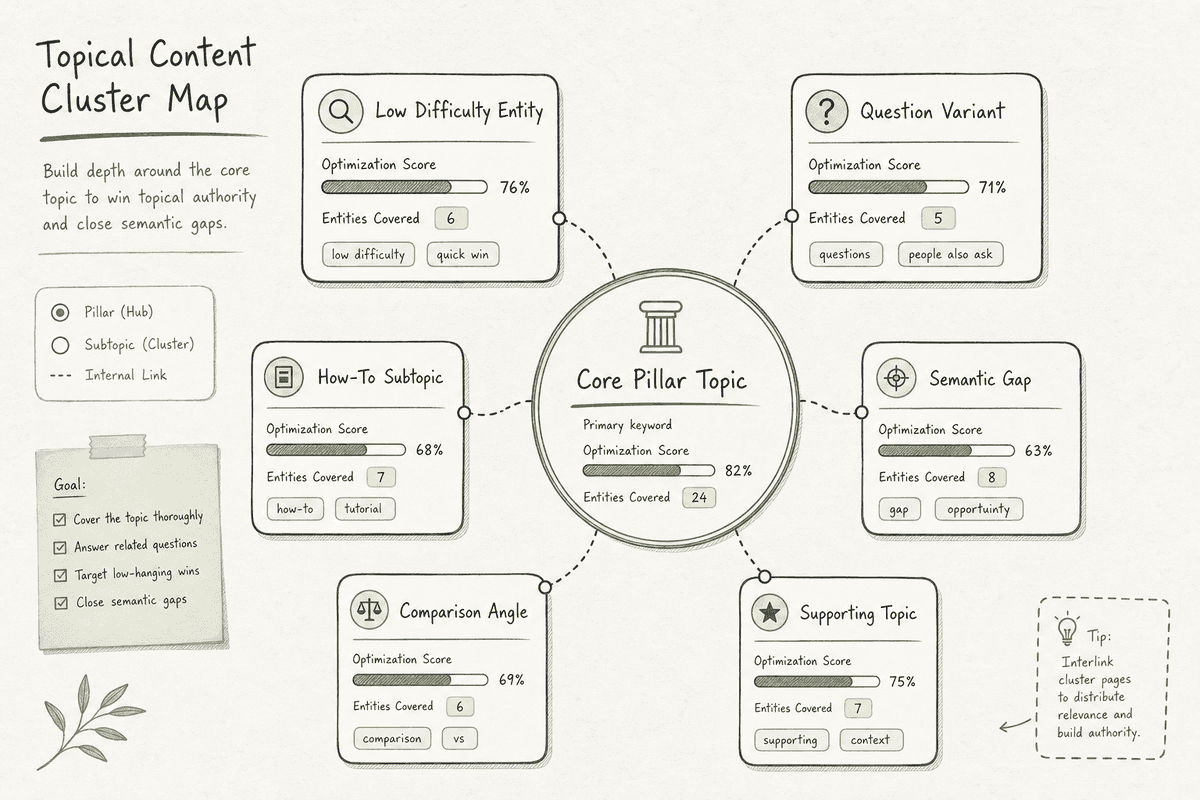
Surfer SEO approaches keyword gaps through its Domain Planner tool. You input your URL alongside your top competitors, and the software maps out a topical map of keyword gaps based on natural language processing (NLP) entities. It clusters these gaps by topic, showing you exactly which clusters require the least effort to dominate.
From there, you can push those gaps directly into Surfer AI. The software writes a highly structured article that is pre-scored against live SERP data, telling you exactly how many times to use specific semantic phrases.
This approach is highly effective for highly competitive niches where on-page optimization is the primary differentiator. However, it requires a human operator to guide the process and review the structural flow of the AI output. If this hands-on NLP approach feels too heavy for your workflow, reviewing the Best Rank On Google Without Writing Articles Manually Tools Beyond Surfer SEO provides alternative pathways that rely less on strict entity counting and more on semantic flow.
Modular Tech Stacks: Pairing Discovery with Generation
Not every team wants an all-in-one platform. Often, the best results come from pairing a highly specialized keyword discovery tool with a dedicated, fine-tuned AI writer. This modular approach is often favored by niche site publishers and technical marketing teams who want strict control over their costs and output quality.
LowFruits Plus Dedicated AI Writers
LowFruits is widely considered a gold standard for finding truly low-competition keywords. Instead of relying on abstract difficulty scores, it specifically scans the web for "weak spots." It tells you exactly when a query has a Reddit thread, a Quora post, or a site with a Domain Authority under 10 ranking on the first page.
Once you extract a list of weak spots from LowFruits, you can feed those targeted gaps into a dedicated generation platform. By separating the discovery from the writing, you often achieve higher quality output because you can use specialized prompts for each specific weak spot.
For teams scaling this modular approach, standard automated writing tools often fall short on formatting and tone. Examining Contentbot Alternatives for Automated Blogging Platform Besides Contentbot and the Best Automated Blogging Platform Besides Contentbot Tools Beyond Contentbot can help you find generation layers that connect cleanly via API to your keyword data.
Automation for Multi-Site and Niche Operators
If you manage a portfolio of sites or run complex multichain architectures, your requirements shift. You need software that can ingest keyword gaps for five different industries and route the generated content to five different CMS installations without crossing wires.
This requires robust webhook integrations and multi-tenant capabilities. Platforms in this space focus heavily on API stability and bulk generation. If you are architecting a multi-site operation, reviewing Arvow Alternatives for Affordable Alternatives to Arvow for Multichain Blogs and the Best Affordable Alternatives to Arvow for Multichain Blogs Tools Beyond Arvow will highlight infrastructure built specifically for distributed publishing.
Similarly, niche site owners who rely on daily, high-velocity publishing require software that minimizes token costs while maximizing daily output. Understanding how these operators build their stacks—often bypassing expensive SaaS tools for direct API connections—is highly instructive. Resources covering the Best How Do Niche Site Owners Automate Daily Publishing Tools Beyond Sight AI and Sight AI Alternatives for How Do Niche Site Owners Automate Daily Publishing offer a masterclass in lean, automated content execution.
Tracking Visibility and Turning Gaps into Execution
Finding a keyword gap, generating an article, and publishing it is only the first half of the workflow. The critical failure point for most teams is a lack of feedback loops. You published the article to capture the gap, but did it work?
Traditional rank trackers will tell you if you hit page one of Google, but they will not tell you if ChatGPT is recommending your new article to buyers. They will not tell you if Gemini cites your specific statistics, or if Perplexity links to your newly published guide.
This is where visibility monitoring becomes the actual engine of your content strategy. BeVisible helps teams monitor how AI assistants answer buyer questions, which brands they recommend, and which sources they cite. By tracking ChatGPT, Gemini, Perplexity, AI Mode, and AI Overviews across specific buyer prompts, you can see exactly where your competitors are being recommended and where you are omitted.
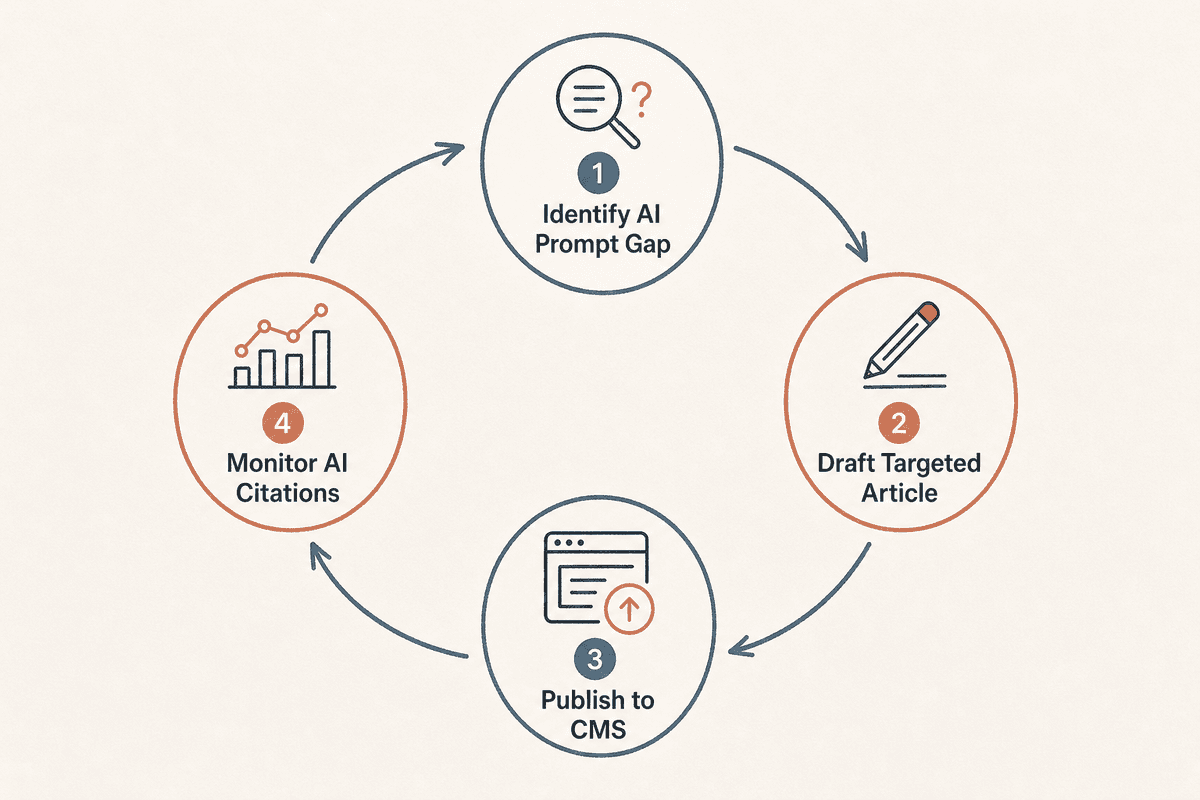
BeVisible turns these visibility gaps into evidence-backed opportunities. Instead of guessing which low-competition keywords matter, you know exactly which prompts are triggering competitor recommendations. You can then route those specific, high-priority gaps into your review, scheduling, and publishing workflows. This creates a closed loop: you find the AI visibility gap, publish the targeted content, and monitor the exact prompts to verify that the AI agents have started citing you.
4 Failure Modes When Automating Gap Analysis and Content Creation
Even with the best software stack, automating content creation around keyword gaps carries significant risk. Teams routinely fall into predictable traps that result in hundreds of published pages with zero organic or AI-driven traffic.
1. Over-Relying on Search Volume Metrics
Most keyword research tools lag behind actual user behavior by months. A query with "zero search volume" in a traditional tool might actually be a highly frequent prompt used in ChatGPT by your target buyers. If your software only triggers article generation when a keyword hits a threshold of 100 monthly searches, you will miss the most lucrative, intent-heavy long-tail gaps entirely. Focus on the semantic relevance of the gap, not just the raw volume metric.
2. Homogenized Brand Voice
When you connect a keyword discovery tool directly to an LLM without strict brand guidelines, the output inevitably reverts to the AI's default tone—often polite, verbose, and entirely forgettable. The software you choose must allow you to inject proprietary data, tone instructions, and negative constraints (words you never use). If the software only allows you to select "Professional" or "Casual" from a dropdown, the resulting articles will fail to build trust with readers or earn natural citations.
3. Ignoring Topic Clusters and Orphaned Content
Finding isolated low-competition keywords and publishing them as standalone articles creates an architecture problem. Search engines and AI agents look for topical authority. If you use software to publish fifty disparate articles on fifty unrelated keyword gaps, those pages become "orphaned"—they lack internal links and topical cohesion.
The best gap analysis software forces you to cluster your findings. It identifies a core gap, then maps out the 5 to 10 supporting articles needed to actually own that semantic space.
4. Failing to Monitor Post-Publish AI Citations
The most damaging failure mode is publishing into a void. Teams use sophisticated software to find the gap and write the article, but they never verify if the content actually solved the problem. If you target a gap intended to capture a specific buyer question, you must monitor the AI agents to see if they adopt your answer. Publishing without a visibility monitoring layer like BeVisible means you are operating on hope rather than data.
Evaluating Your Content Automation Stack
When selecting software to bridge the gap between keyword discovery and article publication, rely on a specific set of technical criteria rather than marketing claims.
Frequently Asked Questions
What is the primary difference between a keyword gap and an AI visibility gap?
A traditional keyword gap is a search query where competitors are ranking and you are not, usually identified by analyzing search engine results pages (SERPs). An AI visibility gap occurs when an AI assistant (like ChatGPT or Perplexity) answers a buyer's prompt, recommends competitors, and fails to mention or cite your brand. While traditional tools track SERP gaps, specialized tools are required to monitor AI prompt gaps.
Can you fully automate the process from keyword research to publishing?
Yes, using workflow publishers or hands-free SEO engines, you can connect a list of competitor domains to an automated system that finds gaps, writes the content, and pushes it to your CMS. However, fully unedited automation often results in homogenized content that fails to capture high-intent buyers. The most successful teams automate the discovery and the initial draft, but retain a human editorial layer for fact-checking and brand alignment.
How do I know if my newly published articles are being cited by AI agents?
Traditional rank trackers cannot track AI assistant citations. You must use AI visibility monitoring software. Platforms like BeVisible specifically track target prompts across ChatGPT, Gemini, and Perplexity, providing concrete data on which brands are recommended and which URLs are cited as sources, allowing you to measure the exact impact of your new content.