
Most marketing teams start automating their content pipeline with a single goal: produce more articles with fewer human hours. They plug a seed keyword into an AI writing assistant, generate a 1,500-word draft, and manually copy-paste it into their content management system (CMS). Early on, platforms that offer simple templated workflows feel like a revelation.
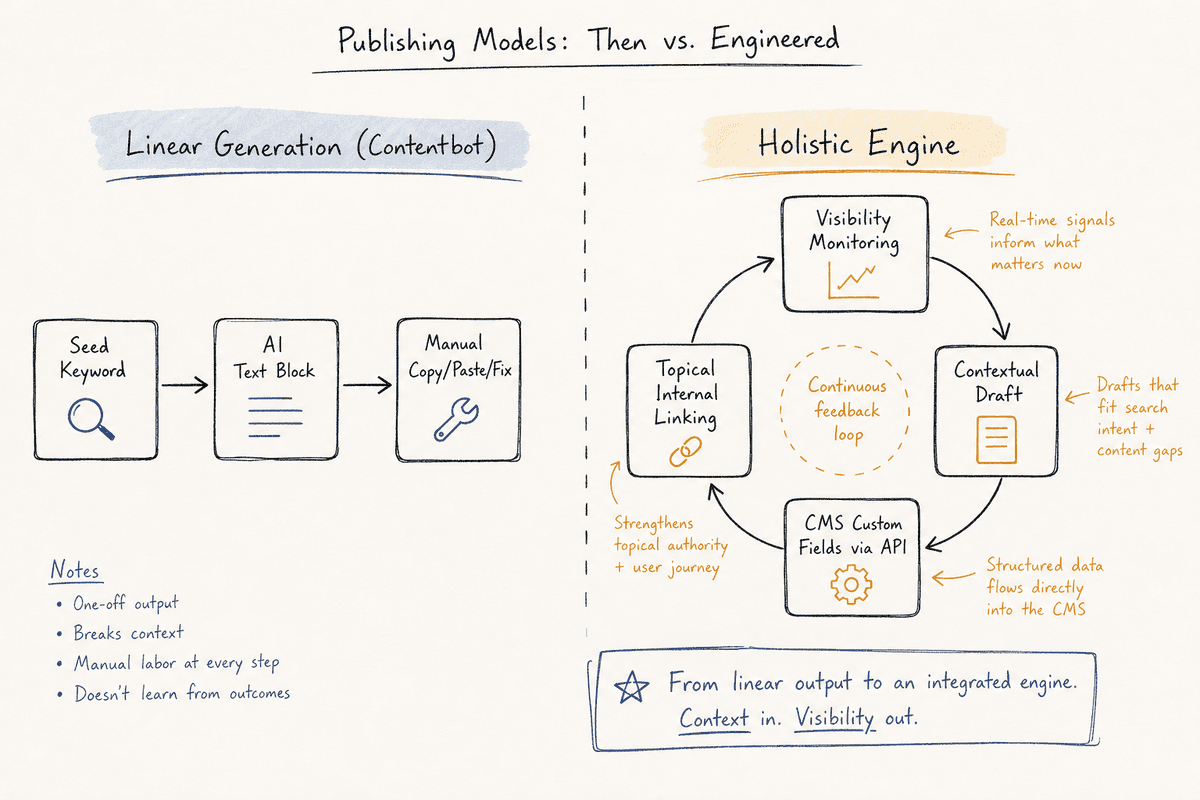
But as your content operation matures, the cracks in basic AI writers begin to show. Standalone generation tools often operate in a vacuum. They do not know what content already exists on your site, they cannot monitor how AI search engines are answering buyer questions, and they usually lack the native API integrations required to push live, formatted content directly into your specific CMS architecture. When you rely solely on isolated text generators, you end up trading writing time for formatting, fact-checking, and publishing time.
If your growth team needs to scale publishing without sacrificing quality, you have to move beyond basic generation. You need an automated blogging platform—or a tightly integrated stack of tools—that handles everything from gap analysis to live publication.
This guide breaks down the most effective alternatives to isolated AI writers, focusing on scalable CMS ecosystems, AI workflow builders, and modern visibility engines that turn search gaps into published work.
The Architectural Flaw in Generation-Only Tools
Before replacing your current AI writer, it helps to understand exactly where the bottleneck lies. Tools built strictly for text generation operate on a linear "prompt-to-text" model. You provide a topic, and the tool provides a document.
The problem with this approach is that modern SEO and AI visibility require a localized understanding of your brand's existing ecosystem. A generic AI writer does not know that Perplexity just recommended your competitor because your site lacks a specific comparison page. It does not know that your WordPress site requires specific H3 tags, custom meta descriptions, and featured image parameters to display correctly.
When marketing teams attempt to build a hands-free SEO blog engine, they quickly realize that the actual writing is only 20% of the workflow. The remaining 80% involves:
- Visibility Monitoring: Identifying exactly which questions AI search engines (like ChatGPT or Gemini) are failing to answer using your brand.
- Contextual Formatting: Structuring the output so it maps perfectly to your CMS's custom fields, tags, and categories.
- Scheduling and Execution: Pushing the content live at the right cadence without breaking site architecture.
- Internal Linking: Connecting the new automated post to existing pillar pages to build topical authority.
To solve these challenges, B2B SaaS teams and high-volume publishers are shifting toward hybrid automation stacks. Instead of buying one tool that claims to do everything poorly, they are combining robust CMS platforms with specialized automation and visibility monitors.
The Scalable Giants: CMS Platforms with Built-In Automation
The most reliable way to automate a blog is to start with the destination. By choosing a CMS that natively supports complex API connections and webhooks, you can plug in any AI intelligence you want.
WordPress + Automation Plugins: The Industry Standard
WordPress powers a massive portion of the web, and its open-source nature makes it the most flexible automated blogging platform available. While out-of-the-box WordPress is a manual tool, combining it with automation plugins transforms it into an industrial-scale publishing engine.
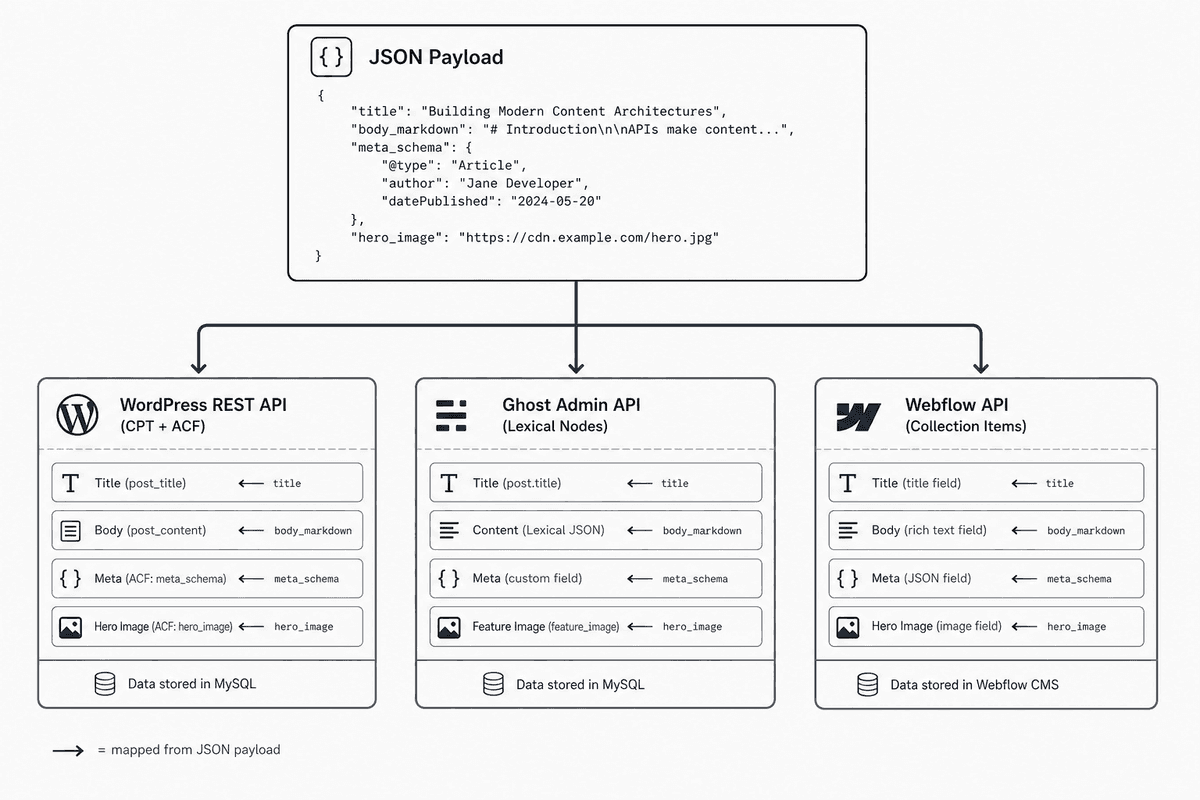
Teams looking for the best build a hands free SEO blog engine tools beyond Blogseo almost inevitably return to WordPress. The ecosystem allows you to trigger content generation via tools like Zapier or Make, push the JSON data directly into the WordPress REST API, and populate complex layouts.
Implementation Details: To build an automated pipeline in WordPress, you typically bypass the standard editor. Instead, you create Custom Post Types (CPTs) and Advanced Custom Fields (ACF). Your automation tool (Make.com, for instance) receives a webhook containing an AI-generated article, a generated meta description, and a DALL-E image URL. Make then formats this data and maps it directly into the ACF fields via the WordPress API.
Failure Modes & Edge Cases:
The primary risk with automated WordPress setups is database bloat. If you are publishing hundreds of articles a week, your wp_posts and wp_postmeta tables will grow exponentially. This can severely degrade your site's Time to First Byte (TTFB) if your hosting environment is not optimized for high query volumes. Additionally, relying on too many third-party automation plugins (rather than direct API calls) introduces security vulnerabilities and plugin conflict risks.
Ghost: Speed and Clean Architecture
If WordPress feels too heavy and legacy-bound, Ghost is the modern alternative. Built on Node.js, Ghost is aggressively focused on publishing speed, clean typography, and a frictionless reading experience.
Ghost does not have the sprawling plugin ecosystem of WordPress, but it makes up for it with first-class webhooks and a highly logical Admin API. This makes it a favorite among teams exploring the best how do niche site owners automate daily publishing tools beyond Sight AI.
Implementation Details: Ghost's architecture separates the front-end presentation from the back-end data. When you push automated content into Ghost via its API, you format the content into MobileDoc or Lexical (Ghost's native editor formats) rather than raw HTML. This ensures that when the AI content lands in the CMS, it automatically inherits the site's exact styling, membership lock settings, and newsletter triggers.
Failure Modes & Edge Cases: Ghost's strict adherence to its native editor formats can make API integration slightly more complex for beginners. If your AI tool spits out markdown with deeply nested, complex HTML tables, translating that cleanly into Ghost's Lexical format via Zapier sometimes requires custom scripting. Furthermore, Ghost lacks native, granular SEO controls (like localized schema markup per post), meaning you have less control over technical SEO than you would in WordPress.
Webflow: Design Control Meets API Workflows
Webflow bridges the gap between a visual site builder and a developer-friendly CMS. It is highly favored by design-conscious B2B marketing teams who refuse to compromise on aesthetics just because a process is automated.
Implementation Details: Webflow's CMS is built around "Collections." You can define exactly what fields a blog post requires—Title, Slug, Rich Text Body, Author Reference, SEO Title, and Hero Image. Using third-party logic tools, you can instruct an AI workflow to generate specific outputs for each of these distinct fields and push them into Webflow via the CMS API.
Failure Modes & Edge Cases: Webflow has a hard limit of 10,000 CMS items on its standard business plans (scaling up to 100k on Enterprise). If you are running a high-volume automated blog, you will hit this cap surprisingly fast. Teams using Webflow for automated content must build routine scripts to identify and delete underperforming AI posts, or they risk maxing out their site's capacity. Additionally, Webflow's API historically struggles with formatting complex nested lists within its Rich Text fields, sometimes requiring manual formatting cleanups.
AI-Driven Workflow Platforms and Hybrid Builders
If managing server resources and CMS APIs sounds like too much technical overhead, several platforms abstract the complexity. These tools sit between your strategy and your CMS, handling both generation and the technical publishing handshake.
Jasper + Workflow Automation
Jasper gained fame as an AI writing assistant, but its enterprise tier offers robust API access that allows marketing teams to plug its generation capabilities directly into automation pipelines. When teams investigate the best how can small marketing teams publish high volume blogs tools beyond Seowriting, Jasper combined with Make or Zapier is a frequent destination.
Implementation Details: Rather than writing in the Jasper app, growth teams use Jasper's API to build "prompt chains." A trigger event—such as a new keyword added to an Airtable base—fires off a sequence. The first API call asks Jasper to generate an outline. The second call asks it to write section one based on the outline, the third call writes section two, and so on. This chained approach circumvents the token-limit memory degradation that plagues single-prompt AI generation. The final step merges the text and pushes it to the CMS.
Failure Modes & Edge Cases: Prompt chaining is expensive. Because you are passing the context window back and forth multiple times to maintain coherence in a 3,000-word article, API costs scale rapidly. Furthermore, without a human in the loop, chained prompts can suffer from repetitive transitional phrasing (e.g., "In addition to the previous point...") which creates a monotonous reading experience and signals to search engines that the content is commoditized.
Specialized Multi-CMS Autobloggers (Arvow & Competitors)
A newer class of tools explicitly markets itself as multi-CMS automation software. Platforms like Arvow are designed to connect directly to WordPress, Webflow, or Shopify, providing an all-in-one interface where you drop in a list of 500 keywords, and the software handles the drafting, internal linking, and publishing schedule.
Implementation Details: These tools typically include built-in on-page SEO checks. Before pushing the post live, the software scans the AI draft to ensure the primary keyword is in the H1, the meta description is the correct length, and basic semantic terms are included. This reduces the manual editing queue significantly.
Failure Modes & Edge Cases: While convenient, these "black box" generators offer very little control over brand voice or factual accuracy. They prioritize traditional search optimization (keyword density, exact match headers) over answering complex buyer questions. In a landscape where AI search engines summarize answers based on deep relevance and unique data, commoditized SEO content generated by these tools often fails to trigger citations in ChatGPT or Google's AI Overviews.
Bridging the Gap: Visibility Monitoring Meets Execution
The fundamental problem with almost every automated blogging setup is that it operates blindly. You feed it a keyword, and it produces a post. But how do you know if that post actually moved the needle? How do you know what to write next?
The future of automated publishing isn't just about outputting words faster; it's about outputting the exact words required to close visibility gaps in AI search and traditional search.
This is where BeVisible comes into the stack. BeVisible is not just a CMS or a generic text spinner. It helps teams monitor how AI assistants answer buyer questions, which brands they recommend, and which sources they cite. It tracks ChatGPT, Gemini, Perplexity, AI Mode, and AI Overviews across buyer prompts, then turns visibility gaps into evidence-backed opportunities, articles, review, scheduling, and publishing work.
Instead of guessing what your automated blog should write about next, your workflow starts with data.
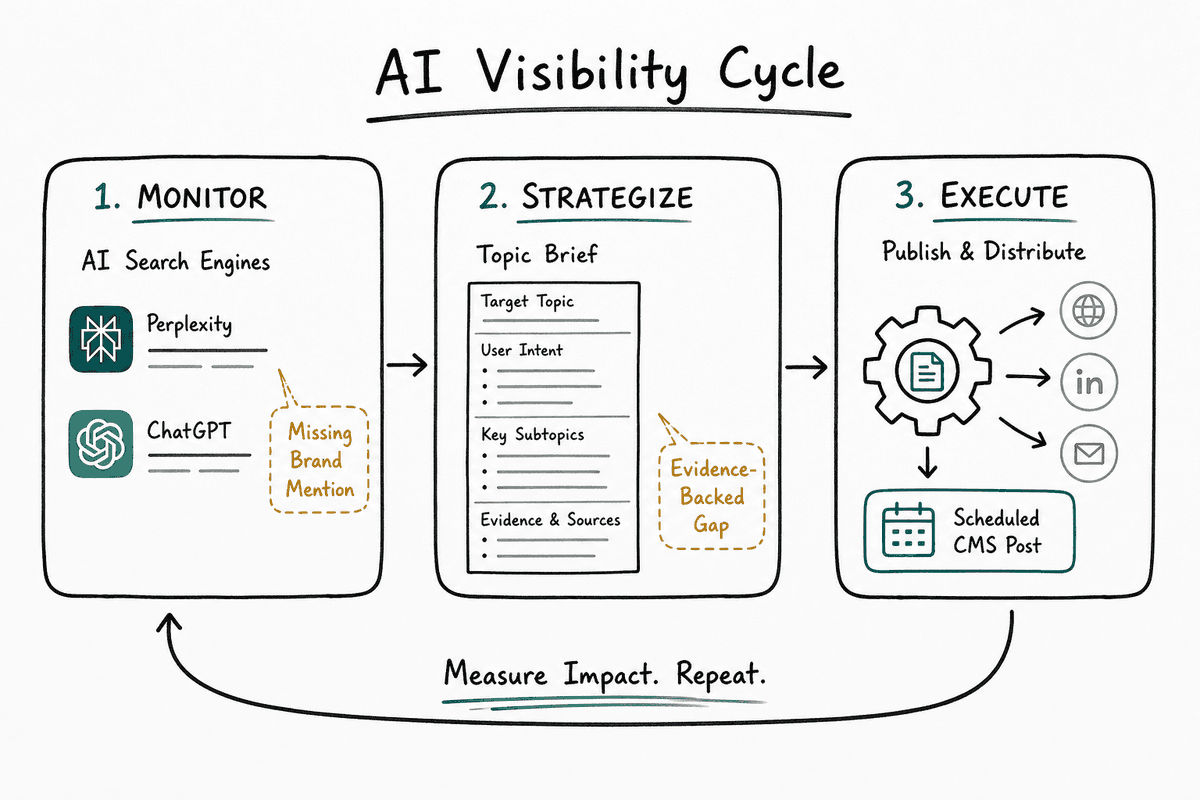
A Modern Visibility Workflow:
- Monitor: You discover that when B2B buyers ask Perplexity, "What is the best enterprise inventory management software?" your brand is entirely omitted, and your competitor is cited because they have a specific technical implementation guide.
- Strategize: You use this visibility gap to define the exact content parameters needed. You don't just need a blog post about "inventory software"; you need a deeply technical comparison of API load limits.
- Execute: Because BeVisible turns these missing mentions into scheduled publishing work, your team can route this specific, evidence-backed brief into your automated pipeline or directly to your content team for targeted creation.
This shifts the automated blogging paradigm from guessing based on search volume to executing based on definitive AI visibility gaps.
Building a Resilient Pipeline: A B2B Scenario
To understand how these alternative platforms function in the real world, consider a mid-sized SaaS company trying to scale their organic acquisition without hiring five new writers.
Initially, they relied on a basic AI drafting tool, copy-pasting outputs into WordPress. It was slow, and the content read like a Wikipedia article. The growth lead realized they needed to build a resilient system that could operate with minimal manual intervention. They began evaluating the best automated content workflow tool for single person startups tools beyond Sight AI and scaled it for their wider team.
They eventually settled on a decoupled architecture.
First, they used BeVisible to continuously track their brand's presence in AI search engines. Every Monday, they reviewed the dashboard to see where ChatGPT was hallucinating features about their product or failing to mention them in category comparisons.
Second, they routed those specific content gaps into Airtable. Airtable served as the central nervous system. Once a gap was approved (e.g., "We need an article explaining our SOC2 compliance protocols because Gemini thinks we only have SOC1"), an automation triggered via Make.com.
Third, Make.com sent the highly specific brief to an LLM API (like Claude or GPT-4), injecting their proprietary brand guidelines and a library of past high-performing articles to ensure the tone matched.
Finally, the resulting draft, completely formatted with markdown headers and image placeholders, was pushed directly into Ghost via the Admin API as a scheduled draft.
The human editing team didn't spend their time formatting, writing generic intros, or guessing what topics mattered. They spent their time reviewing highly targeted, strategically vital content, adding original expert quotes, and hitting publish.
Platform Comparison Breakdown
Choosing the right alternative depends heavily on your team's technical resources and strategic goals.
Evaluating Automation Risks and Edge Cases
Moving away from basic AI writers into fully automated blogging platforms introduces systemic risks. When you remove manual bottlenecks, mistakes happen much faster and at a much larger scale.
Indexation Bloat and Cannibalization
The most common failure mode for teams who successfully automate their publishing pipeline is keyword cannibalization. When it costs virtually nothing in time or money to publish an article, the temptation is to publish everything.
If your automated system generates 50 articles around the topic of "crm software," you are forcing search engines to decide which of your pages is actually the definitive resource. Often, Google will simply suppress all of them. Teams looking into Surfer SEO alternatives for rank on google without writing articles manually often learn this the hard way. Optimization is useless if site architecture collapses under the weight of duplicate intent.
To mitigate this, automated blogging platforms must be tethered to a strict content mapping strategy. Do not automate the creation of new URLs if an existing URL can be updated via an automated workflow instead.
LLM Hallucinations at Scale
When an AI drafts a single post in a web app, a human editor catches the fact that the AI invented a nonexistent software integration. When an automated platform pushes 30 posts live while you sleep, those hallucinations become public brand liabilities.
This is why purely "hands-free" engines are dangerous for B2B brands. The best automated platforms allow for a Human-In-The-Loop (HITL) step. The automation handles the research, the gap analysis, the drafting, the CMS formatting, and the internal linking. But it stops at the "Draft" status. A subject matter expert must spend five minutes verifying the claims before the status is changed to "Live."
The Degradation of "Helpful Content"
Search algorithms and AI chat models are heavily biased toward original information—unique data, strong opinions, and first-hand experience. If your automated blogging platform is simply re-summarizing the top ten Google search results, it adds zero net-new value to the internet.
To bypass this, advanced teams use Retrieval-Augmented Generation (RAG) in their automated workflows. Instead of just asking the API to "write a post," they inject proprietary data into the prompt. They pass customer support transcripts, anonymized product usage data, or internal whitepapers into the context window, forcing the AI to generate insights that a competitor's automated blog literally cannot replicate.
The Overlooked Metric: Optimizing for AI Search Visibility
Ultimately, the goal of an automated blogging platform isn't just to fill a CMS with words. The goal is to be found, cited, and recommended by the platforms where your buyers are making decisions.
Traditional SEO focused entirely on blue links. You published automated content, built backlinks, and hoped to rank on page one of Google. Today, B2B buyers open Perplexity and ask, "Compare [Competitor A] and [Competitor B] for remote teams." If your automated content pipeline isn't designed to feed these Large Language Models the exact structured data they need to formulate an answer, your publishing velocity is wasted.
This requires a fundamental shift in how you evaluate blogging tools. It is no longer enough to ask, "Can this tool write a 2,000-word post?" You must ask, "Can this workflow identify why Gemini recommends our competitor, and can it generate the specific, evidence-backed page we need to reclaim that citation?"
By pairing a robust CMS like WordPress or Ghost with a visibility execution engine, you ensure that every automated keystroke serves a strategic purpose. You stop throwing content at the wall, and you start building a defensive moat around your brand's AI search presence.
Frequently Asked Questions (FAQs)
What is the best alternative to Contentbot for WordPress?
For WordPress users, the most scalable alternative is bypassing all-in-one AI plugins and instead building a custom workflow using Make.com or Zapier connected directly to the WordPress REST API. This allows you to route high-quality LLM outputs into specific Advanced Custom Fields (ACF), maintaining total control over formatting, SEO schema, and internal linking without slowing down your site with bloated plugins.
Can you fully automate a blog without human editing?
Technically, yes. Practically, it is not recommended for B2B brands. While tools exist that can push content live autonomously, fully "hands-free" setups are highly susceptible to factual hallucinations and duplicate intent (keyword cannibalization). The safest automated blogging strategy automates 95% of the workflow—gap analysis, drafting, formatting, and scheduling—but retains a mandatory Human-In-The-Loop (HITL) review step before publication to verify brand safety and accuracy.
How do you ensure automated content ranks in AI search engines?
AI search engines like ChatGPT and Perplexity look for authoritative citations, structured data, and direct answers to complex queries. To rank in AI overviews, your automated content cannot just summarize existing generic information. It must include proprietary data, clear definitions, and formatted elements (like lists and tables) that LLMs can easily parse and cite. Monitoring your brand's visibility gaps and writing specifically to answer the questions these AI models are currently failing to answer is the most direct path to earning citations.